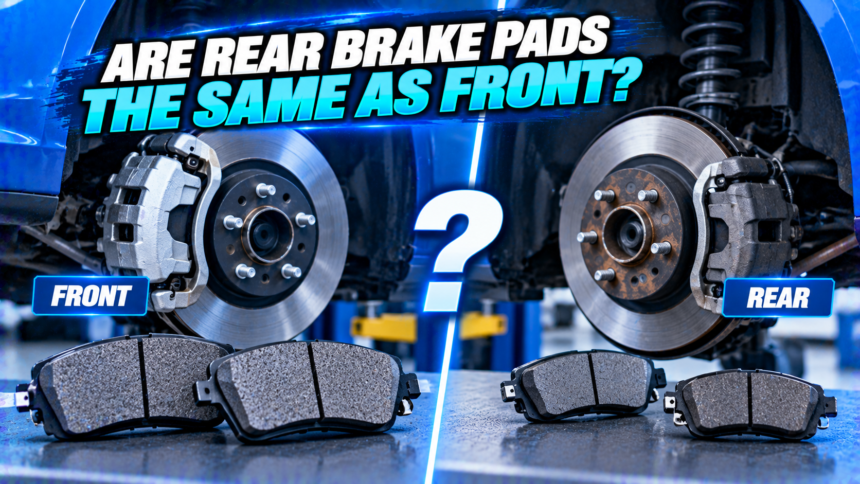
No. Rear brake pads are almost never the same as front brake pads. They are different in size, shape, thickness, and often in the material they are made from. The front pads do most of the stopping, so they are built bigger and tougher. The rear pads have an easier job, so they are smaller. You cannot swap them, and you should not try.
- Why front and rear brake pads are different?
- How front and rear brake pads differ?
- Are the pad materials different too?
- Can you use front pads on the rear, or the other way round?
- Why front pads wear out faster than rear pads?
- When rear pads wear out faster than you would expect?
- What about electric cars and hybrids?
- How to check your front and rear pads?
- Replacing front and rear pads: what to know
- Conclusion
- Frequently asked questions
- Can I use rear brake pads on the front?
- Do front and rear brake pads cost the same?
- Should I replace front and rear brake pads at the same time?
- Which brake pads wear out first, front or rear?
- How thick should brake pads be before I replace them?
- Related Articles
This guide explains why the two sets differ, what those differences look like, and what they mean when you buy pads or plan a brake job.
Why front and rear brake pads are different?
The short reason is weight. When you press the brake pedal, the weight of the car shifts forward. Think of how your body leans ahead when a bus stops suddenly. The nose of the car dips, the front tires press harder into the road, and the rear tires get lighter.
That forward shift changes how much braking each end of the car can use. On a typical passenger car, the front brakes handle roughly 60 to 70 percent of the stopping force. The rear brakes handle the rest. In a hard stop, the front share can climb even higher.
Car makers build the brakes to match. The front gets bigger rotors, bigger calipers, and larger pads. The rear gets smaller versions of each. If the rear brakes were as strong as the front, they could lock the rear wheels too easily, and a car with locked rear wheels can spin.
Key point: front brakes do the heavy work, rear brakes keep the car steady. Each set of pads is designed for its own job.
How front and rear brake pads differ?
Once you put a front pad next to a rear pad, the differences are easy to spot. Here is what changes from one end of the car to the other.
| Feature | Front brake pads | Rear brake pads |
| Size | Larger, to fit a bigger caliper and rotor | Smaller, to fit a smaller caliper and rotor |
| Share of braking | Roughly 60 to 70 percent | Roughly 30 to 40 percent |
| Thickness | Usually about 10 to 12 mm when new | Often similar, sometimes a little thinner |
| Heat handling | Built for high heat and hard use | Lower heat, so materials can differ |
| Wear rate | Wear out faster | Last longer in most cars |
| Extra features | Wear sensors or slots on many cars | May fit a parking brake mechanism |
Shape matters as much as size. A pad has to fit the exact caliper it sits in, down to the holes, clips, and metal tabs. Front and rear calipers are different parts, so the pads made for them cannot be used in place of each other. A Toyota Corolla is a simple example: it uses one part number for the front pads and a different one for the rear.
The friction material can differ too. Front pads take on more heat, so they often use compounds chosen to resist it, such as ceramic or semi-metallic blends. Rear pads see less heat, and some use a slightly softer compound. The exact mix depends on the maker and the car.
Are the pad materials different too?
Sometimes. There are three common types, and a car maker may choose a different one for each axle.
- Organic pads are soft and quiet. They are gentle on the rotor but wear faster and handle less heat.
- Semi-metallic pads contain metal fibers. They grip well, shrug off heat, and last longer, but they are noisier and harder on rotors.
- Ceramic pads are quiet, make little dust, and give steady stopping in most weather. They usually cost the most.
Heat is the deciding factor. Front brakes get hotter, so they often get the tougher material. Rear brakes stay cooler, so a softer compound can do the job. If you want to change the material, for example from organic to ceramic, match it front and rear where you can, and ask the parts counter or your shop whether your car has a preferred pad type at each end.
Can you use front pads on the rear, or the other way round?
No. In almost every case the pads will not fit, and if they did, they would not work well.
A front pad is usually too large for a rear caliper. A rear pad is usually too small to cover the friction area a front rotor needs. Even when the shapes look close, small differences in mounting points, backing plate thickness, and sensor location mean a pad can sit wrong, rattle, wear unevenly, or fail to grip properly.
There is a money reason to avoid it too. Front pads wear faster, so putting them on the rear only uses up a part that would have lasted much longer in its own place. Buy the pad listed for the correct axle and your exact vehicle, and check that the make, model, year, and trim all match, since some trims come with different brake setups.
Why front pads wear out faster than rear pads?
Because the front brakes do more work, they wear faster. Most cars go through two or even three sets of front pads before the rear pads need attention. The gap is often large. Under normal driving, front pads wear 40 to 50 percent faster than rear pads, and on some cars the front set can wear out about three times faster.
Front pads commonly last somewhere between 30,000 and 70,000 miles. Rear pads often last 50,000 to 100,000 miles or more. Your own numbers depend on how and where you drive. Stop-and-go city traffic, late hard braking, towing, and steep hills all shorten pad life.
This is why the two sets rarely need replacing at the same time. Do not assume the rears are fine just because the fronts were changed recently, and do not assume the rears are due just because the fronts are. Check each set on its own.
When rear pads wear out faster than you would expect?
Front pads wearing first is the normal pattern, but a few situations flip it or narrow the gap.
- Heavy loads and towing. Extra weight over the rear axle reduces the forward weight shift, so the rear brakes do more of the work.
- Electronic brake force distribution. Many modern cars use electronic systems, tied into ABS and stability control, to send more braking to the rear when it helps. If you drive in hills, in slippery conditions, or where stability control steps in often, the rear pads can wear faster than you would think.
- Special systems. Some vehicles have features that use the rear brakes more, such as a brake-based locking differential. On a Jeep Wrangler with that feature, the rear pads can be the first set to wear out.
If your rear pads are wearing quickly, that is worth mentioning to the person who services your car. It can be normal for your model, or it can point to a sticking caliper.
What about electric cars and hybrids?
Electric cars change the picture. Regenerative braking uses the motor to slow the car and send energy back to the battery, so the regular brake pads do less. The result is that pads on many electric cars last over 100,000 miles, compared with 40,000 to 50,000 miles on a typical gas car. Wagner explains how EV brakes and regenerative braking work in more detail.
Long life brings a different problem, which is rust. Many electric cars do most of their slowing with the motor, so the rear brakes may barely touch the rotor on a normal drive. Without that light scrubbing, moisture and road salt sit on the metal. Over time, rust can build up, and calipers can stick. On these cars the pads may need replacing because of rust and age rather than heavy use.
If you drive an electric car or a hybrid, look at the rear brakes as often as the front ones, and press the brake pedal firmly now and then so the pads can clean the rotor.
How to check your front and rear pads?
You can often check the pads yourself in a few minutes, and the same steps work for both ends of the car.
- Park on level ground, set the parking brake, and let the brakes cool.
- Look through the wheel spokes at the caliper. You will see the pad pressed against the rotor. If you cannot see it well, remove the wheel using a jack and jack stands.
- Measure the friction material, which is the part that touches the rotor, not the metal plate behind it.
- Compare it to the guide below, and check both wheels on the same axle.
- Check the front and the rear separately, because they wear at different rates.
There is no federal minimum for pad thickness in the United States. The usual advice is to replace pads at about 3 mm (about 1/8 inch), and to treat 2 mm as the point where you should act right away. A new pad is around 12 mm thick. For photos and a full walk-through, see this guide to checking brake pad thickness. Your owner’s manual may list a different limit for your car, and that number wins.
Your car can warn you as well. Many pads have a small metal tab that squeals when the pad is low, and some cars use a sensor that turns on a dashboard light. Do not ignore either one. Other signs include a soft or sinking pedal, grinding noises, and the car pulling to one side when you brake.
Replacing front and rear pads: what to know
The basic rule is to replace pads in pairs, both sides of one axle at the same time. Changing just one side leads to uneven braking, and the car may pull. Pads are sold in axle sets for this reason.
You do not have to change front and rear together. Replacing one axle at a time is fine as long as the other axle has enough life left. If you want the most even braking, or you want to save a second trip to the shop, changing all four wheels at once is a fair choice.
Rear pads have one extra step. On most cars with rear disc brakes, the piston in the caliper also works the parking brake, so you cannot just push it back with a clamp. It needs to be turned while it is pressed in, using a wind-back tool. Cars with an electronic parking brake usually need to be put into service mode first, often through the dash menu or a scan tool. Skipping that step can damage the motor. If you are not sure, this is a good part to leave to a shop.
Whichever end you work on, replace the hardware kit if the clips look rusty, and look at the rotors while the wheels are off. Worn pads can score the rotors, and rotors below their minimum thickness need replacing too.
Tip: buy pads by the axle and your exact vehicle details, never by size alone. Look for the words front or rear on the box before you pay.
Conclusion
Rear brake pads are not the same as front brake pads. The front pads are larger and tougher because they handle most of the stopping. The rear pads are smaller and last longer in most cars. They fit different calipers, so they cannot be swapped. Check each axle on its own, replace pads in pairs, and replace them at about 3 mm. If you have an electric car, watch the rear brakes for rust.
Frequently asked questions
Can I use rear brake pads on the front?
No. Rear pads are usually too small for a front caliper and rotor, and the mounting points rarely match. Even if they fit, they would not give enough stopping power, and they would wear out quickly. Always buy the pad listed for that axle.
Do front and rear brake pads cost the same?
Not always. Front pads are larger and often use tougher material, so they usually cost a little more. Prices also depend on the brand, the pad material, and your vehicle. Compare sets built for your exact make, model, and year.
Should I replace front and rear brake pads at the same time?
You must replace both sides of one axle together. You do not have to change front and rear at once. If the other axle still has plenty of pad left, it can wait. Doing all four saves a shop visit.
Which brake pads wear out first, front or rear?
The front pads usually wear out first because they do most of the braking. Front pads often need replacing two or three times before the rears do. Towing, heavy loads, and stability control can make the rear pads wear faster.
How thick should brake pads be before I replace them?
Replace them at about 3 mm (1/8 inch) of friction material. A new pad is around 12 mm thick. Below 2 mm, act right away, because the metal backing can damage the rotor. Your owner’s manual may give a different limit.
Related Articles
How to Keep Mice Out of Your Car Engine?
How to Get Stains Out of Car Seats?