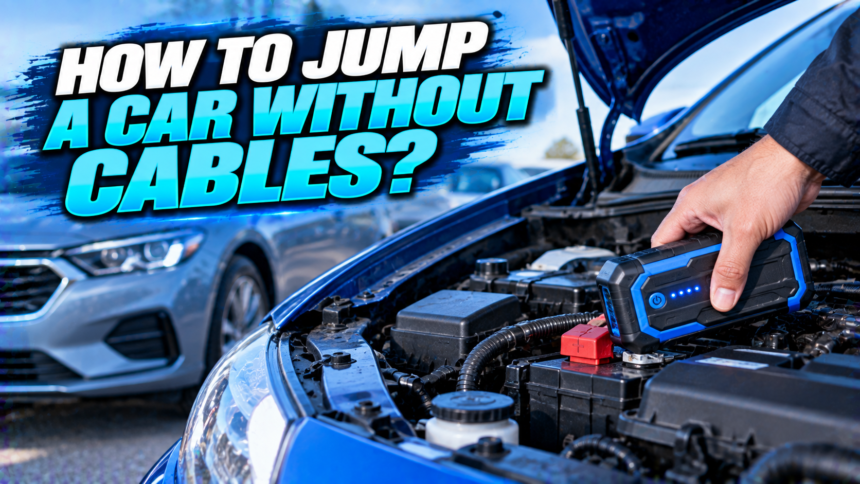
There are three methods that actually work. Use a portable jump starter, which is a lithium battery pack with clamps built in and the only option that works on any car. Push start it, which works on a manual transmission and nothing else. Or call someone with the equipment. Everything else you will hear about is either useless or expensive.
Before any of it, spend two minutes making sure the battery is the problem. A surprising number of no-start calls turn out to be a loose clamp, a gear selector, or a dead key fob.
First, confirm it is the battery
The dashboard tells you most of it before you touch anything.
| What happens when you turn the key | What it usually means |
| Rapid clicking, dash lights dim as you crank | Battery is low on cranking power. This is the case a jump fixes. |
| One solid clunk, then nothing | Starter motor or solenoid, not the battery. A jump will not help. |
| Dash lights bright and normal, engine does nothing at all | Gear selector, clutch or brake pedal switch, immobilizer, or a dead key fob |
| Absolutely nothing, no lights at all | Flat battery, or a disconnected or corroded terminal |
| Engine cranks normally but will not fire | Fuel or ignition, not the battery |
Two things worth checking with your hands. Wiggle each battery terminal: if a clamp moves, tighten it, because a loose connection imitates a flat battery exactly. And on an automatic, try shifting to Neutral and starting from there, since a worn neutral safety switch will refuse to work in Park while working fine in Neutral.
Method one: a portable jump starter
This is the real answer to the question. A modern jump pack is a lithium battery about the size of a paperback with clamps attached, and it will start a car on its own with no second vehicle involved. Decent units start well under $100 and will start an engine repeatedly on one charge.
The procedure is short:
- Turn the car and all its accessories off, and take off rings and metal watch straps.
- Make sure the pack is switched off before you connect anything.
- Red clamp to the positive battery terminal, marked with a plus.
- Black clamp to a bare, unpainted metal point on the engine block or chassis, away from the battery, unless your pack’s instructions say otherwise.
- Switch the pack on and wait a minute, longer if the battery is deeply flat.
- Start the engine. If it does not fire within a few seconds, stop and wait rather than cranking continuously.
- Switch the pack off, then remove the black clamp first and the red clamp second.
That grounding point matters for the same reason it does with cables. A lead-acid battery vents hydrogen, and the last connection is the one that sparks, so you want the spark somewhere other than directly over the vents. OSHA’s guidance on lead-acid battery hazards covers the hazards involved in handling batteries, and eye protection is a reasonable habit whenever a hood is open. Interstate Batteries’ guide to jump packs walks through the same procedure in more detail.
Two practical notes on owning one. Size it for your engine, because a large V8 pulls far more current to crank than a small four-cylinder, and peak amp ratings are what to compare. And keep it charged: top it up every three to six months whether you have used it or not. Lithium packs also lose output in the cold, which is exactly when you need one, so a pack stored in the house over winter will outperform the same pack left in the trunk.
Method two: push starting, and why it only works on a manual
In a manual car the clutch makes a direct mechanical connection between the wheels and the crankshaft. Roll the car with a gear selected and let the clutch out, and the wheels turn the engine over. That is all a starter motor does anyway.
An automatic has no such link. Between the engine and the gearbox sits a torque converter, which is a fluid coupling that only transmits drive when engine-driven hydraulic pressure is behind it. With the engine off there is nothing connecting the wheels to the crankshaft, so pushing achieves nothing. Worse, the transmission’s fluid pump is driven by the engine too, so rolling an automatic in gear spins internal components with no lubrication pressure behind them. That is how a dead battery turns into a transmission bill.
Push starting also needs some electricity left. A fuel-injected engine needs the computer, the fuel pump, and the injectors running before it can fire, and a battery flat enough to show no dash lights cannot supply that. Push starting rescues a weak battery, not an empty one.
If you have a manual, a weak battery, a helper or a slope, and somewhere safe:
- Pick a clear, gently sloping or flat stretch with nothing to hit and no traffic. Not a public road.
- Turn the ignition to ON so the dash lights up and the fuel pump primes. Do not turn it to start.
- Clutch in, second gear selected. First is usually too abrupt.
- Foot on the brake, then release the parking brake.
- Get the car rolling, either downhill or with people pushing from the rear.
- At around 5 mph, release the clutch smoothly and firmly.
- The engine should catch and buck slightly. Push the clutch straight back in, shift to neutral, and use the brake.
- Let it run for a good twenty minutes, or drive it, before switching off.
Two warnings. With the engine off you have no power assistance, so the steering is very heavy and the brakes need a hard shove, which is the main reason to do this somewhere empty. And if it does not fire after three or four attempts, stop. Repeated failed attempts pump raw fuel into the exhaust, and the catalytic converter does not enjoy it.
Method three: call someone
Not a failure, just the efficient answer when the first two are unavailable. Roadside assistance often comes free with an insurance policy, a credit card, or a new car warranty, and plenty of people are paying for it without knowing. Most tow operators carry a jump pack and will do it on the spot for less than a tow. Some auto parts stores will test and even fit a battery in their own parking lot.
If the car has needed jumping more than once recently, that is the useful signal. A battery that goes flat overnight twice is finished, or something is drawing current while the car sleeps.
The methods that do not work
| The idea | What actually happens |
| Push starting an automatic | The torque converter provides no link with the engine off, so nothing turns the crankshaft. Rolling it in gear risks real transmission damage. |
| A phone power bank, AA cells, or a 9V battery | Nowhere near the current a starter motor needs. A starter draws in the hundreds of amps. |
| Extension cord, speaker wire, or fence wire as jumper cables | Not rated for that current. The wire heats up fast enough to melt insulation and start a fire. |
| Tow starting an automatic with a rope | Same problem as pushing, with more speed and more damage available. |
| Rocking the car back and forth in gear | If the car starts afterward, something moved a bad connection. It is not a starting method. |
| Revving the donor car hard during a jump | Not the mechanism, and it is not where the current comes from. |
Once it starts
Do not switch the engine off at the first stop. An alternator replaces charge slowly, and idling replaces it slower still, so run the car for twenty to thirty minutes or take it for a drive before you park it. A five-minute idle in the driveway will not put back what starting took out.
Then get the battery and the charging system tested, which most parts stores do free in a few minutes. That distinguishes between a battery at the end of its life, an alternator that is not charging, and a parasitic drain emptying the battery overnight. Car batteries typically last three to five years, so a car on its fourth winter with a weak start is telling you something straightforward.
Not needing any of this next time
- Keep a charged jump pack in the car. It is the single thing that turns this from a problem into a delay.
- Drive the car at least once a week for a decent distance, since short trips never replace what starting costs.
- Clean corrosion off the terminals and make sure the clamps are tight.
- Put a trickle charger on any car that sits for weeks at a time.
- Have the battery tested before winter, because cold cuts the current a battery can deliver at exactly the moment the engine is hardest to turn.
Conclusion
A portable jump starter is the answer that works on every car and needs nobody else’s help. Push starting is a genuine alternative if you drive a manual, have a slight slope or a friend, and still have some charge left, but it does not work on an automatic and should never be attempted on one. Check the terminals and the gear selector before you assume the worst, and once the engine is running, drive it long enough to actually recharge.
Frequently asked questions
Can you push start an automatic car?
No. The torque converter between the engine and gearbox only transmits drive when the engine is running and generating hydraulic pressure, so pushing turns the wheels and nothing else. Rolling one in gear also risks transmission damage.
Can I jump a car with a phone power bank?
No. A starter motor draws hundreds of amps for a few seconds and a phone power bank is designed for a couple of amps. You need a purpose-built jump starter, which is a different class of device.
How fast do you need to be going to push start a car?
Around 5 mph in second gear is enough for most engines. Faster helps on a high-compression engine. Release the clutch smoothly rather than dumping it, and be ready to push it straight back in when the engine catches.
Do portable jump starters work in cold weather?
Less well. Lithium packs lose output as temperature drops, which is when engines are hardest to turn. Keep the pack indoors during winter and charge it every few months so it is at full capacity when you need it.
Can I use ordinary wire instead of jumper cables?
No. Household wire, speaker wire, and extension cords are not rated for starter current. They overheat within seconds, melt their insulation, and are a genuine fire risk.
Related Articles
How to Keep Mice Out of Your Car Engine?
How Long Can a Car Sit Before the Battery Dies?