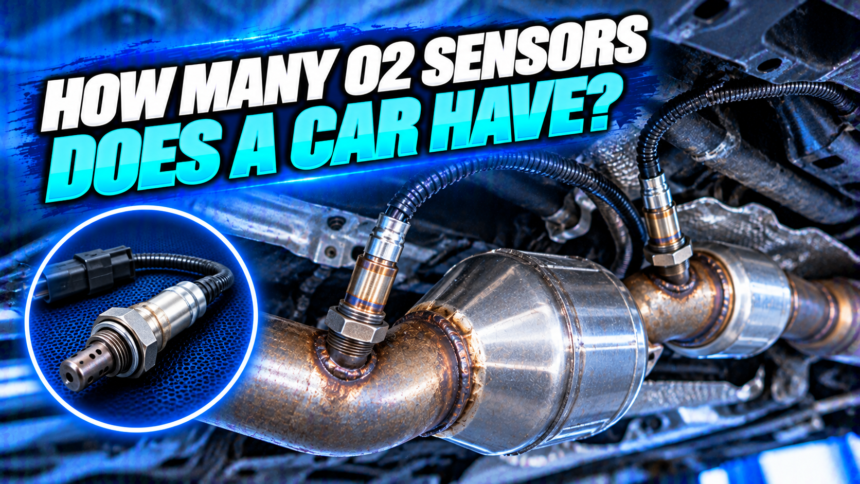
Most cars have either two or four oxygen sensors. A car with an inline engine, like a four-cylinder or a straight-six, usually has two. A car with a V-shaped engine, like a V6 or a V8, usually has four. The exact number depends on three things: your engine layout, your exhaust setup, and how old the car is.
- The short answer, by engine type
- What each oxygen sensor actually does?
- What Bank 1, Bank 2, Sensor 1, and Sensor 2 mean
- Why the number is different from car to car
- How to find the exact count for your car
- What happens when an O2 sensor goes bad
- How long O2 sensors last and what replacement costs
- Conclusion
- Frequently asked questions
- Does a 4-cylinder car have 2 or 4 oxygen sensors?
- How many O2 sensors does a V6 or V8 have?
- What is the difference between upstream and downstream O2 sensors?
- Which O2 sensor is Bank 1 Sensor 1?
- Do I need to replace all my O2 sensors at once?
- Related Articles
If you are shopping for a replacement part or reading a check engine code, the count matters, because each sensor sits in a set spot and does a set job. Here is how to work out the number for your own car and find each one.
The short answer, by engine type
The number tracks closely with how many exhaust paths your engine has. An inline engine sends all its exhaust down one side, so it needs one sensor before the catalytic converter and one after it. That is two. A V-shaped engine splits its cylinders into two rows, called banks, and each bank has its own exhaust path and its own converter, so it needs a pair of sensors on each side. That is four.
| Engine type | Typical O2 sensor count | Why |
| Inline-4 (four-cylinder) | 2 | One exhaust path, one converter: a sensor before it and one after. |
| Inline-6 (straight-six) | 2 | Same single exhaust path as a four-cylinder. |
| V6 | 4 | Two banks, each with a sensor before and after its converter. |
| V8 | 4 | Two banks, same paired layout as a V6. |
| Older car (before 1996) | 1, sometimes 2 | Early systems only needed a sensor before the converter. |
So a modern Honda Civic or Toyota Corolla with a four-cylinder runs two sensors. A Ford F-150 or a Dodge Charger with a V8 runs four. A turbocharged four-cylinder still runs two in most cases, because the turbo sits in the same single exhaust path. A few high-performance or true dual-exhaust setups climb higher, but two and four cover the large majority of cars on the road.
What each oxygen sensor actually does?
An oxygen sensor reads how much oxygen is left in your exhaust and reports it to the car’s computer, the engine control unit. From that reading, the computer knows whether the engine is burning too much fuel or too little, and it adjusts the fuel supply in real time. The target is a mix of about 14.7 parts air to 1 part fuel, the ratio at which gasoline burns cleanest.
The way it does this is simple. The sensing tip is made from a ceramic material, usually zirconia, that produces a small voltage based on the difference between the oxygen in the exhaust and the oxygen in the outside air. A rich mix, meaning too much fuel, pushes the voltage one way. A lean mix, meaning too little fuel, pushes it the other way. The computer reads that swinging voltage hundreds of times a minute and trims the fuel to match. Many newer cars use a more precise version called an air-fuel ratio sensor for the upstream job, but it counts the same way in your total.
The sensors come in two types, based on where they sit in the exhaust.
Upstream sensors
An upstream sensor sits before the catalytic converter, close to the engine. This is the one doing the real work of tuning your fuel mix. It reads the raw exhaust coming straight off the engine and feeds the computer the data it needs to keep combustion efficient. Every car has at least one of these.
Downstream sensors
A downstream sensor sits after the catalytic converter. Its job is to check that the converter is doing its work and cleaning up the exhaust. By comparing the reading before the converter with the reading after it, the computer can tell whether the converter is still healthy. If those two readings start to look alike, the converter is wearing out.
Quick rule: the sensor before the converter controls your fuel mix, and the sensor after it checks your emissions. Both matter, but only the upstream one changes how the engine runs minute to minute.
What Bank 1, Bank 2, Sensor 1, and Sensor 2 mean
When you read a check engine code or buy a replacement part, you will see labels like Bank 1 Sensor 1. These are just a map. Once you know the pattern, you can point to the exact sensor the car is talking about.
Here is the whole system in four lines:
- Bank 1 is the side of the engine that holds cylinder number one.
- Bank 2 is the other side. Inline engines have only Bank 1, because all their cylinders sit in one row.
- Sensor 1 is the upstream sensor, before the converter.
- Sensor 2 is the downstream sensor, after the converter.
Put them together and the code tells you both the side and the position. Bank 1 Sensor 1 is the upstream sensor on the cylinder-one side. Bank 2 Sensor 2 is the downstream sensor on the far side. On a four-cylinder car you will only ever see Bank 1, so a code there points to either Sensor 1 or Sensor 2. On a V6 or V8 you can see all four combinations.
Take a V6 Toyota Camry as an example. It has four sensors: Bank 1 Sensor 1 and Sensor 2 on the rear bank, and Bank 2 Sensor 1 and Sensor 2 on the front bank. A code for Bank 2 Sensor 1 sends you straight to the upstream sensor on the front bank, with no guessing about which of the four to touch.
Finding cylinder one is the one step that trips people up, because it moves around by make. On many cars it is at the front of the engine, but on plenty of others it is at the back or to one side. A quick look at your engine diagram or a repair manual settles it for your specific car.
Why the number is different from car to car
Three things move the count up or down.
Engine layout
This is the big one. One row of cylinders means one exhaust path and two sensors. Two rows, as in any V engine, means two paths and four sensors. This single fact explains most of the difference you will see between cars.
Model year and emissions rules
The second factor is age. Federal rules required oxygen sensors on new gasoline cars starting in 1981, but early cars often carried just one, placed before the converter. The 1996 model year brought in the OBD-II standard, which added the downstream sensor so the car could watch its own converter. That is why a car built in the last thirty years carries at least two sensors, while something from the early 1990s might have only one.
Exhaust setup
The third factor is the pipes. A car with true dual exhaust, or a big engine that uses more than one converter per side, can carry extra sensors to cover each path. This is where the occasional car climbs past four. Diesel engines use a different setup again and do not follow the same two-or-four pattern.
The oxygen sensor itself is not new technology. Bosch built the first one for a production car back in 1976, fitting it to a Volvo. What has changed since is how many a car uses and how closely the computer leans on them.
How to find the exact count for your car
You do not have to guess. Three quick methods give you a firm number.
- Start with the engine. Count the exhaust paths. One row of cylinders is two sensors. A V engine is four. This gets you the right answer for almost every car in a few seconds.
- Check a parts lookup. Enter your year, make, model, and engine on any auto parts site and search oxygen sensors. The listing shows every sensor position your car uses, which is both the count and the location.
- Look under the car. Follow the exhaust from the engine back. Each oxygen sensor looks like a spark plug with a wire running out of it, screwed into the exhaust pipe. Count the ones before and after each converter.
There is a fourth option if you own or can borrow an OBD-II scanner. Plug it into the port under the dashboard and it will list the live data from each sensor by its bank and position. This both confirms the count and shows you which sensors are reporting, which is handy when you are chasing a fault.
The parts lookup is the fastest if you just want the number and the exact part. Crawling under the car is worth it when you need to see a sensor’s real condition or reach it for a repair. One note for newer drivers: a fully electric car has no oxygen sensors at all, because it has no exhaust. A hybrid with a gasoline engine follows the same two-or-four rule as any other gas car.
What happens when an O2 sensor goes bad
A worn sensor feeds the computer bad data, and the engine responds by burning fuel poorly. The signs show up fast:
- The check engine light comes on. This is the most common first sign, and the stored code usually points to the exact bank and sensor.
- Fuel economy drops. A bad upstream sensor can push the engine to burn more fuel than it needs.
- The engine idles rough or hesitates. Wrong fuel data can make the engine run uneven.
- The car fails an emissions test. A dead downstream sensor means the car can no longer prove its converter is working.
You can usually still drive for a short while with one bad sensor, but it is not a good idea to leave it. A poor fuel mix wastes gas and, over time, can send unburned fuel into the catalytic converter and damage it, which is a far bigger bill than the sensor. Fixing the sensor early protects the expensive part downstream of it.
Sensors wear out on a schedule, not all at once, so it is normal to replace one at a time as each ages. Knowing your total count and the bank-and-sensor labels means you can buy the right single part instead of a full set.
How long O2 sensors last and what replacement costs
Oxygen sensors are wear items, not lifetime parts. Most last somewhere between 60,000 and 100,000 miles before they slow down and need changing. Heat, road salt, oil, and fuel additives all age them over time, so the exact life varies with how and where you drive.
Upstream sensors tend to wear faster than downstream ones, because they sit closer to the engine and take more heat and more raw exhaust. That is also why they cost a little more to buy. A single sensor usually runs somewhere in the range of 20 to 100 dollars for the part on a common car, with labor on top if a shop does the work. An air-fuel ratio sensor on a newer car sits at the higher end.
This is exactly why the count and the labels are worth knowing. If your car has four sensors and only Bank 1 Sensor 1 has failed, you buy one part, not a set of four. Matching the code to the right position keeps a simple repair from turning into an expensive one.
Conclusion
Most cars run two or four oxygen sensors: two for an inline engine, four for a V6 or V8, with one sensor before each catalytic converter and one after it. To pin down your own number, count your exhaust paths or run your car through a parts lookup. Once you know the count and the bank-and-sensor labels, you can read a trouble code and buy the exact replacement with no guesswork.
Frequently asked questions
Does a 4-cylinder car have 2 or 4 oxygen sensors?
A four-cylinder car almost always has two: one upstream sensor before the catalytic converter and one downstream sensor after it. Four-cylinder engines have a single exhaust path, so they do not need the extra pair a V engine uses.
How many O2 sensors does a V6 or V8 have?
Both typically have four. A V engine splits its cylinders into two banks, and each bank gets its own converter with a sensor before and after it. Two banks times two sensors each equals four.
What is the difference between upstream and downstream O2 sensors?
The upstream sensor sits before the converter and controls your fuel mix. The downstream sensor sits after the converter and checks that it is cleaning the exhaust. The upstream one affects how the engine runs; the downstream one watches emissions.
Which O2 sensor is Bank 1 Sensor 1?
It is the upstream sensor on the side of the engine that holds cylinder number one. Sensor 1 always means upstream, and Bank 1 always means the cylinder-one side. Check your engine diagram to find which side that is.
Do I need to replace all my O2 sensors at once?
No. Sensors wear out one at a time, so you can replace just the failed one. The trouble code tells you which bank and position to target, so you only buy the part you need.
Related Articles
How to Replace Fuel Injectors: A Step-by-Step Guide
How Many Engine Mounts Does a Car Have?