



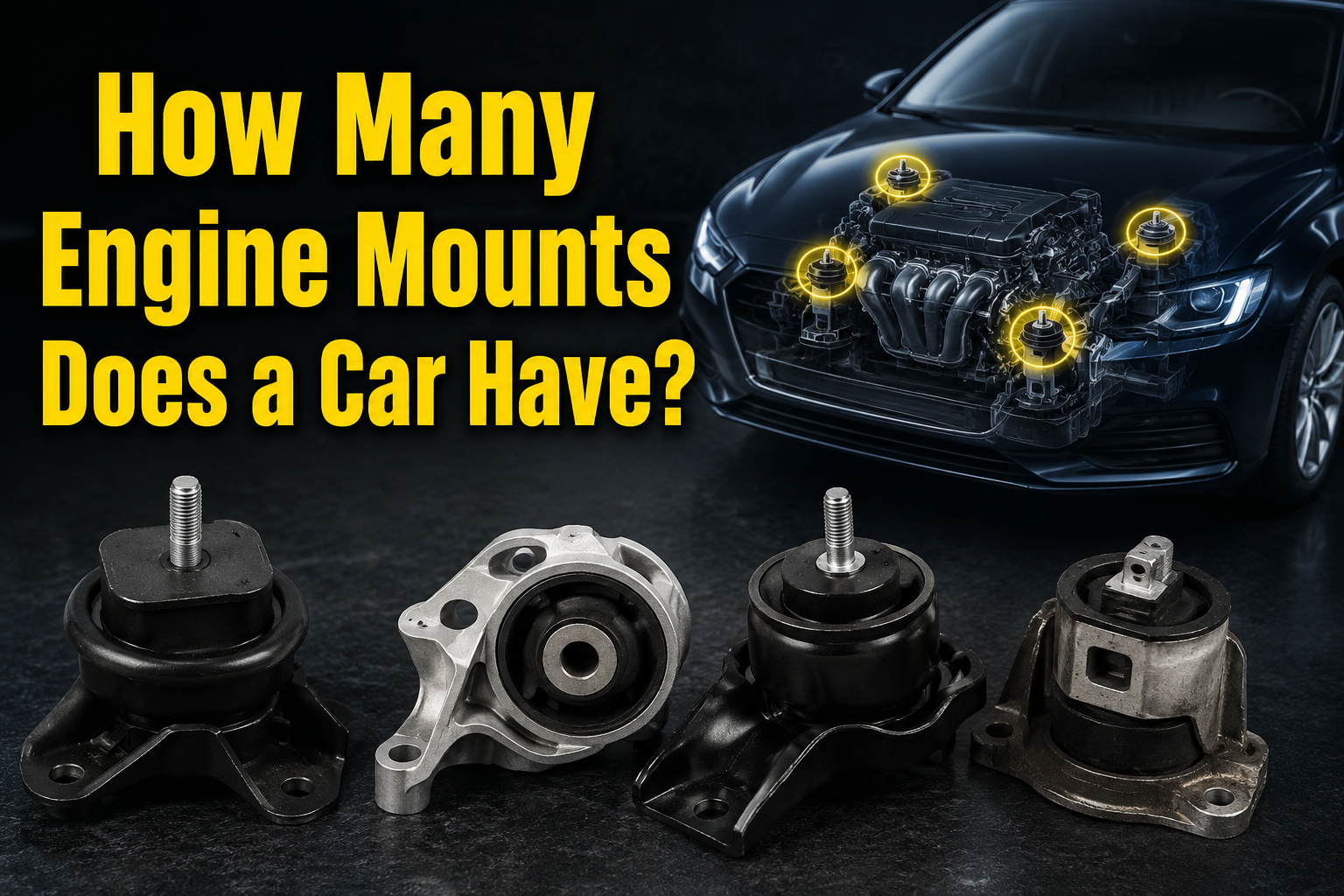
Most cars have three or four engine mounts. Front-wheel-drive cars with a sideways-mounted engine usually have four. Rear-wheel-drive cars with the engine sitting front to back usually have three.
- What an engine mount actually does
- Why the number depends on your drivetrain
- Engine mounts and transmission mounts
- How to find the number on your car
- How long they last and how they fail
- Should you replace them all at once?
- Conclusion
- Frequently asked questions
- Do all cars have four engine mounts?
- Is a motor mount the same as an engine mount?
- Can I drive with one bad engine mount?
- How do I know how many mounts my specific car has?
- What is a dog bone mount?
- Related Articles
The number depends on how your engine is positioned and how the car sends power to the wheels. Here is how to work out the count on your own car, what each mount does, and why the parts counter and your mechanic sometimes give you different numbers.
What an engine mount actually does
An engine mount is a bracket that bolts the engine to the car’s frame, with a layer of rubber or fluid in between.
That rubber layer is the whole point. An engine is heavy, between roughly 200 and 450 pounds for a four-cylinder or V6, and up to 700 pounds for a big V8 or diesel. It also shakes constantly, because pistons are firing and stopping hundreds of times a second. Bolt that directly to the body and the vibration would travel straight into the cabin and shake the car apart over time.
Mounts do two jobs at once. They carry the engine’s weight, and they isolate its vibration from everything else. Each one connects in two places: to the engine, and to the chassis or subframe.
That dual job is why the count varies. A mount that carries weight sits under or beside the engine. A mount that controls twisting motion sits wherever it can best resist that twist, and some layouts need more of those than others.
Not every mount on your car is the same kind, either. Plain rubber mounts are the most common and cheapest, and you will find them on economy cars, older vehicles, and work trucks. Fluid-filled mounts, sometimes called hydraulic, contain a liquid chamber that absorbs vibration far better than rubber alone, and they are standard on many modern sedans and anything marketed on refinement. Some luxury cars go further with active mounts, which use engine data to adjust their stiffness as conditions change.
This matters when you replace one. A hydraulic mount costs considerably more than a plain rubber one, and fitting the cheaper type in its place will make the car noticeably buzzier at idle.
Why the number depends on your drivetrain
Here is the part most answers skip. Engine layout is what sets the count, and there are two main layouts.
In a front-wheel-drive car, the engine sits sideways across the engine bay. This is called a transverse layout, and it is what most sedans, hatchbacks, and crossovers use. The engine and transmission form one wide unit spanning the bay, so it needs support at both ends plus something to stop it rocking.
In a rear-wheel-drive car, the engine sits lengthways, front to back. This is a longitudinal layout, common on trucks, larger SUVs, and performance cars. The engine sits between the frame rails with the transmission behind it, which is a naturally more stable arrangement.
A small number of cars put the engine behind the cabin instead, either mid-mounted or at the rear. These follow the same principle even though the location differs, so the count still comes down to how the powertrain is oriented and how much twisting force it has to resist.
| Layout | Typical count | What you will find |
| Transverse (most FWD cars) | 4 | Engine mount, transmission mount, plus one or two torque struts |
| Longitudinal (most RWD cars and trucks) | 3 | Two engine mounts (one per side), one transmission mount |
| Longitudinal with 4WD or AWD | 3 to 4 | As above, sometimes with an extra transfer case mount |
| Larger or heavier engines | 4 or more | Extra support for the additional weight and torque |
There is a reason transverse layouts need that extra piece. When a front-wheel-drive car accelerates, the drivetrain twists the front wheels, and the engine tries to roll backwards in reaction. Two mounts at the ends cannot stop that rolling on their own.
The mount that solves it is called a torque strut, and mechanics often call it a dog bone because of its shape. Some cars use one, some use two. A few skip it entirely and rely on the main mounts being positioned to resist the roll themselves.
Engine mounts and transmission mounts
This is where the confusion usually starts. Ask a dealer how many mounts your car has and you may get four. Ask a parts counter and you may get two.
Both can be right, because they are counting different things. The engine and transmission are bolted together as one unit, so the whole assembly is held by a set of mounts. Some support the engine end, some support the transmission end. Shops often refer to all of them as engine mounts because they support one powertrain. Parts catalogues usually list them separately, with engine mounts and transmission mounts in different categories.
When you are buying parts or getting a quote, ask which specific mounts are involved rather than just how many. The count matters less than knowing which positions need work.
How to find the number on your car
Three ways, from easiest to most reliable.
Look up your exact vehicle in a parts catalogue. Enter your year, make, model, and engine size on a parts retailer’s site and check the engine mount category. What comes back is the actual set for your car. This is the most reliable method, because two cars of the same model can differ if one has a bigger engine or all-wheel drive.
Open the hood and look. Mounts usually look like chunky metal brackets with a thick rubber section in the middle, sitting where the engine meets the frame. Check both sides of the engine bay first. The transmission mount and any torque strut are often underneath, so you will not see everything from above.
Ask a mechanic. Any technician can identify all of your mounts in seconds on a lift. This is worth doing if you already suspect a problem, since they can check condition at the same time.
Do not rely on a general figure for “most cars” when ordering parts. Same model, different engine, different mount count is common.
How long they last and how they fail
Engine mounts wear out slowly, which is why most people never notice until one is badly gone.
Expect somewhere between 60,000 and 100,000 miles, or roughly five to ten years, though plenty last longer. Rubber hardens and cracks with age and heat cycling. Fluid-filled mounts can leak, which makes them lose their damping ability while still looking intact from outside.
A few things shorten that life. Oil leaks are the big one, because engine oil degrades rubber quickly, so a leaking valve cover gasket above a mount can destroy it early. Hard driving, high torque, and frequent heavy loads also wear mounts faster. So does a rough-running engine, since extra vibration means extra work for the mounts.
Signs a mount has failed:
- Vibration through the seat or steering wheel that gets worse at idle and changes with engine speed
- A clunk or thud when shifting into drive or reverse, or when you lift off the throttle
- The engine visibly lifting or rocking when someone revs it while you watch from outside
- A general looseness or slop in the drivetrain when you get on and off the throttle
That last symptom creeps up so gradually that owners often mistake it for the car simply getting old.
Should you replace them all at once?
Not always, but often it makes sense.
If one mount has failed and the others look healthy, replacing the single bad one is fine. Mounts do not always wear at the same rate, because they carry different loads.
The argument for doing several together is labour. Reaching a mount can mean supporting the engine on a jack and removing parts to get access, and that setup work is shared if the mechanic replaces more than one in the same visit. Doing them one at a time months apart means paying for that access twice.
Cost is mostly labour, not parts. A single rubber mount can be as little as $10 to $150, while hydraulic or active mounts run higher. Labour ranges widely because access varies, from about half an hour for an easy mount on top of the engine to two hours or more for one buried in the bay. Budget roughly $200 to $500 per mount installed, and more for a full set.
One thing worth knowing before you buy: harder aftermarket mounts change how the car feels. Stiff polyurethane or solid mounts reduce engine movement and sharpen throttle response, which some drivers want, but they also send more vibration into the cabin. If you liked how the car felt when it was new, standard replacement mounts are the right choice.
Conclusion
Most cars have three or four engine mounts, and the layout tells you which. A front-wheel-drive car with a sideways engine usually has four, including a torque strut to stop the engine rolling under acceleration. A rear-wheel-drive car with a lengthways engine usually has three. Look your exact vehicle up in a parts catalogue rather than trusting a general figure, since engine size and drivetrain change the answer even within one model.
Frequently asked questions
Do all cars have four engine mounts?
No. Three and four are both common, and some layouts use two or more than four. Front-wheel-drive cars with transverse engines tend toward four, while rear-wheel-drive cars with longitudinal engines usually have three.
Is a motor mount the same as an engine mount?
Yes, the terms are interchangeable. Some shops also call them isolators. Transmission mounts are technically separate parts, though many people count them together since they support the same powertrain.
Can I drive with one bad engine mount?
Briefly, but it is not a good idea. The remaining mounts take extra load and wear faster, and excess engine movement can stress hoses, wiring, and the exhaust. Get it replaced rather than putting it off.
How do I know how many mounts my specific car has?
Enter your year, make, model, and engine size into a parts retailer’s catalogue and check the engine mount listings. That accounts for differences between engine options and drivetrains within the same model.
What is a dog bone mount?
It is a torque strut, a link-shaped mount that stops the engine rolling backwards when a front-wheel-drive car accelerates. The nickname comes from its shape. Not every car has one.
Related Articles
How Much Oil to Put in Your Car: Quarts by Engine?
How Long Can a Car Sit Before the Battery Dies?
Do Hybrid Cars Need Oil Changes? Intervals Explained