


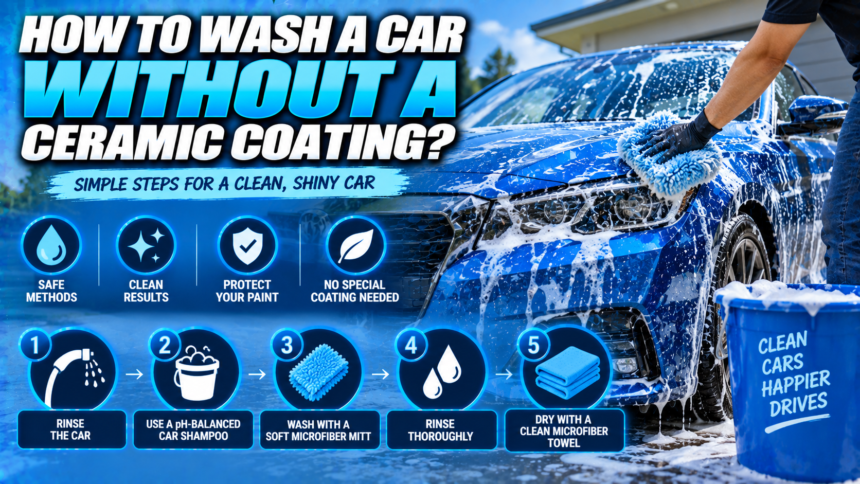
Wash it by hand, with two buckets and a pH-neutral car shampoo, working from the roof down, rinsing the mitt after every panel, and drying immediately with plush microfiber. Then put a layer of protection back on. That last step is the one people skip, and on uncoated paint it is the difference between a car that stays clean for a week and one that looks dusty by Wednesday.
- What actually changes without a coating?
- What you need?
- Pick your spot before you start
- The wash, step by step
- What soap will not remove?
- Put protection back on
- The mistakes that actually damage paint
- When you cannot use a hose?
- How often to wash?
- Conclusion
- Frequently asked questions
- Can you wash a car that has no ceramic coating the same way as a coated one?
- What soap should I use on uncoated paint?
- How do I stop water spots on a car with no coating?
- Is a touchless car wash safe without a coating?
- Do I need a clay bar if my car is not coated?
- Related Articles
Paint without a coating is not fragile. It just has no help. Every part of the process that a coating would forgive is now down to your technique.
What actually changes without a coating?
A ceramic coating is a hard, slick, water-repelling layer bonded to the clear coat. Dirt struggles to key into it, water pulls into beads and runs off, and a mediocre wash does less harm because contamination releases before you have to push on it. That is what you are paying for, and it is why how long a ceramic coating lasts is measured in years rather than weeks.
Uncoated paint behaves differently in three ways worth planning around.
Dirt bonds harder. Road film sticks to bare clear coat, so you are tempted to press with the mitt, and pressure plus grit is exactly how swirl marks appear.
Water clings instead of sheeting. Droplets sit still and dry in place, leaving mineral deposits that etch if they bake in the sun.
Protection is temporary. A carnauba wax gives you weeks and a synthetic sealant a few months, so the wash routine has to include reapplying it rather than assuming it is still there.
What you need?
- Two buckets, ideally with grit guards in the bottom
- pH-neutral car shampoo, not dish soap
- A microfiber or lambswool wash mitt
- A separate bucket, brush, and mitt for wheels and tires
- A hose with an adjustable nozzle
- Two large plush microfiber drying towels
- A spray sealant, spray wax, or drying aid for afterwards
A foam cannon is a nice extra rather than a requirement. What it buys you is dwell time, which loosens grit before anything touches the paint.
Pick your spot before you start
Work in the shade on cool panels. Direct sun dries shampoo and rinse water on the surface faster than you can wipe it, and on uncoated paint that means spots almost every time. Early morning and evening are the easy windows.
Think about where the water goes too. Runoff from a driveway carries soap, oil, brake dust, and metals straight into a storm drain, which usually empties into a creek or river without treatment. Guidance on car washing and runoff is consistent: wash over grass or gravel where the soil can filter it, use a biodegradable phosphate-free soap, or use a commercial wash that routes water to treatment. Some municipalities have local rules on this, so it is worth a two-minute check.
Water hardness matters more than people expect. Hard tap water carries dissolved minerals, and those minerals are what a dried droplet leaves behind. If your area has hard water, work in smaller sections and dry faster, or fit an inline filter to the hose for the final rinse.
The wash, step by step
- Do the wheels and tires first, with their own bucket, brushes, and mitt. Brake dust is metallic and abrasive, and it must never reach the tools you use on paint.
- Pre-rinse the whole car from the top down. Most of the loose grit comes off with water alone, and every particle you rinse away is one that cannot be dragged across the clear coat.
- Pre-soak if you can. Foam or a spray-on pre-wash left for three to five minutes softens road film. Do not let it dry.
- Set up the buckets. One with shampoo at the dilution on the bottle, one with plain rinse water, grit guards in both.
- Wash top down, one panel at a time, using straight overlapping passes rather than circles. Let the mitt glide. If a spot needs pressure, it needs more soap and more dwell time instead.
- Rinse the mitt in the rinse bucket after every panel, rubbing it against the grit guard so the dirt drops to the bottom instead of going back into your suds.
- Rinse panels as you go on a warm day so nothing dries on the paint.
- Finish with an open-flow rinse, nozzle off, letting water sheet down the panels. It takes a surprising amount of water off before you touch a towel.
- Dry immediately. Lay a plush towel flat and drag it gently, or blot. Do not scrub. Get the mirrors, badges, and trim edges where water hides and runs out later.
The lower six inches of every panel is the dirtiest part of the car. Save the rockers, lower bumpers, and behind the wheels for last, and consider using a second mitt down there.
What soap will not remove?
Without a coating, the paint picks up bonded contamination faster, and a normal wash leaves it behind.
Bugs, sap, and bird droppings need soaking, not scrubbing. Lay a soaked microfiber over the spot for a few minutes to soften it, then wipe gently. Anything acidic that has sat in the sun may have already marked the clear coat.
Tar spots come off with a dedicated tar remover, not with force.
Iron fallout from brake dust and rail dust sits in the paint as tiny rust-colored specks. An iron remover dissolves it and rinses away.
Bonded grime that survives all of the above comes off with a clay bar or clay mitt and plenty of lubricant. Uncoated paint usually wants this once or twice a year. The test is simple: wash the car, dry it, then feel the paint through a thin plastic bag. If it feels rough, it needs claying.
Do all of this on a clean, washed car, and always finish decontamination with fresh protection, because clay and iron removers strip whatever wax was left.
Put protection back on
This is where an uncoated car wins or loses. Wax and sealant are consumable, and every wash removes a little.
The quickest version takes five minutes. After the final rinse, mist a spray sealant or spray wax over the wet panel and dry it in with your towel. It works as a drying aid and leaves a protective layer at the same time.
The longer version, done every few months, is a proper paste wax or sealant applied to clean, cool, decontaminated paint in thin coats. A carnauba typically lasts four to eight weeks, a synthetic sealant three to six months.
Either way, the payoff shows up at the next wash. Protected paint releases dirt with far less contact, which means fewer chances to put a scratch in it.
The mistakes that actually damage paint
- Dish soap. It is built to strip grease and it strips wax with it, leaving bare clear coat and drying out rubber trim.
- One bucket. Every mitt rinse puts the grit you just removed back into the water you are about to wipe on the car.
- A sponge. Flat sponges trap grit against the paint. A mitt with a deep pile pulls it up and away from the surface.
- Circular motions. They create the swirl pattern you see in low sun. Straight lines still cause fine marring, but it is far less visible.
- Washing in direct sun. Water spots on uncoated paint can etch into the clear coat if they bake on.
- Letting it air dry. Every drop that evaporates leaves its minerals behind.
- Automatic washes with spinning brushes. Those bristles carry grit from the car in front of you.
- Pressure washing at close range. Keep the tip back and avoid blasting directly at trim edges, badges, and any paint chips.
When you cannot use a hose?
Apartment parking and water restrictions rule out a full wash, and there are two workarounds.
A rinseless wash uses a concentrated solution in a bucket with several microfiber towels. Soak a towel, wipe one panel with almost no pressure, flip to a clean side, and dry behind yourself. It is genuinely safe on lightly soiled paint and uses a couple of gallons.
A waterless wash is a spray and wipe, and it is only for a car with a light coat of dust. On anything gritty it is a scratching tool. When in doubt, pre-rinse somewhere first.
A touchless automatic wash is the reasonable middle ground. The chemicals are strong and will shorten your wax, but nothing physical touches the paint.
How often to wash?
Every two weeks suits most uncoated cars. Weekly is better through winter salt, coastal salt air, or heavy pollen, because those are the things that damage bare paint fastest.
Look after the kit as well. Wash mitts and drying towels go in the machine on their own, with no fabric softener, since softener clogs the fibers and kills absorbency. If a mitt hits the ground, it is done for paint work. Demote it to wheels rather than risk grinding a stone into a door.
Two situations override the schedule. Bird droppings and tree sap come off the day you see them, since both etch. Road salt gets rinsed off promptly, including the underbody, which most home washes never touch.
Conclusion
Two buckets, a pH-neutral shampoo, a soft mitt, top-down straight-line passes, and a fast dry in the shade will keep an uncoated car looking sharp without putting swirls into it. Add a spray sealant as you dry, do a full wax or sealant every few months, and decontaminate once or twice a year. Without a coating nothing is doing that work for you, so the routine is the protection.
Frequently asked questions
Can you wash a car that has no ceramic coating the same way as a coated one?
The method is the same, but the aftercare is not. A coated car needs nothing added afterwards. An uncoated car needs wax or sealant put back on, since every wash removes a little of what is protecting the clear coat.
What soap should I use on uncoated paint?
A pH-neutral car shampoo. It cleans without stripping wax or drying out trim. Skip dish soap, which strips protection on purpose, and skip household cleaners entirely.
How do I stop water spots on a car with no coating?
Wash in the shade on cool panels, rinse panels before the soap dries, finish with an open-flow sheeting rinse, and dry straight away with plush microfiber. Uncoated paint holds water in place, so drying speed matters most.
Is a touchless car wash safe without a coating?
Safer than a brush wash, since nothing touches the paint. The trade-off is stronger chemicals, which shorten the life of your wax. Reapply a spray sealant afterwards.
Do I need a clay bar if my car is not coated?
Once or twice a year, yes. Uncoated paint picks up bonded contamination faster. Wash, dry, then feel the surface through a thin plastic bag. Rough means clay it, then re-protect.
Related Articles
Is a Car Battery AC or DC? (And Why It Matters)
Is Doing a Burnout Bad for Your Car? What It Costs
What to Do With Old Car Seats?
How to Remove Tree Sap From a Car Without Damaging the Paint?