


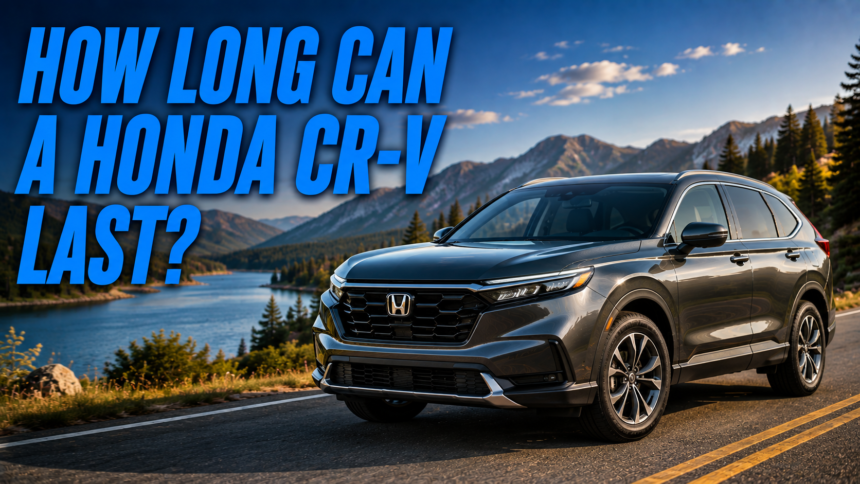
If you are asking how long can a Honda CR-V last, the honest answer is that a well-maintained CR-V can comfortably run for 200,000 to 300,000 miles, which translates to roughly 15 to 20 years of regular driving. This makes the CR-V one of the most dependable compact SUVs available today, and it is a big reason why so many owners keep driving the same unit for over a decade.
- Honda CR-V Average Lifespan Overview
- Factors That Affect How Long A CR-V Lasts
- Maintenance History And Routine Servicing
- Driving Habits
- Climate And Road Conditions
- Model Year And Generation Differences
- Engine Type
- Transmission Type
- Honda CR-V Reliability By Generation
- First And Second Generation (1995–2006)
- Third And Fourth Generation (2007–2016)
- Fifth And Sixth Generation (2017–Present)
- Common Problems That Can Shorten CR-V Lifespan
- How To Extend Your CR-V’s Life
- Follow The Recommended Maintenance Schedule
- Prioritize Fluid Changes
- Maintain Tires And Alignment
- Address Recalls And Service Bulletins Promptly
- Signs Your CR-V May Be Nearing End Of Life
- CR-V Versus Competitors: Longevity Comparison
- Real Owner Experiences And High-Mileage Examples
- Cost Of Ownership Over Time
- FAQs
- Is 150,000 miles a lot for a CR-V?
- What year CR-V is most reliable?
- Should I buy a high-mileage used CR-V?
- How often should a CR-V be serviced?
- Conclusion
- Related Articles
The actual number you get will always depend on how the vehicle is treated, not just the badge on the hood. A CR-V that receives timely oil changes, fluid checks, and prompt repairs will almost always outlast one that is neglected, even if both started out with the exact same engine and transmission.
Below, this guide breaks down everything that influences longevity, generation by generation, so you can understand exactly what to expect from your own CR-V.
Honda CR-V Average Lifespan Overview
On average, a Honda CR-V is built to last between 200,000 and 300,000 miles when it receives consistent care. That places it well above the industry average for compact SUVs, most of which struggle to comfortably pass the 150,000-mile mark without major component failures.
Mileage Expectancy By Generation
Newer CR-V generations, particularly the fifth and sixth generations, tend to hold up slightly better than earlier models because of improved engineering and updated materials.
Older generations from the late 1990s and early 2000s can still reach high mileage, but they often need more frequent part replacements along the way. Regardless of generation, the core mechanical formula of a dependable four-cylinder engine paired with routine care remains the biggest factor in reaching six-figure mileage.
Years Of Service Under Normal Use
For an average driver covering around 12,000 to 15,000 miles per year, a CR-V can realistically remain on the road for 15 to 20 years before major repairs become financially impractical.
Drivers who cover fewer miles annually may keep their CR-V even longer in calendar years, though age-related wear on rubber and plastic components still applies. This is why mileage and age should always be considered together rather than in isolation.
Comparison To Average Car Lifespan
Most standard vehicles today are expected to last around 150,000 to 200,000 miles before significant reliability concerns appear.
The CR-V consistently exceeds this benchmark, which is why it holds strong resale value and remains a popular choice in the used SUV market. This gap in longevity is one of the clearest indicators of Honda’s engineering reputation.
Factors That Affect How Long A CR-V Lasts
Several everyday factors directly determine whether a CR-V reaches the higher end of its lifespan or falls short of it. Understanding these factors gives owners practical control over their vehicle’s future.
Maintenance History And Routine Servicing
A CR-V that has followed Honda’s recommended service schedule from day one will almost always outperform one with gaps in its maintenance record.
Skipped oil changes, ignored fluid flushes, and delayed filter replacements accelerate internal wear far faster than most owners realize. Consistent servicing is the single strongest predictor of a long-lasting CR-V.
Driving Habits
Highway-heavy driving tends to be gentler on a CR-V’s engine and transmission compared to constant stop-and-go city traffic. Aggressive acceleration, hard braking, and frequent short trips put additional strain on the drivetrain and can shorten component life over time. Smooth, moderate driving habits consistently correlate with higher lifetime mileage.
Climate And Road Conditions
Vehicles driven in regions with harsh winters, heavy road salt, or extreme heat often experience faster rust formation and rubber degradation.
Owners in milder climates typically see less corrosion-related damage, allowing the underlying mechanical components to remain the primary factor in the vehicle’s lifespan. Storing the vehicle in a garage when possible helps reduce this environmental wear significantly.
Model Year And Generation Differences
Later CR-V generations benefit from refined engineering, improved rustproofing, and updated technology that earlier models did not have. However, even older generations remain capable of high mileage when properly cared for, showing that generation alone does not guarantee or prevent longevity.
Engine Type
Naturally aspirated CR-V engines have a long-standing reputation for simplicity and durability, with fewer components that can fail under stress.
Turbocharged engines, introduced in later generations, offer more power but require stricter adherence to oil change intervals to avoid premature wear.
Transmission Type
Continuously Variable Transmissions, used in more recent CR-V models, can last a long time but are noticeably more sensitive to fluid condition than traditional automatic transmissions.
Regular CVT fluid changes are essential, since neglecting this specific maintenance item is one of the fastest ways to shorten a CR-V’s usable life.
Honda CR-V Reliability By Generation
Each CR-V generation carries its own reputation for durability, and knowing these differences helps buyers set realistic mileage expectations before purchasing a used unit.
First And Second Generation (1995–2006)
These early CR-Vs are mechanically simple, which makes them relatively easy and affordable to maintain long-term. Surviving units today often have high mileage already, proving the platform’s basic durability, though rust and aging electronics are common concerns.
Third And Fourth Generation (2007–2016)
This period introduced more refined engines and improved interior technology while keeping mechanical reliability strong. These generations are widely regarded as a sweet spot for buyers seeking high-mileage potential combined with modern comfort features.
Fifth And Sixth Generation (2017–Present)
Newer CR-Vs include turbocharged engine options and advanced safety technology, which slightly increases maintenance complexity. Reliability remains strong overall, but owners must stay disciplined with oil changes and software updates to avoid known issues specific to these years.
Common Problems That Can Shorten CR-V Lifespan
Certain recurring issues are known to affect CR-V longevity if left unaddressed, and being aware of them allows owners to catch problems early.
Transmission And CVT Issues
Some model years have documented CVT-related complaints, including hesitation or shuddering under acceleration. Addressing these symptoms early, along with regular fluid changes, typically prevents them from developing into major failures.
Oil Dilution Concerns
Certain earlier turbocharged CR-V models experienced fuel mixing with engine oil in cold climates, which can reduce lubrication effectiveness over time. Honda addressed this through software updates, and staying current with recalls resolves most related concerns.
AC And Electrical Component Wear
Air conditioning compressors and minor electrical glitches are common wear items in higher-mileage CR-Vs. These issues rarely affect core drivability but should be repaired promptly to avoid secondary damage to related systems.
Suspension Wear
As with any vehicle nearing higher mileage, suspension bushings and struts naturally wear down and require replacement. This is considered normal wear-and-tear rather than a reliability flaw specific to the CR-V.
How To Extend Your CR-V’s Life
Owners have significant influence over how long their CR-V ultimately lasts, and a few consistent habits make the biggest difference.
Follow The Recommended Maintenance Schedule
Sticking closely to Honda’s official service intervals ensures that every major system receives attention before small issues become expensive repairs. This single habit has the greatest cumulative impact on long-term reliability.
Prioritize Fluid Changes
Engine oil, transmission or CVT fluid, coolant, and brake fluid all need to be changed at their specified intervals to protect internal components. Fresh fluids reduce friction and heat buildup, which are two of the biggest contributors to premature wear.
Maintain Tires And Alignment
Regular tire rotations and proper wheel alignment reduce unnecessary strain on the suspension and drivetrain. This also improves fuel efficiency and handling, extending the useful life of related components.
Address Recalls And Service Bulletins Promptly
Honda periodically issues recalls and technical service bulletins to correct known issues at no cost to the owner. Taking care of these promptly prevents minor design flaws from evolving into serious mechanical problems.
Signs Your CR-V May Be Nearing End Of Life
Recognizing early warning signs helps owners plan ahead rather than facing sudden, costly breakdowns.
Frequent And Expensive Repairs
When repair costs begin to regularly approach or exceed the vehicle’s current market value, it is often a sign that the CR-V is nearing the end of its practical lifespan. At this stage, owners typically decide between a major repair investment or replacement.
Transmission Or Engine Performance Decline
Noticeable power loss, rough shifting, or unusual noises from the engine bay often indicate that core components are wearing out. These symptoms should be diagnosed quickly, as ignoring them usually leads to more expensive failures.
CR-V Versus Competitors: Longevity Comparison
The table below offers a quick, easy comparison of how the CR-V stacks up against its closest rivals in terms of expected lifespan.
| SUV Model | Expected Mileage | Reliability Reputation |
| Honda CR-V | 200,000–300,000 miles | Very strong, low long-term issues |
| Toyota RAV4 | 200,000–300,000 miles | Very strong, closely comparable |
| Ford Escape | 150,000–200,000 miles | Moderate, more frequent repairs |
| Mazda CX-5 | 150,000–200,000 miles | Good, but slightly less proven long-term |
As the table shows, the CR-V and RAV4 are widely considered the two most durable options in this class, while the Escape and CX-5 trail slightly behind in long-term mileage potential.
Real Owner Experiences And High-Mileage Examples
Many long-term CR-V owners report crossing the 250,000 to 300,000-mile mark with nothing more than routine maintenance and a handful of expected part replacements.
These real-world accounts consistently reinforce that the CR-V’s reputation for longevity is not just marketing, but a pattern seen across multiple generations and driving conditions.
Cost Of Ownership Over Time
Maintenance costs generally rise gradually as a CR-V ages, with major milestones around 100,000, 150,000, and 200,000 miles often requiring larger services like timing components, suspension parts, or transmission fluid flushes.
Despite this, the CR-V’s strong resale value and relatively low repair frequency compared to competitors keep total ownership costs reasonable over a 15-to-20-year period.
FAQs
Is 150,000 miles a lot for a CR-V?
Not particularly, since most well-maintained CR-Vs are expected to comfortably surpass this figure with proper care.
What year CR-V is most reliable?
Generations from 2007 to 2016 are frequently cited as especially dependable, though all generations can achieve high mileage.
Should I buy a high-mileage used CR-V?
Yes, as long as service records confirm consistent maintenance, since mileage alone does not determine remaining lifespan.
How often should a CR-V be serviced?
Following Honda’s official interval schedule, typically every 6,000 to 12,000 miles depending on the service type, is recommended.
Conclusion
So, how long can a Honda CR-V last? With consistent maintenance, moderate driving habits, and prompt attention to recalls or repairs, most CR-Vs comfortably reach 200,000 to 300,000 miles over 15 to 20 years of use.
Compared to competitors like the Ford Escape and Mazda CX-5, the CR-V remains one of the strongest long-term choices in its class, rivaled closely only by the Toyota RAV4. For buyers prioritizing durability and low long-term ownership stress, the CR-V continues to stand out as a smart, dependable investment.
Related Articles
How Much Does It Cost to Tow a Car? Complete Price Guide
Can Car Oil Expire? Shelf Life and Storage Explained
How Old to Rent a Car in Texas? Complete Age Requirements Guide