


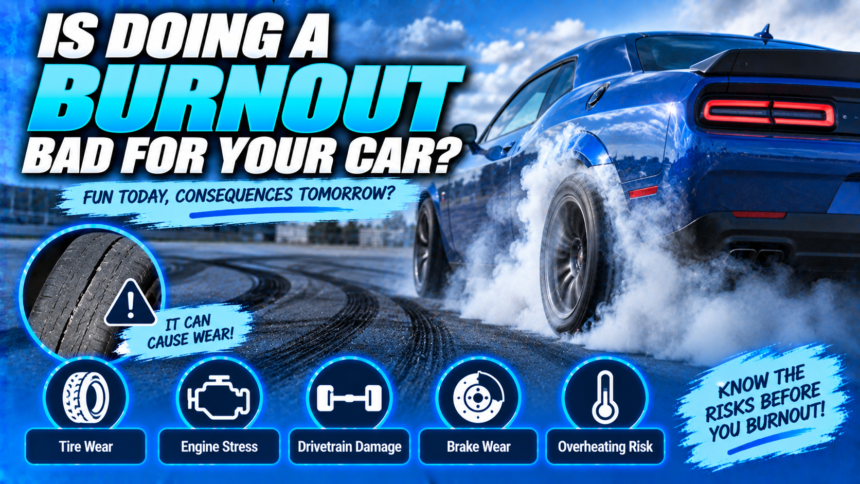
Yes. Every burnout costs you something, and the only real question is which part pays and how much.
- What a burnout does mechanically?
- Tires: the guaranteed cost
- What pays the price, by drivetrain?
- Manual cars: the clutch takes the hit
- Automatics: heat is the enemy
- The cooling problem nobody mentions
- Brakes, differentials, and the rest
- Electric cars
- Warranty and legality
- If you are going to do one anyway
- How to tell if something got hurt?
- Conclusion
- Frequently asked questions
- Related Articles
Tires pay every single time, without exception. After that it depends on what you are driving, how long you hold it, and how often you do it. One short spin in a healthy car is a tire bill. A thirty-second smoke show in a tired car is a repair bill, and sometimes a large one.
Here is what is actually happening to each part of the car while the tires are spinning, so you can judge the trade rather than guess at it.
What a burnout does mechanically?
A burnout is your engine making power that goes nowhere useful. Normally that energy moves a car forward. With the wheels spinning against a stationary body, almost all of it turns into heat and friction instead.
That heat has to go somewhere. It goes into the tires, the transmission fluid, the brakes, the differential, and the coolant. At the same time the driveline takes repeated shock loads as the tires grip and release, which is the shudder you feel through the floor.
The other half of the problem is that the car is not moving. Nearly every cooling system on a vehicle assumes air is flowing through it. Standing still with the engine near full load removes that assumption at exactly the moment the car needs it most.
Tires: the guaranteed cost
This is the one nobody argues about. A sustained burnout can remove a noticeable fraction of the tread on a set of rear tires, and a long one can take a set from usable to scrap in a single go.
The wear is only part of it. Rubber degrades under heat, and a tire that gets hot enough to smoke has been taken well beyond what it was designed for. Every passenger tire carries a temperature grade of A, B, or C under the federal grading system, indicating its resistance to heat build-up. NHTSA’s tire safety guidance explains that sustained high temperature causes tires to deteriorate and can lead to blowouts and tread separation.
That damage is not always visible afterwards. A tire that looks fine may have compromised bonding between the tread and the belts underneath, which is the failure mode that lets go at speed rather than in a car park.
Check the tires after any burnout, and if you see flat spots, cords, blistering, or chunking, the tire is finished regardless of how much tread is left.
What pays the price, by drivetrain?
| Drivetrain | Takes the worst of it |
| Rear-wheel drive, manual | Clutch, driveshaft, U-joints, differential |
| Rear-wheel drive, automatic | Torque converter and transmission fluid temperature |
| Front-wheel drive | CV joints, half shafts, steering and suspension components |
| All-wheel drive | Centre differential or coupling, both axles |
| Electric | Motor and inverter heat, tires above all |
Front-wheel drive is the setup that spreads the damage widest. The same components that transmit the torque also steer the car, so the shock loads run through tie rods, lower arms, and strut mounts. Wheel hop at the front end is a genuinely destructive motion, and it shows up later as bad alignment and uneven tire wear rather than as an immediate bang.
Manual cars: the clutch takes the hit
Starting a burnout in a manual usually means slipping or dumping the clutch, and both are hard on it.
Slipping generates enormous friction heat in the clutch disc and flywheel, which glazes surfaces and burns off friction material fast. This is where the smell comes from, and a clutch that starts slipping under load afterwards is telling you it has been cooked.
Dumping the clutch at high revs does something different. It applies the engine’s torque to the driveline almost instantly, and that shock has to be absorbed somewhere. On a rear-drive car the load runs through the driveshaft, the U-joints, and into the differential. Axles and U-joints do break this way, and they usually break at the moment of engagement rather than gradually.
Motor and transmission mounts also suffer. They are rubber, they are designed to damp normal torque reaction, and repeated shock loading tears them.
Automatics: heat is the enemy
An automatic transmission does not have a clutch to burn, so the damage arrives as temperature instead.
Holding the brake and building revs, sometimes called brake-torquing, makes the torque converter absorb the difference between engine speed and output speed. That difference becomes heat, and it goes straight into the transmission fluid. Automatic transmission fluid has a working temperature range, and running it well above that range shortens its life sharply and degrades the friction material inside the clutch packs.
The damage is cumulative and quiet. Fluid that has been overheated repeatedly loses its properties long before anything feels wrong, and the first symptom is often a shift that has gone soft or a converter that shudders under light throttle.
Anyone who does this more than occasionally should be changing transmission fluid far more often than the service book says, and an auxiliary transmission cooler stops being an optional extra.
The cooling problem nobody mentions
Sitting still at high load is close to the worst case for engine cooling.
There is no ram air through the radiator, so you are relying entirely on the fans. Coolant temperature climbs, oil temperature climbs behind it, and on a turbocharged car the intake temperature climbs too. A car that would happily hold full throttle at 70 mph all day can get into trouble doing the same thing stationary for twenty seconds.
Watch the temperature gauge, not the smoke. If the needle moves, you are past the point where this is free.
Brakes, differentials, and the rest
Holding the car against its own power heats the brakes, particularly on a front-drive burnout where the rear brakes are doing the holding with far less capacity than the fronts.
The differential works hard too. An open differential in a car with one wheel spinning sends all the torque through the spider gears, which are not designed for sustained one-wheel operation and can weld themselves together in extreme cases. A limited-slip differential handles it better but wears its clutch packs doing so.
Wheel bearings, hubs, and suspension bushings all take load they were not designed for, and none of that damage announces itself on the day.
Electric cars
The instant torque makes wheelspin trivially easy, and there is no clutch or torque converter to worry about.
What replaces them is thermal management. Motors, inverters, and battery packs all have temperature limits, and a car that gets close to them will reduce power on its own to protect itself. Repeated abuse can push components past where the software can protect them.
Tires are the bigger story on an EV regardless. They are heavier cars with more torque, they already wear tires faster than equivalent petrol cars, and a burnout accelerates that dramatically.
Warranty and legality
Manufacturer warranties generally exclude damage caused by racing, competition, or abuse, and a broken axle with a fresh set of burnout marks on the tires is not a difficult case for a dealer to make. Modern cars also log data, and a technician can often see what the car was doing.
On public roads, burnouts are illegal essentially everywhere, usually under exhibition of speed, reckless driving, or similar statutes, and the penalties in some places include vehicle impoundment. This is not a grey area worth testing.
If you are going to do one anyway
Assuming a legal surface such as a drag strip or private property with permission, a few things reduce the damage.
Keep it short. Most of the harm scales with duration, and two seconds costs a fraction of what twenty seconds costs.
Start with everything at normal operating temperature but not hot, and stop before the temperature gauge moves. Watch the coolant and transmission temperatures rather than the tire smoke.
Use a surface with less grip, such as a damp or dusty patch, because it takes less torque to break traction and puts less shock through the driveline.
Do it on old tires you intend to replace, and inspect them afterwards before driving at speed.
And know the state of the car first. Worn U-joints, an old clutch, tired fluid, or perished mounts turn a stunt into a repair. The car that survives this is the one that was in good condition before.
How to tell if something got hurt?
Damage from a burnout often announces itself days or weeks later rather than immediately, so it helps to know what you are listening for.
A clutch that has been cooked will slip under load. The revs climb in a higher gear without the car accelerating to match, usually noticeable first when pulling up a hill.
A stressed automatic shows up as flaring between gears, a shudder at light throttle around 40 mph, or shifts that have gone vague. Pull the dipstick if the car has one and look at the fluid. Dark, thin, or burnt-smelling fluid has been overheated.
Driveline damage tends to be a noise. A clunk when taking up drive, a vibration that appears at a specific speed, or a clicking on full lock in a front-drive car all point at U-joints, mounts, or CV joints.
The differential announces itself as a whine that changes with speed rather than engine revs.
Any of these are worth investigating early. The parts get more expensive the longer they run damaged, and a failing U-joint or CV joint can take other things with it.
Conclusion
A burnout is bad for your car, and the cost is real rather than theoretical. Tires pay every time, the clutch and driveline pay in a manual, the fluid temperature pays in an automatic, and the cooling system pays because the car is standing still. One short spin in a healthy vehicle mostly costs rubber. Making a habit of it shortens the life of the most expensive components you own, and the damage usually shows up weeks after the fun did.
Frequently asked questions
Will one burnout damage my car?
Probably not permanently if the car is healthy and the burnout is short. You will use tire life and add heat and shock load to the drivetrain, but a single brief spin rarely breaks anything on its own.
Are burnouts worse in an automatic or a manual?
They damage different things. Manuals burn the clutch and shock the driveline. Automatics cook the transmission fluid through the torque converter. Neither is safe, and the automatic damage is quieter and more cumulative.
Can a burnout void my warranty?
It can void a claim. Warranties typically exclude abuse and racing damage, and if a failed component shows signs of that, the manufacturer can decline the repair. Many modern cars also record the data.
Do burnouts hurt electric cars?
Yes. There is no clutch or torque converter, but motors, inverters, and battery packs heat up quickly, and the car may cut power to protect itself. Tire wear on EVs is heavier than on comparable petrol cars to begin with.
Are burnouts illegal?
On public roads, yes, in effectively every jurisdiction, usually under exhibition of speed or reckless driving laws. Drag strips and private property with permission are the legal places to do them.
Related Articles
How to Remove Corrosion From a Car Battery?
How Long Can a Car Sit Before the Battery Dies?