Vacuuming alone does not work, and knowing why saves an hour of frustration. Dog hair hooks into woven fabric and static holds it there, so suction on its own lifts the loose hair sitting on top and leaves everything that matters behind.
- Why the vacuum loses
- Do it in this order
- The tools, ranked by what they are actually good for
- The pumice stone warning
- Working through the car
- Dealing with the static
- How long it takes, and when to hand it over
- Stopping it building up again
- One thing that makes it worse
- Conclusion
- Frequently asked questions
- Related Articles
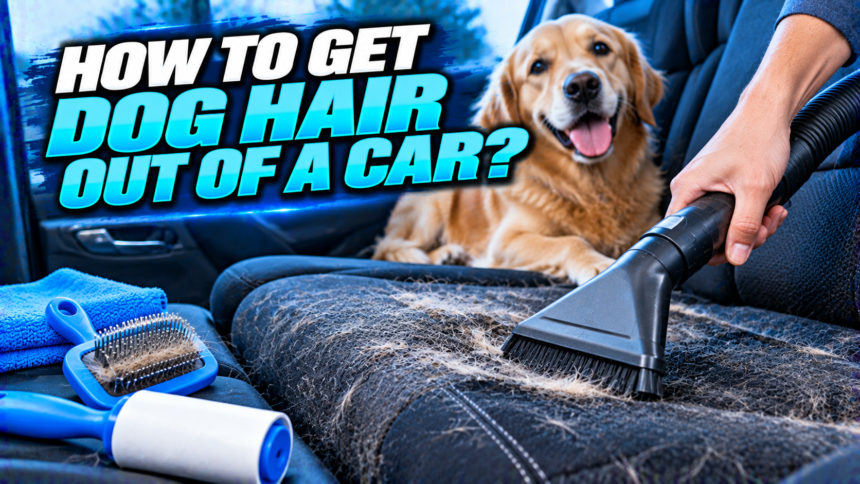
The sequence that does work is: break the static, loosen the hair mechanically, gather it into clumps, then vacuum. A rubber squeegee or a damp rubber glove does most of that, and both cost a few dollars. The one tool that does the rest, a pumice stone, will permanently scratch your dashboard if you use it in the wrong place.
Why the vacuum loses
Dog hair has a barbed outer layer, and those barbs hook into the loops of woven upholstery and carpet in a way that human hair does not. Once worked in, it is physically anchored rather than just resting there.
On top of that, car interiors are dry and full of synthetic fabric, which is close to ideal for building static charge. That charge holds hair flat against the surface and actively resists the airflow a vacuum produces.
A vacuum moves air. It does not break either of those bonds. That is why running one over a dog-owner’s back seat produces a visibly cleaner surface and a seat that still has hair in it when you look closely. The mechanical step in the middle is not optional.
Do it in this order
- Take everything out. Floor mats and cargo liners come out of the car entirely, get shaken out, and get dealt with separately where the hair can blow away.
- First vacuum pass. This is for loose surface hair and grit, and it stops you grinding debris into the fabric during the next step.
- Break the static. A light mist of plain water is often enough. Diluted fabric softener works better, roughly two or three teaspoons in a spray bottle of water, but patch test it on a hidden area first.
- Work the surface with a rubber tool, using short firm strokes in one direction rather than scrubbing back and forth. Hair rolls up into visible ropes and clumps.
- Collect the clumps by hand and bin them, rather than trying to vacuum every one.
- Second vacuum pass to lift what the first pass could not reach and what the rubber tool loosened.
- Detail the seams last, with a crevice tool and a stiff detailing brush or an old toothbrush.
The tools, ranked by what they are actually good for
| Tool | Use it on | Notes |
| Rubber squeegee | Carpet and cloth seats | Cheapest, fastest, best all-rounder. Short strokes, always in one direction. |
| Damp rubber glove | All fabric, especially contours | Follows the shape of a seat better than any rigid tool. Rinse the hair off under warm water and carry on. |
| Rubber pet brush | Carpet and cloth | Same principle as the squeegee with better reach into footwells |
| Pumice stone or fur-removal block | Carpet and cloth upholstery only | The most effective thing on deeply embedded hair, and abrasive by design. See the warning below. |
| Vacuum with a motorized or rubber-bristle head | Everything fabric | The rotating brush is doing the work here, not the suction |
| Lint roller | Headliner, light surface hair | Fine for finishing. Useless on anything embedded. |
| Static balloon trick | Very light loose hair | Genuinely works and is genuinely slow. A novelty rather than a method. |
The pumice stone warning
A pumice block is the single most effective thing you can drag across a dog-hair-covered carpet, and it is also abrasive stone. That is not a footnote. It will scratch plastic trim, vinyl, leather, painted surfaces, screens, and carbon fiber, and those scratches are permanent.
Use it on carpet and cloth upholstery only, with light pressure, in one direction, and stop well short of anywhere fabric meets trim. If your seats are leather or part-leather, put the stone away entirely and use a damp rubber glove instead. The five seconds it takes to stray onto a door sill is not worth the result.
Working through the car
- Cloth seats: rubber glove or squeegee, then vacuum, then a crevice tool down the seam between cushion and backrest, which is where most of it hides.
- Carpet and mats: mats out of the car and worked over outside. Pumice or squeegee on the fixed carpet, then vacuum.
- Leather seats: soft brush vacuum attachment and a damp microfiber only. No pumice, no abrasives. Hair gathers in the grain and in perforations, and a damp cloth lifts it without scratching.
- Trunk and cargo area: usually the worst part of the car. Take the liner out, lift the floor panel, and check around the spare wheel well.
- Headliner: lint roller or a very soft brush, and nothing wet. The fabric is bonded with water-soluble adhesive and a soaked headliner sags permanently.
- Seat belts and seat rails: detailing brush or toothbrush, since hair wraps around the rails and webbing edges and no tool reaches it.
- Cabin air filter: hair and dander end up in it. If the car carries a dog regularly, replace it more often than the service schedule suggests.
Dealing with the static
Static is doing more of the work holding hair down than most people realize, and neutralizing it changes how much effort the rest of the job takes.
A light mist of water is the simplest option and costs nothing. Diluted fabric softener performs better because it is designed to reduce static cling, but it needs a patch test first and it needs to be dilute; a heavy application leaves residue that attracts dirt. Dedicated anti-static sprays exist and work as advertised.
The word that matters throughout is damp. Wet fabric solves a hair problem and creates a mildew one, particularly in a closed car. Mist lightly, let it sit a minute, and work while the surface is barely moist rather than saturated.
How long it takes, and when to hand it over
For a car that carries a dog occasionally, budget 45 minutes to an hour and a half with the method above. For a car that has been a dog’s daily transport for a few years, expect three or four hours, most of it spent on the cargo area and the seat seams rather than the obvious surfaces.
The point where paying makes sense is when hair has been ground into carpet over years, because at that stage it is genuinely bonded into the pile and hand tools stop being efficient. A detailer with a proper extractor and a motorized brush head will do in an hour what takes a weekend by hand. It is also worth considering before selling the car, since visible pet hair is one of the things buyers price against hardest.
One thing not to bother with: repeated passes with the same tool on the same spot. If two or three firm strokes with a rubber tool have not lifted the hair, the answer is a different tool or a mist of anti-static solution, not more pressure.
Stopping it building up again
This is the part that actually saves time, because hair that has not yet worked into the weave comes out in minutes rather than hours.
- A fitted seat cover or cargo liner is close to a complete solution, and it goes in the washing machine. This is the single highest-value change for anyone who drives with a dog weekly.
- Brush the dog outside before rides rather than letting the car do the brushing. Five minutes on the driveway removes most of what would otherwise end up in the upholstery.
- Vacuum weekly rather than seasonally if the dog is a regular passenger.
- Keep a rubber glove or a small squeegee in the door pocket. A two-minute pass after a trip prevents the two-hour job later.
A secured crate contains the hair better than anything else, and it is worth knowing that restraint is a safety matter as much as a cleaning one. An unrestrained dog is a genuine driver distraction and becomes a projectile in a collision, which is why the American Veterinary Medical Association and AAA both recommend crates or crash-tested harnesses in the back seat rather than a loose dog in the cabin. If you are buying something to keep the hair off the upholstery anyway, buying the thing that also keeps everyone safer is an easy decision.
One thing that makes it worse
Wet dog is the accelerant here. Damp hair mats down into fabric and bonds far more tightly than dry hair, and it dries in place hooked into the weave rather than sitting loose on top. A single trip back from a beach or a rainy walk can embed more hair than a month of ordinary journeys.
The practical response is a towel and two minutes before the dog gets in, plus a waterproof cover for those trips specifically. If it has already happened, deal with it before the car dries out rather than after, because damp hair still lifts easily and the same hair is considerably harder to shift once it has dried into the fabric.
Conclusion
Vacuum first, mist lightly to kill the static, then do the real work with a rubber squeegee or a damp rubber glove using short strokes in one direction. Save the pumice block for carpet and cloth only, keep it away from every hard surface in the car, and finish with a second vacuum pass and a detailing brush in the seams. Then put a washable cover down, because the fastest way to get dog hair out of a car is to stop it getting into the fabric in the first place.
Frequently asked questions
What is the best tool for removing dog hair from a car?
A rubber squeegee or a damp rubber glove for most surfaces, and a pumice-style fur block for hair deeply embedded in carpet. All three work by friction rather than suction, which is what a vacuum cannot supply.
Why does vacuuming not remove dog hair?
Because the hair is barbed and hooks into the weave, and static holds it flat against synthetic fabric. A vacuum moves air, which breaks neither bond. Loosening the hair mechanically first is what makes the vacuum effective.
Does fabric softener really help remove pet hair?
Yes, diluted heavily in water and misted lightly. It reduces the static charge holding hair to the fabric. Patch test first, keep it dilute to avoid residue, and never soak the upholstery.
Will a pumice stone damage my car?
On carpet and cloth upholstery, no, if you use light pressure. On plastic, vinyl, leather, screens or paint it will leave permanent scratches. Keep it well away from anywhere fabric meets trim.
How do I get dog hair out of leather seats?
A soft brush vacuum attachment followed by a damp microfiber cloth. Hair collects in the grain and perforations rather than embedding, so it lifts easily. Never use abrasive blocks or stiff brushes on leather.
Related Articles
How to Get Stains Out of Car Seats?