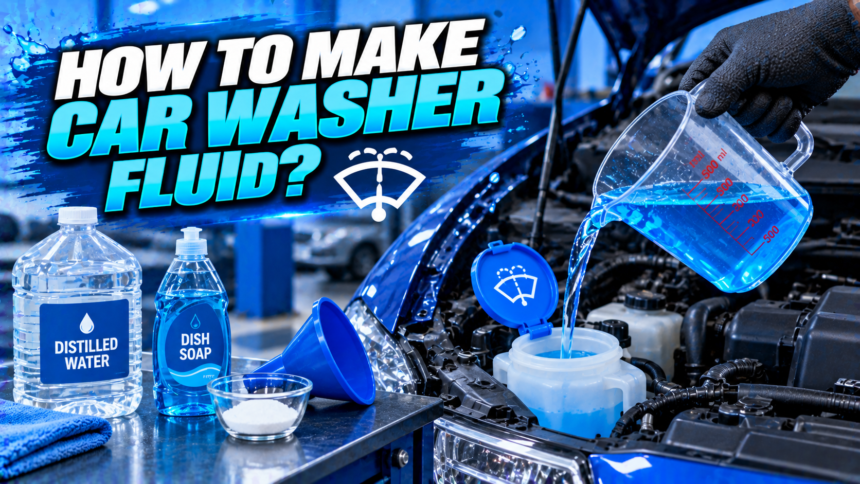
To make car washer fluid, mix one gallon of distilled water with one tablespoon of liquid dish soap. That is the entire summer recipe, and it costs under a dollar a gallon. For freezing weather, replace some of that water with isopropyl alcohol, using roughly three cups per gallon for mild frost and more as temperatures drop.
- What you need
- Why distilled water is the one ingredient not to substitute
- The summer recipe
- The winter recipe
- Skip the ammonia
- Filling the reservoir
- Safety and storage
- What it actually saves
- When homemade is not the right call
- Fixing common problems
- Conclusion
- Frequently asked questions
- Can I just use plain water in my washer reservoir?
- How much rubbing alcohol do I need to stop it freezing?
- Is vinegar safe for a windshield?
- Why does my homemade washer fluid leave streaks?
- Does homemade washer fluid damage the pump or nozzles?
- Related Articles
Two things matter more than the recipe itself. Use distilled water rather than tap, because minerals in tap water clog the tiny spray nozzles. And skip ammonia, despite how often it appears in washer fluid recipes.
What you need
Three items cover every version of this:
- Distilled water. A gallon costs about $1 to $2 at any grocery store. Tap water leaves mineral deposits that block nozzles and shorten pump life.
- Liquid dish soap. One tablespoon per gallon. More is not better, as extra soap foams up and smears.
- Isopropyl alcohol (rubbing alcohol). Only needed below freezing. Buy 91% or 99% concentration, not 70%.
An empty gallon jug with a cap makes mixing and storage easy. Rinse it thoroughly first, since leftover residue from whatever was in it can react with your mix.
Why distilled water is the one ingredient not to substitute
Tap water carries dissolved calcium and magnesium. When it dries on glass it leaves those minerals behind as the white spotting you see after rain dries on a car. Inside the system the same thing happens in a worse place.
Washer nozzles spray through openings smaller than a pinhead. Mineral scale builds up at that opening a little at a time, and the spray pattern goes from a wide fan to a thin jet that shoots over the glass or misses one side. That is the single most common complaint about homemade washer fluid, and it traces back to the water rather than the recipe.
Scale also settles in the pump and the narrow feed lines. Replacing a washer pump is not a large repair, but it is entirely avoidable for the price difference between distilled and tap.
If your home has soft water, tap is less risky, though distilled at a dollar or two a gallon is still cheap insurance. Filtered pitcher water is not the same thing, since those filters target taste and chlorine rather than dissolved minerals.
The summer recipe
For bugs, dust, pollen, and general road film:
- Start with a clean, empty gallon jug.
- Pour off about one cup of distilled water to leave mixing room.
- Add one tablespoon of liquid dish soap.
- Cap the jug and tip it end over end a few times. Do not shake it, which whips up foam that takes an hour to settle.
That is it. If bug splatter is your main problem, add half a cup of white vinegar, which helps break down the residue and cuts streaking.
Test it before you commit a full gallon. Mix a small batch, spray it, and run the wipers. If you see streaks or a hazy film in direct sunlight, you used too much soap. Dilute with more distilled water and try again.
The winter recipe
Water freezes. A frozen reservoir cracks the plastic tank, splits the hoses, and can burn out the pump, which turns a two-dollar mix into a repair bill. Alcohol lowers the freezing point, and how much you need depends on how cold your winters get.
| Lowest expected temperature | Isopropyl alcohol per gallon |
| Around freezing, light frost | 2 to 3 cups |
| Down to about 10°F (-12°C) | 4 to 6 cups |
| Below 0°F (-18°C) | Buy commercial winter fluid instead |
Replace water with alcohol rather than adding on top, so the jug still holds a gallon. Keep the same tablespoon of dish soap.
Use 91% or 99% isopropyl alcohol. The 70% bottle is nearly a third water already, so you are diluting your own antifreeze and will need far more of it to reach the same protection.
For a sense of scale, commercial washer fluid lowers the freezing point of your tank contents by about 20 to 35°F below the freezing point of water. A home mix using rubbing alcohol has a harder time reaching the deep end of that range, which is the honest reason to buy commercial fluid for severe cold rather than mixing your own.
Always test overnight. Fill a small sealed container with your mix, leave it outside on a cold night, and check it in the morning. Slushy means add more alcohol. Solid means you are well short. This five-minute test is the only reliable way to know your mix suits your climate.
Skip the ammonia
Plenty of washer fluid recipes call for half a cup of ammonia, and it does cut grease well. It also causes problems that show up months later.
Ammonia dries out rubber and plastic. It reaches the wiper blades on every spray, and over time it makes the rubber brittle so the blades chatter and streak. It travels through your washer hoses and past the nozzle seals, drying those out too. Where it lands on trim or overspray hits paint, it can strip wax and dull the finish.
It also attacks window tint. If your car has aftermarket tint on the side or rear glass, repeated ammonia exposure can discolor it or lift the edges. That is why auto glass shops sell ammonia-free glass cleaner as a specific product category.
Dish soap and alcohol clean well enough for a windshield. Neither carries these side effects.
Two more things to keep out of your mix:
- Bleach. Never, in any amount. It corrodes metal and rubber, and mixed with ammonia it produces toxic chloramine gas.
- Household glass cleaner. Most contain ammonia, which puts you back at the problem above, and they are not formulated to sit in a plastic tank through temperature swings.
Filling the reservoir
Open the hood with the engine off and cool. Look for a cap marked with a windshield-and-spray symbol, usually blue or black. It sits separately from the coolant tank, which is easy to confuse if you are in a hurry.
Pour slowly with a funnel and stop short of the very top so the fluid has room to expand. Wipe up any spills, then close the cap firmly.
If you are switching from commercial fluid, either run the tank low first or accept some mixing. Mixing homemade fluid with leftover commercial fluid is fine chemically. What you cannot do is add a summer mix on top of winter fluid and assume you still have freeze protection, because you have just diluted it.
Safety and storage
Store the jug where children and pets cannot reach it, keep the cap tight, and label it clearly. Never decant into a drink bottle or cup.
This matters more than it sounds. Commercial washer fluid contains methanol, typically 30 to 50 percent in ready-to-use products and up to 90 percent or more in concentrates, and methanol is severely toxic. Swallowing a small amount can cause blindness or death, and the worst symptoms are delayed by hours, so someone can seem fine long after a dangerous dose. The National Capital Poison Center recommends storing washer fluid in its original container, keeping it locked away from children and pets, and calling a poison center immediately if any is swallowed.
Your homemade mix avoids methanol entirely, which is one real advantage of making your own. Isopropyl alcohol is still not something to drink, and dish soap will make a child sick, so the same storage rules apply.
Dispose of leftover commercial fluid through your local hazardous waste program rather than down a drain.
What it actually saves
The summer mix works out to roughly a dollar a gallon, almost all of it the distilled water, since a bottle of dish soap holds enough for dozens of batches. Store-bought summer fluid usually runs about $3 to $6 a gallon, and name brands sit at the higher end.
Winter mixes narrow that gap. A large bottle of 91% isopropyl alcohol costs several dollars on its own, and a cold-weather mix can need most of one. Once you are at four to six cups per gallon, homemade winter fluid often costs about the same as commercial winter fluid while protecting to a warmer temperature.
So the savings are real in summer and thin in winter. The stronger argument for mixing your own in cold months is control over the ingredients, particularly avoiding methanol in a garage where children or pets spend time.
When homemade is not the right call
Buy commercial fluid instead when any of these apply:
| Situation | Why |
| Winters below 0°F (-18°C) | Rubbing alcohol mixes struggle to reach that protection reliably |
| You need de-icing performance | Commercial winter formulas melt ice on contact; a home mix mostly just avoids freezing |
| Heated washer system or sensors in the nozzle path | Manufacturers specify fluid for these, and soap residue can build up |
| Your windshield has a hydrophobic coating | Some coatings have specific fluid recommendations to avoid stripping them |
Also worth knowing: a few newer vehicles route washer fluid to camera and sensor lenses for driver assistance systems. Soap residue on a camera lens is a different problem from a slightly hazy windshield. Check your owner’s manual if your car has forward cameras behind the glass.
Fixing common problems
Streaks in sunlight. Too much soap. Cut the mix with more distilled water. A tablespoon per gallon is genuinely enough.
Weak or uneven spray. Usually a clogged nozzle rather than a bad mix, especially if you used tap water previously. A pin or a thin needle clears most nozzles.
Fluid sprays but the glass stays smeared. Look at your wiper blades. Fluid cannot fix a blade with a torn or hardened edge, and most blades want replacing every six to twelve months.
Cloudy or separated mix. Normal with vinegar or hard water. Tip the jug a few times before pouring, and switch to distilled water if you have not already.
Conclusion
One gallon of distilled water plus one tablespoon of dish soap handles warm weather, and swapping two to six cups of that water for 91% isopropyl alcohol handles frost. Leave out ammonia and bleach entirely. Test any winter mix outside overnight before you trust it, and buy commercial fluid when temperatures drop below zero. A good result is clear glass with no streaks in low sun, and a reservoir that still sprays freely on the coldest morning of the year.
Frequently asked questions
Can I just use plain water in my washer reservoir?
Only briefly in warm weather. Plain water freezes and can crack the tank or burn out the pump, and it does little against bug residue or road film. Tap water also leaves mineral deposits that clog nozzles.
How much rubbing alcohol do I need to stop it freezing?
About two to three cups per gallon for light frost, and four to six cups for temperatures near 10°F. Use 91% or 99% alcohol, and test a sealed sample outside overnight to confirm before filling the tank.
Is vinegar safe for a windshield?
Half a cup per gallon is fine and helps with bug splatter. Avoid high concentrations, since acidic mixes in quantity can affect trim and window tint over time.
Why does my homemade washer fluid leave streaks?
Almost always too much dish soap. Dilute with more distilled water until the streaking stops. Hard tap water and worn wiper blades also cause streaking that no mix will fix.
Does homemade washer fluid damage the pump or nozzles?
Not if you use distilled water and go light on the soap. Damage comes from tap water minerals, excess soap residue, and freezing, so getting those three right matters more than the recipe.
Related Articles
How Much to Tint Car Windows? 2026 Cost Guide
How Long Does It Take to Tint Windows?