



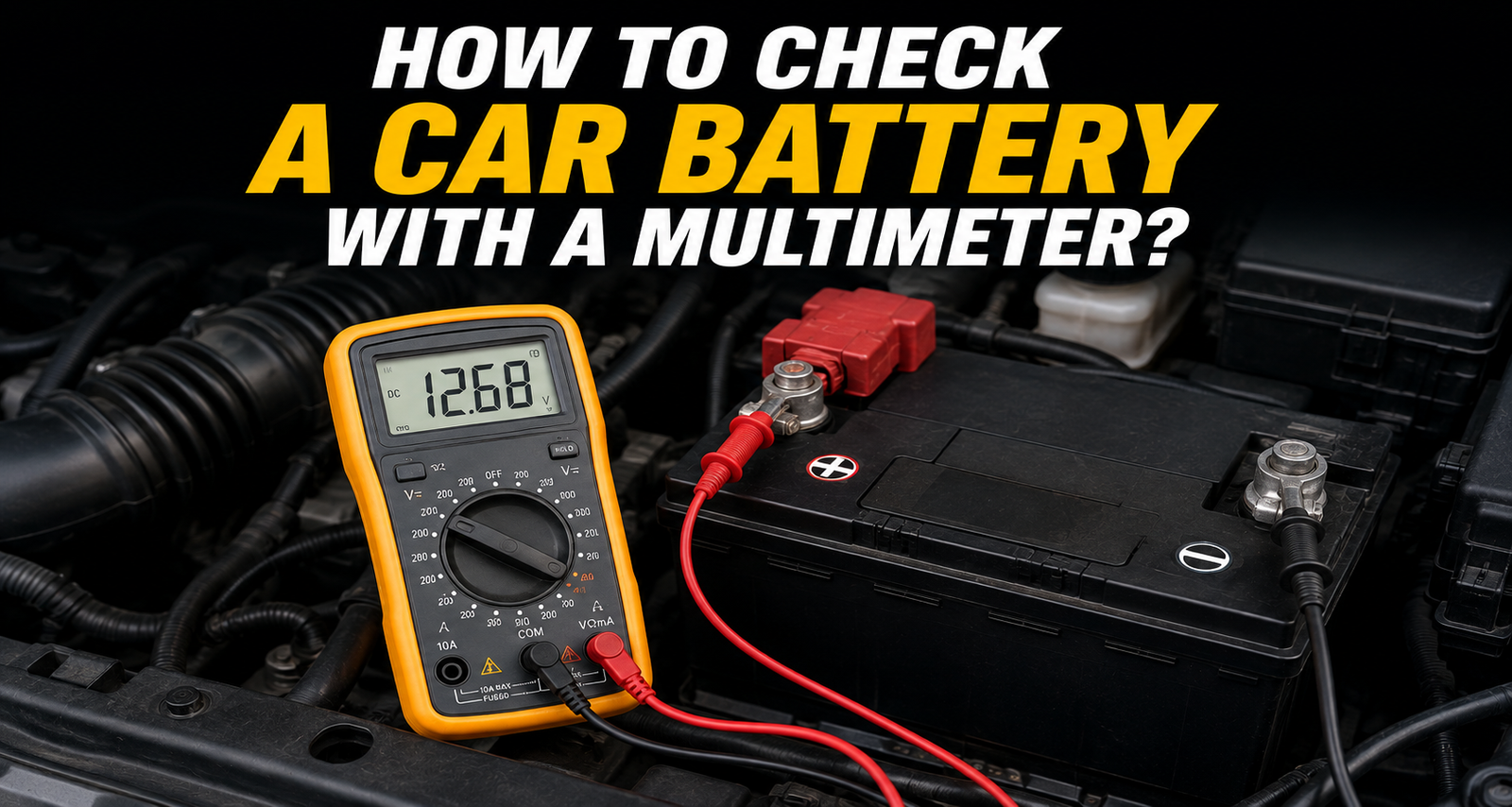
To check a car battery with a multimeter, set the meter to 20 DC volts, touch the red probe to the positive terminal and the black probe to the negative terminal, and read the display. A healthy, fully charged battery shows about 12.6 volts or more with the engine off. It takes under a minute and tells you whether the battery is healthy, weak, or needs replacing.
A multimeter is cheap, and knowing how to read your battery can save you from being stranded. For a full picture, there are actually three quick tests: one with the engine off, one while starting, and one while running. Here is how to do all three.
What you need?
Very little, which is the appeal of this check:
- A digital multimeter. Inexpensive and available at any auto parts or hardware store.
- Access to the battery. Usually under the hood, with clearly marked positive and negative terminals.
- Safety basics. Do the test with the car off to start, and avoid touching the two terminals together with anything metal.
If the terminals are dirty or corroded, clean them gently first with a wire brush, since corrosion can throw off the reading and the connection.
Set up the multimeter correctly
Getting the meter set right is the one part beginners tend to fumble, so take a moment here. Two things matter: the setting and the probe ports.
Turn the dial to DC volts, shown as a V with a solid line and a dashed line above it. Do not use the V with a wavy line next to it, as that is AC volts and wrong for a battery. If your meter has number ranges, select 20, which covers a 12-volt battery. Auto-ranging meters set the range themselves. Then plug the black probe into the port marked COM and the red probe into the port marked with a V (often VΩmA).
If your reading shows a minus sign (like -12.6 instead of 12.6), your probes are on the wrong terminals. Just swap them: red goes to positive, black to negative. A negative reading is harmless, it only means the leads are reversed.
Step-by-step: the resting voltage test
The first and most important test is the resting voltage, taken with the engine and everything off. This shows the battery’s state of charge:
- Turn everything off. Make sure the ignition, lights, and accessories are all off.
- Set the meter to 20 DC volts and connect the probes to the ports as above.
- Touch the probes to the terminals. Red probe to the positive terminal (marked + or with a red cover), black probe to the negative terminal (marked -).
- Read the display. The number that appears is your battery’s resting voltage. Compare it to the table below.
For the most accurate resting reading, the battery should have rested, ideally not driven for a few hours. As AutoZone notes, testing right after driving can give a falsely high reading from a surface charge (see the tips section).
What the voltage numbers mean?
Here is how to read your result:
| Resting reading (engine off) | What it means |
| 12.6 to 12.8 volts | Healthy, fully charged |
| 12.4 to 12.6 volts | Okay, slightly low; charge soon |
| Around 12.2 volts | About 50% charged; needs charging |
| Below 12.0 volts | Discharged; may not start the car |
| 13.8 to 14.5 volts (engine running) | Alternator is charging correctly |
The pattern to remember: 12.6 volts or higher with the engine off is a healthy, charged battery, and the reading drops as the charge does. A surprising fact for many people is that 12.2 volts is only about half charged, not nearly full, so anything below 12.4 is a red flag worth acting on.
Test 2: the cranking test
The resting voltage tells you the charge, but not how the battery holds up under the strain of starting. The cranking test checks that. It is easiest with a helper.
With the probes still on the terminals, have someone start the engine while you watch the meter. The voltage will dip as the starter draws power, which is normal. What you are looking for is how far it drops: the reading should stay above about 10 volts during cranking. If it plunges well below 10 volts, the battery is weak and struggling to deliver power, even if its resting voltage looked acceptable. This test catches a battery that is on its way out.
Test 3: the charging (alternator) test
The third test checks that the alternator is charging the battery properly while the engine runs, which is just as important as the battery itself. A good battery will still go flat if the alternator is not recharging it.
With the engine running and the probes on the terminals, read the voltage again. It should rise to roughly 13.8 to 14.5 volts, which shows the alternator is charging. If it stays down near the resting voltage or does not climb, the alternator may be failing. For a tougher test, turn on all the electrical loads, headlights, climate control, stereo, and check the voltage still holds in that range. A reading that drops too low under load points to a weak charging system.
The three tests together tell the full story: resting voltage checks the charge, the cranking test checks the battery under load, and the running test checks the alternator. Doing all three is far more revealing than a single reading.
Tips for an accurate reading
A few small things make your results more reliable:
- Remove the surface charge. If you just drove, turn on the headlights for about two minutes then off, or let the car rest a few hours, before the resting test. This clears a temporary surface charge that reads falsely high.
- Get a solid contact. Press the probes firmly onto clean metal terminals. A poor connection or corrosion gives a low or jumpy reading.
- Mind the temperature. Cold affects voltage slightly, so readings can run a touch lower in winter. Judge against the ranges above.
- Watch the polarity. A minus sign just means reversed probes. Swap them for the correct positive reading.
- Note your battery’s age. If it is over about three to five years old and reading low, it may be near the end of its life.
Voltage vs a load test
A multimeter voltage test is quick and useful, but it has a limit worth knowing. It measures the battery’s charge and how it holds up in the tests above, but it does not fully measure the battery’s capacity, how much power it can actually deliver over time.
For that, a dedicated load test is the gold standard, and it is what tells you definitively whether a battery is faulty rather than just discharged. The good news is that many auto parts stores will load test your battery for free. So if your multimeter readings are borderline, or the battery keeps going flat despite testing okay, a load test at a shop is the next step to confirm whether it needs replacing.
Conclusion
Checking a car battery with a multimeter is simple: set it to 20 DC volts, touch red to positive and black to negative, and read it, aiming for 12.6 volts or more with the engine off.
For the full picture, add the cranking test (should stay above 10 volts) and the charging test (13.8 to 14.5 volts running) to check the alternator too. Clear any surface charge first for accuracy, and if readings are borderline, get a free load test at a parts store to confirm the battery’s health.
Frequently asked questions
What setting should the multimeter be on to test a car battery? DC volts, at the 20-volt range if your meter has number ranges. Avoid the AC volts setting (the V with a wavy line). Auto-ranging meters set the range for you once on DC volts.
What voltage should a healthy car battery read? About 12.6 to 12.8 volts with the engine off. Around 12.2 is only 50% charged, and below 12 volts is discharged. With the engine running, 13.8 to 14.5 volts shows the alternator is charging.
Why is my multimeter showing a negative voltage? Your probes are on the wrong terminals. It is harmless. Just swap them so the red probe is on the positive terminal and the black on the negative, and the reading will be positive.
Do I need to test with the engine running too? It helps. The running test (13.8 to 14.5 volts) checks that the alternator is charging the battery. A good battery still goes flat if the alternator is not recharging it, so it is worth checking.
Is a multimeter enough to know if my battery is bad? It is a great first check of charge and basic health, but it does not measure full capacity. If readings are borderline or the battery keeps dying, get a free load test at a parts store to confirm.
Related Articles
What Cars Come With the 8HP95 Transmission?
Why Does My Car Smell Like Burning Oil?
Can You Put Gas in a Running Car?