Checking brake fluid takes about two minutes and needs no tools. Open the hood, find the clear plastic reservoir near the back of the engine bay, and look at the fluid through the side of the tank. If the level sits between the MIN and MAX lines and the fluid looks clear to light gold, your brakes are in good shape. If it is below MIN or has turned dark brown, you need to act. Here is how to do the whole check the right way, and how to read what you find.
- What brake fluid does, and why the check matters?
- What you need before you start?
- Where is the brake fluid reservoir?
- How to check the brake fluid level?
- What the level is telling you?
- How to check the brake fluid color and condition?
- Why moisture matters so much?
- How to top up brake fluid safely?
- How often to check and change brake fluid?
- When to stop and see a mechanic?
- Conclusion
- Frequently asked questions
- Related Articles
What brake fluid does, and why the check matters?
Brake fluid is what turns the push of your foot into stopping power at each wheel. When you press the pedal, the fluid carries that force through sealed lines to the brakes. For that to work, the fluid has to be full and in good condition. Unlike petrol, brake fluid does not get used up as you drive, so the level should stay fairly steady. When it drops or changes color, the fluid is telling you something, and a quick check catches most brake problems long before they become dangerous.
The check has two parts, and both take seconds. First you read the level. Then you read the color. Neither needs a garage or special skill, just a minute of looking in the right place.
What you need before you start?
Almost nothing. A clean rag or paper towel, gloves if you have them, and your owner’s manual in case the engine bay is unfamiliar. Park on level ground so the fluid settles evenly, switch the engine off, and let it cool for a few minutes so you are not reaching near hot parts. Brake fluid strips paint and irritates skin, so try to keep it off both your car and yourself.
Where is the brake fluid reservoir?
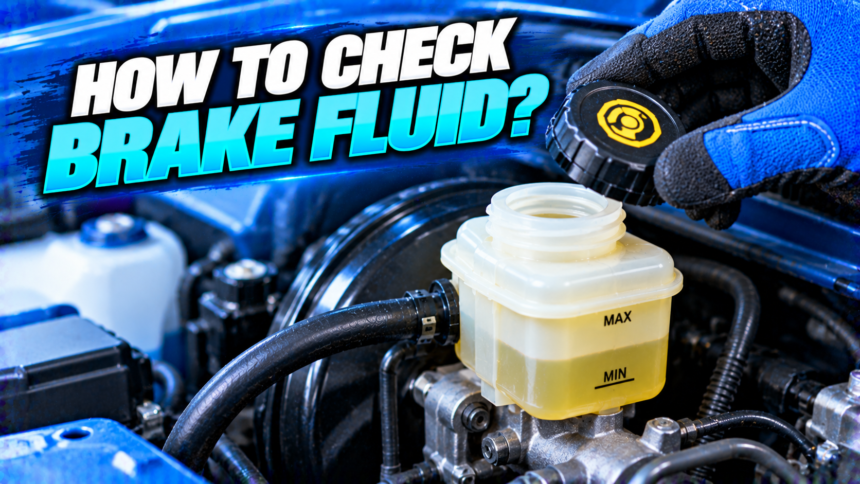
The brake fluid reservoir is a small, see-through plastic tank mounted high at the back of the engine bay, usually on the driver’s side. It sits on top of the master cylinder, close to the firewall, which is the metal wall between the engine and the cabin, and next to the round black brake booster. The cap is often yellow or black and marked with the word “brake” or a circle inside brackets.
On most cars built in the last twenty years the tank is translucent, so you can read the level through the plastic without opening anything. If you cannot spot it, the owner’s manual shows its exact place with a picture.
Take a moment to make sure you have the right tank. Do not confuse it with the windshield washer bottle, which is bigger and often has a blue cap, or with the clutch fluid reservoir on a manual car, which is smaller and sits nearby. On some older vehicles the reservoir is metal with a clip-on lid, and on those you do have to open it to see inside.
How to check the brake fluid level?
Work through these steps in order. The whole thing takes under a minute once you know where the tank is.
- Wipe the outside of the reservoir. Grime on the plastic hides the fluid line. A quick pass with a clean rag makes the level easy to read.
- Find the MIN and MAX marks. They are molded into the side of the tank, sometimes labelled LOW and FULL instead. The fluid should sit at or just below the MAX line.
- Read the level at eye level. Crouch so your eye lines up with the fluid. Looking down from above makes a full tank look low and a low tank look full.
- Keep the cap on. If the tank is see-through, you never need to open it just to read the level. Leaving it sealed protects the fluid, and the reason for that matters (see below).
- Note where the fluid sits. At or near MAX is healthy. A little below is common and usually fine. Below MIN needs attention before you drive far.
What the level is telling you?
A brake fluid level that sits slightly low is not always a problem. As your brake pads wear down, the pistons in the calipers push out a little further, and fluid moves from the reservoir into the lines to fill that space. So the level drops slowly and naturally over the life of a set of pads. A level near the middle of the range can simply mean your pads are about half worn.
A fast drop, or a level below MIN, is a different story. It usually points to either badly worn pads or a leak somewhere in the system. If you top the fluid up and it falls again within days or weeks, treat it as a leak and get the car checked before driving it hard. Your brakes depend on the fluid staying sealed and full, and a leak can end in a pedal that sinks toward the floor with little braking left.
How to check the brake fluid color and condition?
The level is only half the check. The color tells you how healthy the fluid itself is. Fresh brake fluid is clear with a light yellow or honey tint, close to the look of clean cooking oil. Over time it darkens as it picks up moisture, heat, and tiny bits of rubber and metal worn from inside the system. The darker it gets, the more tired it is.
Read the color through the side of the tank, or dip a clean white cloth or a cheap test strip into the fluid if you cannot judge it through the plastic. Use this simple guide.
| Color | What it means | What to do |
| Clear to light gold | Fresh, healthy fluid | Nothing, keep to your normal schedule |
| Amber to light brown | Aging, some moisture and wear | Plan a change soon, test if unsure |
| Dark brown | Old and contaminated | Book a brake fluid flush |
| Black, or bits floating in it | Heavily degraded, possible rust or seal wear | Flush now and have the system checked |
Test strips and small electronic testers go a step further and measure the water content directly, which takes the guesswork out of a borderline color. They cost little and give you a clear yes or no on whether the fluid still has life in it.
Why moisture matters so much?
Brake fluid is hygroscopic, which is a plain way of saying it pulls water out of the air. This is the whole reason you keep the cap on and open it only as briefly as you must. Even a short exposure in humid air starts letting moisture in, and once water is in the fluid it stays there.
Water in the fluid is a safety issue, not just a cleanliness one. It lowers the temperature at which the fluid boils, and hard or repeated braking makes the fluid hot. If it boils, gas bubbles form in the lines. Gas squashes in a way that liquid does not, so the pedal goes soft and your braking fades right when you need it most, such as on a long downhill or during heavy stop-and-go traffic.
The numbers show why this matters. Dry DOT 3 fluid boils at around 401 degrees Fahrenheit (205 Celsius), but that drops to about 284 Fahrenheit (140 Celsius) once it has soaked up water. DOT 4 starts higher, near 446 Fahrenheit (230 Celsius), and falls to roughly 311 Fahrenheit (155 Celsius) when wet. You can see the different grades and their boiling points on Bosch’s brake fluid guide. The lesson is simple: old, wet fluid is weaker fluid, and color is the easiest early warning you get.
How to top up brake fluid safely?
If the level is low but the fluid still looks clean, you can top it up yourself, as long as you use the right type. The correct fluid is printed on the reservoir cap, almost always DOT 3, DOT 4, or DOT 5.1. Match it exactly. Never pour silicone-based DOT 5 into a system built for the others, and never guess, because the wrong fluid can damage the seals and stop the brakes working properly.
- Clean the cap and the area around it before you open it, so no grit falls in.
- Open the cap for as little time as possible to limit moisture getting in.
- Add fresh fluid slowly until the level reaches MAX, and no higher. Overfilling can cause problems as the fluid expands with heat.
- Reseal the cap firmly and wipe up any spills straight away, since brake fluid damages paint.
Topping up is a short fix, not a cure. If the fluid is dark, it needs replacing rather than adding to. And if you find yourself topping up often, something is wearing or leaking and needs a proper look from a mechanic.
How often to check and change brake fluid?
Check the level and color roughly once a month, and every time you open the hood to look at oil or coolant. Once you know where the tank is, it adds under a minute to the job and it is the easiest brake maintenance you can do.
Changing the fluid is a separate task on a longer clock. A common guide is every two years or about 25,000 miles, whichever comes first, though the exact figure is in your owner’s manual and varies by car and fluid grade. Bosch, for example, lists two years or 40,000 kilometres for standard DOT 4. Lean on time as much as mileage, because the fluid absorbs water whether you drive a lot or leave the car parked. If you are not sure how old yours is, a test strip settles it in seconds.
When to stop and see a mechanic?
Some findings mean the check is over and it is time for a professional. Book the car in if the pedal feels soft or spongy or sinks toward the floor, if the brake warning light is on, if the fluid is dark brown or black, if the level keeps dropping after you top it up, or if you see fluid pooling near a wheel or under the master cylinder. A brake fluid flush is a routine, low-cost service, and it is far cheaper than the repairs that follow ignoring worn-out fluid.
Conclusion
Checking brake fluid is a two-minute habit that keeps your brakes honest. Open the hood, read the level against the MIN and MAX lines on the reservoir, and look at the color: clear to light gold is healthy, while dark brown or black means it is time for a flush. Top up with the exact fluid printed on the cap if the level is low but clean, and see a mechanic if it keeps dropping or the pedal feels soft. Do it monthly and you will rarely be caught out.
Frequently asked questions
Can I check brake fluid myself without any tools?
Yes. Most cars have a see-through reservoir, so you just wipe the outside and read the level and color through the plastic. No tools are needed unless you are topping up the fluid.
What color should healthy brake fluid be?
Clear with a light yellow or honey tint, similar to fresh cooking oil. If it has turned dark brown or black, it is contaminated and should be flushed and replaced.
Is it normal for brake fluid to be a little low?
A small drop is normal as brake pads wear, because fluid moves into the lines. A fast drop or a level below MIN usually means worn pads or a leak, so get it checked.
How often should I change brake fluid?
About every two years or 25,000 miles for most cars, but check your owner’s manual. Because the fluid absorbs water over time, go by age as much as mileage.
Can I mix different types of brake fluid?
Only use the DOT type printed on your cap, usually DOT 3, DOT 4, or DOT 5.1. Never add silicone-based DOT 5 to a system built for the others, as it can damage the brakes.
Related Articles
How to Reset the Oil Light on a Honda Civic?
How Much to Tint Car Windows? 2026 Cost Guide