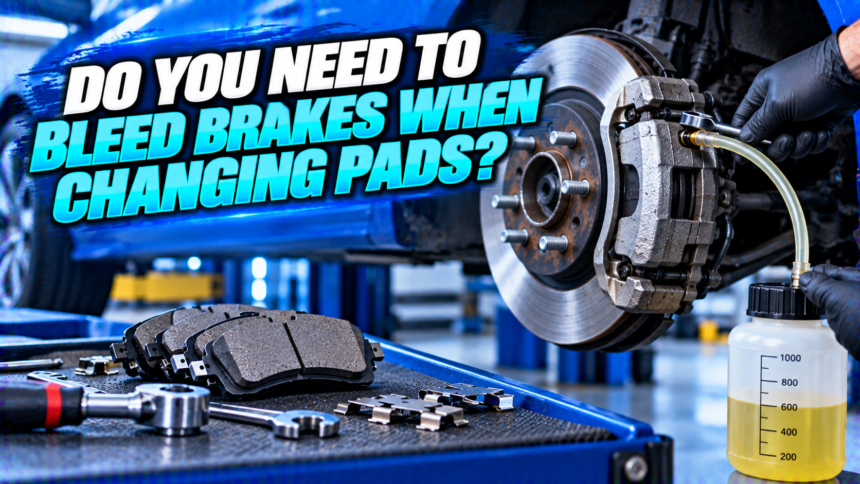
No. A standard brake pad change does not need bleeding, because swapping pads never opens the sealed part of the brake system where air could get in. You take the wheel off, unbolt the caliper, slide the old pads out, push the piston back, fit the new pads, and bolt it all back together. The fluid stays sealed the whole time. So when the job goes normally, you can drive away without touching a bleeder screw.
- Why a pad swap leaves the brake fluid alone?
- When you do need to bleed after changing pads?
- The one step that trips people up: pushing the piston back
- What if you are changing the discs too?
- How to tell if your brakes actually need bleeding?
- Should you change the brake fluid while the wheels are off?
- How brake bleeding works, in short?
- Conclusion
- Frequently asked questions
- Related Articles
There are a few clear exceptions, and this guide walks through each one, so you know exactly when to reach for the bleed kit and when to leave it in the drawer.
Why a pad swap leaves the brake fluid alone?
Your brakes run on a closed loop of fluid. Press the pedal and the master cylinder pushes brake fluid down sealed lines to each caliper, which squeezes the pads against the spinning disc. Bleeding is the separate job of getting trapped air out of that loop. Air is the problem because it squashes under pressure while fluid does not, and that squash is what gives you a soft, spongy pedal.
A pad change never breaks into that loop. The pads sit outside the fluid, pushed by the caliper piston. You are working on the mechanical side of the brake, not the hydraulic side. Nothing gets disconnected, so no air can sneak in. That is the whole reason a pad change and a brake bleed are two different jobs.
One small link between the two is the fluid level in the reservoir. As your old pads wore down, the pistons slid further out to keep the pads touching the disc, and fluid quietly moved from the reservoir to fill the space behind them. That is why the level often sits low on a car with worn pads. It is normal, and it matters in a minute when you push those pistons back.
Rule of thumb: if you did not open a brake line, hose, caliper, or bleeder screw, then you did not let air in, so you do not need to bleed.
When you do need to bleed after changing pads?
A handful of situations flip the answer from no to yes. Each one comes down to the same thing: air found a way into the sealed loop, or the fluid in it is no longer fit to work. Bleed the brakes if any of these happened during or before the job:
- You opened the hydraulic system. If you cracked a bleeder screw, undid a brake line, or pulled off a hose, air got in and has to come back out.
- You replaced a caliper, hose, or line. Any new hydraulic part arrives full of air that needs bleeding out.
- The pedal feels soft or sinks to the floor. A spongy pedal after the job points to air in the lines, so bleed until it firms up.
- The reservoir ran dry. If the fluid dropped below the minimum mark and let air into the master cylinder, you need to bleed.
- You are changing the fluid anyway. Old fluid is its own reason to bleed, and a pad change is a handy time to do it. More on that below.
If none of these apply, a short test is all you need. Sit still, pump the pedal a few times to seat the new pads against the disc, then check that the pedal is firm before you roll.
The one step that trips people up: pushing the piston back
To fit thicker new pads, you have to push the caliper piston back into its bore, and this is the only part of a pad change that touches the fluid at all. When the piston goes in, it sends fluid back up the line toward the reservoir. Two things can go wrong here, and both are easy to avoid.
First, the reservoir can overflow. Remember that low level from worn pads? Push all four pistons fully back and that fluid has nowhere to go but up and out. Before you retract the pistons, pull some fluid out of the reservoir with a syringe or a clean turkey baster, then check the level again at the end. Brake fluid strips paint, so an overflow is not just messy.
Second, you can push old, dirty fluid backward through the ABS unit. Many mechanics avoid this by opening the bleeder screw while they press the piston in, so the old fluid drains out at the caliper instead of traveling back up the system. If you do this, you have opened the hydraulic system on purpose, which means you now do need a quick bleed at that corner afterward. It is a fair trade for keeping grit out of your ABS.
One thing to never do while the pads are out or the caliper is off: do not press the brake pedal. With nothing to stop it, the piston can shoot out of its bore, which spills fluid, lets in air, and turns a clean pad change into a bleed job and a mess. Keep feet off the pedal until the caliper is bolted back over the pads.
The tool depends on the caliper. Most front calipers, and many rears, take a straight push, so a C-clamp or a caliper spreader does the job. But a rear caliper with a built-in parking brake usually has to be wound in with a twisting motion, using a cheap wind-back tool that pushes and turns at once. Forcing one of these straight in can wreck it.
Watch out for electric parking brakes too. Many newer cars hold the rear caliper with a small electric motor instead of a cable. On these you cannot wind the piston back by hand at all. You have to put the caliper into service mode with a scan tool first, or you risk damaging the motor.
What if you are changing the discs too?
Changing the discs, also called rotors, does not add a bleed either, for the same reason. You unbolt the caliper and its bracket, lift the old disc off the hub, and slide the new one on. None of that opens a brake line or hose, so no air gets into the fluid. As long as you hang the caliper on a piece of wire and do not let it dangle on its rubber hose, the hydraulic side stays sealed and untouched.
The only extra care is the same piston step from before. New discs are full thickness, so you still push the pistons back to make room for the fresh pads, and the reservoir warning still applies. Bleed only if you crack a fitting, damage a hose while wrestling the caliper off, or notice a soft pedal at the end.
How to tell if your brakes actually need bleeding?
The pedal tells you almost everything. After the pad change, sit still, pump the pedal a few times to take up the gap, then press and hold with steady pressure. A good pedal is firm and stops high, near the top of its travel. If it feels soft, spongy, or slowly sinks under your foot, you have air in the system and it is time to bleed.
A few other signs point the same way: the pedal travels closer to the floor than it used to, braking feels weaker, or the car pulls to one side. If you saw the reservoir level drop very low at any point during the job, treat that as a reason to bleed even if the pedal seems okay. Better to spend twenty minutes bleeding than to find out on the road.
Make your first drive a careful one either way. Before you pull into traffic, roll forward slowly in a quiet spot and brake gently a few times to check the pedal and let fresh pads bed in against the disc. New pads need a short break-in before they bite fully, so leave extra room on your first few stops even when the pedal feels perfect.
Should you change the brake fluid while the wheels are off?
It is often worth it. Brake fluid soaks up water from the air over time, a property called being hygroscopic, and that water causes two problems. It rusts the metal parts inside your brakes from the inside out, and it lowers the temperature at which the fluid boils.
Boiling matters more than it sounds. Fresh fluid stays liquid at the high heat your brakes make, but wet, aged fluid can boil during hard use. Boiling fluid turns to gas, gas compresses, and the pedal drops to the floor with the brakes barely working. This failure is called vapor lock, and it usually shows up at the worst moment, on a long downhill or during heavy braking. You can read more about how brake fluid boiling points work and why they fall as the fluid ages.
How the boiling point drops once fluid absorbs water:
| Fluid type | Dry boiling point | Wet boiling point |
| DOT 3 | 205 C (401 F) | 140 C (284 F) |
| DOT 4 | 230 C (446 F) | 155 C (311 F) |
| DOT 5.1 | 260 C (500 F) | 180 C (356 F) |
Those wet numbers are why age matters as much as mileage. Most carmakers say to change brake fluid every two years, whatever the odometer reads. You can also check it with a cheap set of brake fluid test strips or a moisture meter, which read the water content in a few seconds. If your fluid looks dark brown instead of clear gold, or you cannot remember the last change, a pad job is a smart time to flush it. The wheels are already off and the calipers are open, so you save yourself a second round of work later.
How brake bleeding works, in short?
If you do need to bleed, the idea is simple: push fresh fluid through each line and let the air escape at the bleeder screw. Keep the reservoir topped up the whole time so it never runs dry and pulls in more air, which would send you back to the start.
Most people bleed in a set order, working from the corner farthest from the master cylinder to the nearest one. On many cars that is right rear, left rear, right front, then left front, but your owner’s manual gives the exact sequence for your car, and some models want a different order. You can bleed with a helper pumping the pedal, a one-way check valve on the bleeder, a vacuum tool, or a pressure bleeder. Whichever method you use, you are watching for the fluid at the bleeder screw to run clear and free of bubbles. When it does, that corner is done.
If you opened only one caliper, say to push a piston back with the bleeder cracked, you usually only need to bleed that one corner, not the whole car. That keeps a careful pad change from turning into a full afternoon.
As a home job, bleeding is cheap and quick. A liter of fresh fluid runs about 10 to 20 dollars, the basic tools are a wrench and a clear hose, and a single corner takes a few minutes once you are set up. The one rule you cannot break is watching that reservoir, because letting it empty pulls air right back into the master cylinder and undoes your work.
Conclusion
Most of the time, changing brake pads does not call for bleeding, because a normal pad swap never opens the sealed hydraulic system. Bleed only if you opened a line, fitted a new caliper or hose, ran the reservoir dry, or the pedal feels soft afterward. Retract the pistons gently so the reservoir does not overflow, pump the pedal to seat the pads, and check for a firm, high pedal before you drive. If the fluid is old or dark, flush it while you are already in there.
Frequently asked questions
Will my brakes work right after changing pads without bleeding?
Yes, as long as you did not open the hydraulic system. Pump the pedal a few times to seat the new pads, then check that it feels firm and stops high before you drive off.
Why is my brake pedal soft after changing pads?
A soft pedal usually means air got into the lines, often from the reservoir running low or a bleeder screw being opened. Bleed the affected corner until the pedal feels firm again.
Do I need to open the bleeder to push the caliper piston back?
No, but many mechanics do. Opening the bleeder while retracting the piston stops old fluid from flowing back through the ABS. If you open it, bleed that corner afterward.
Should I change the brake fluid when I change the pads?
It is not required, but it is smart if the fluid is over two years old or looks dark. The wheels are off and the calipers are open, so it saves you repeating the work.
How do I know if I need to bleed my brakes?
The pedal is the best guide. If it feels spongy, sinks slowly under steady pressure, or sits lower than before, there is air in the system and you should bleed.
Related Articles
How Long Does It Take to Tint Windows?
How to Put Brake Fluid in a Car: Do This First