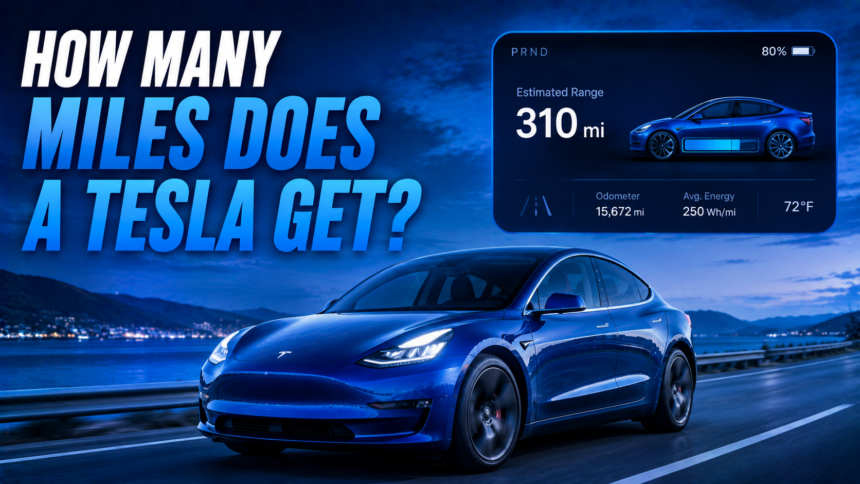
If you’ve been shopping for an electric car, chances are you’ve typed the question “how many miles does a Tesla get?” into a search bar at least once. It’s one of the most common questions new EV buyers ask, and for good reason — range anxiety is still one of the biggest hesitations people have before switching from gas to electric. The good news is that Tesla has spent over a decade refining its battery technology, and today’s lineup offers some of the longest ranges available in the EV market.
- Tesla Range by Model: Quick Overview
- EPA Estimated Range vs Real-World Range
- Factors That Affect Tesla Range
- How to Maximize Your Tesla’s Range
- Charging and Range Replenishment
- Tesla Range Compared to Other EVs
- Battery Degradation and Long-Term Range
- Frequently Asked Questions
- Final Thoughts
- Related Articles
In short, a Tesla can travel anywhere from about 260 miles to over 400 miles on a single charge, depending on which model and trim you choose. But that number isn’t the whole story. Real-world range depends on your driving habits, the weather outside, how fast you drive, and even the size of your wheels. In this guide, we’ll break down exactly how many miles each Tesla model gets, what affects that number, and how you can stretch every charge a little further.
Tesla Range by Model: Quick Overview
Before diving into the details, here’s a snapshot of how far each current Tesla model can travel on a full charge, based on official EPA estimates for the 2026 lineup.
| Tesla Model | Trim | EPA Estimated Range |
|---|---|---|
| Model 3 | Standard RWD | ~321 miles |
| Model 3 | Premium RWD | ~363 miles |
| Model 3 | Premium AWD | ~346 miles |
| Model 3 | Performance | ~309–315 miles |
| Model Y | Standard RWD/AWD | ~327 miles |
| Model Y | Premium (Long Range) AWD | ~357 miles |
| Model Y | Performance | ~306 miles |
| Model S | Standard Dual Motor | ~405–410 miles |
| Model X | Long Range | ~348 miles |
Keep in mind that these numbers can shift slightly depending on wheel size, options, and software updates, so always check the specific configuration you’re considering for the most accurate figure. Tesla has also streamlined parts of its lineup recently, so availability of certain trims like the Model S and Model X can vary by market and time of purchase.
As you can see, the Model S remains the range champion of the Tesla family, while the Model 3 offers the best balance of affordability and efficiency. The Model Y, Tesla’s best-selling vehicle worldwide, sits comfortably in the middle, offering enough range for most daily commutes and the occasional road trip.
EPA Estimated Range vs Real-World Range
One thing that trips up a lot of new EV owners is the gap between the range shown on the window sticker and what they actually see on the road. The EPA range rating is calculated under controlled, ideal conditions — moderate temperatures, steady speeds, and no extreme use of climate control. It’s a useful number for comparing vehicles side by side, but it doesn’t always reflect how you’ll actually drive.
In everyday use, most Tesla owners report seeing somewhere between 80% and 95% of the EPA-rated range, depending on their driving style and the season. Highway driving at higher speeds tends to reduce range more than city driving, since aerodynamic drag increases significantly at faster speeds. Meanwhile, stop-and-go city traffic actually plays to an EV’s strengths, since regenerative braking helps recapture energy that would otherwise be lost.
So when someone asks “how many miles does a Tesla get,” the honest answer is: it depends on how and where you’re driving it. Treat the EPA number as a best-case scenario and plan your trips with a reasonable buffer, especially in extreme weather.
Factors That Affect Tesla Range
Several real-world variables can cause your Tesla’s actual range to differ from the advertised figure. Understanding these factors can help you plan trips more accurately and avoid unexpected surprises.
Driving speed and style play one of the biggest roles. Aggressive acceleration and sustained highway speeds above 70 mph noticeably increase energy consumption. Driving smoothly and maintaining a moderate, consistent speed helps preserve range.
Weather and temperature have a major impact, especially cold weather. Battery chemistry becomes less efficient in low temperatures, and the energy needed to heat the cabin and battery pack itself pulls directly from the same battery that powers the wheels. It’s common to see a 10–30% range reduction in freezing conditions.
Battery age and degradation naturally reduce range slightly over time, though Tesla batteries are generally built to last. Most owners see only modest capacity loss even after covering well over 100,000 miles.
Use of climate control and onboard features like heated seats, defrosters, and infotainment systems all draw power, which can chip away at your available range on shorter trips more noticeably than on longer ones.
Tire type and wheel size matter more than people expect. Larger wheels with lower-profile tires look sportier but typically reduce range compared to smaller, more efficient wheel options.
Cargo weight and towing add strain to the motor and battery. Hauling heavy cargo or towing a trailer (on capable models) can reduce range significantly, sometimes by 30% or more.
Here’s a quick summary list of the main range-reducing factors:
- High-speed highway driving
- Cold weather and battery preconditioning needs
- Heavy use of climate control
- Larger wheels and low-profile tires
- Added cargo weight or towing
- Aggressive acceleration habits
How to Maximize Your Tesla’s Range
If you want to stretch every mile out of a charge, a few simple habits can make a real difference over time.
Driving with a lighter foot and anticipating stops rather than braking hard allows the regenerative braking system to recover more energy. Preconditioning your battery before a trip — especially in cold weather — helps the battery operate at a more efficient temperature from the moment you start driving, rather than wasting energy warming up mid-trip.
Charging habits matter too. Tesla generally recommends keeping your daily charge between 20% and 80% for long-term battery health, only charging to 100% when you’re preparing for a long trip. Software updates can also play a role, as Tesla periodically rolls out efficiency improvements through over-the-air updates that can subtly extend usable range without any hardware changes.
Charging and Range Replenishment
Range isn’t just about how far you can go — it’s also about how quickly you can recharge when you need to. Tesla’s Supercharger network remains one of the fastest and most reliable fast-charging networks available, with many stations capable of adding well over 150 miles of range in about 15 minutes under ideal conditions.
For everyday use, most owners rely on home charging. A standard Level 1 outlet charges very slowly, adding only a few miles of range per hour, which makes it suitable mainly as a backup. A Level 2 home charger, which most Tesla owners install, can fully recharge a depleted battery overnight, making daily range concerns largely a non-issue for typical commuting distances.
Tesla Range Compared to Other EVs
Tesla has historically led the EV industry in range efficiency, and while competitors have closed the gap in recent years, Tesla models still rank among the longest-range electric vehicles on the market. Compared to many rivals in similar price brackets, Tesla vehicles tend to squeeze more real-world miles out of a similarly sized battery pack, largely thanks to years of software optimization and aerodynamic design refinement.
That said, several competitors — including certain trims from Hyundai, Rivian, and other manufacturers — now offer ranges that rival or occasionally exceed Tesla’s own numbers in specific categories. If range is your top priority, it’s worth comparing the exact trim levels of both brands rather than relying on general reputation alone.
Battery Degradation and Long-Term Range
A common concern for prospective buyers is how much range a Tesla loses over the years. According to available ownership data, most Tesla battery packs retain a large majority of their original capacity even after passing well beyond 100,000 miles, with many owners reporting only modest single-digit percentage losses over several years of regular use.
Tesla backs its battery packs with a warranty that covers a set number of years and miles, guaranteeing a minimum percentage of battery capacity during that period. This gives buyers a level of assurance that the range they pay for today won’t disappear prematurely.
Frequently Asked Questions
Which Tesla has the longest range? The Tesla Model S typically holds the title for the longest range in the current lineup, with EPA estimates reaching around 400 miles or more in its standard dual-motor configuration.
Does cold weather really reduce Tesla range that much? Yes. Cold temperatures are one of the biggest factors affecting real-world range, sometimes reducing it by 10–30% due to battery chemistry and cabin heating demands.
How is Tesla’s range calculated? Tesla’s official range figures come from EPA testing procedures, which simulate a mix of city and highway driving under controlled conditions to produce a standardized estimate.
Can software updates improve range? Yes, in some cases. Tesla periodically releases over-the-air software updates that improve energy efficiency, which can subtly extend a vehicle’s usable range over time.
Final Thoughts
So, how many miles does a Tesla get? The answer ranges from roughly 260 miles on the more compact, efficiency-focused trims to well over 400 miles on the longest-range Model S variants. For most everyday drivers, any current Tesla model offers more than enough range to comfortably handle daily commuting, errands, and even the occasional road trip with a bit of charging planned in.
If your priority is affordability and efficiency, the Model 3 remains an excellent choice. If you want maximum interior space with strong range, the Model Y is hard to beat. And if long-distance range is your top priority above all else, the Model S continues to lead the pack. Whichever model you choose, understanding the real-world factors that influence range will help you get the most out of every charge.
Related Articles
What Does Dual Motor Mean on a Tesla? Complete Guide
How Long Can a Honda CR-V Last? Real Mileage & Lifespan Guide