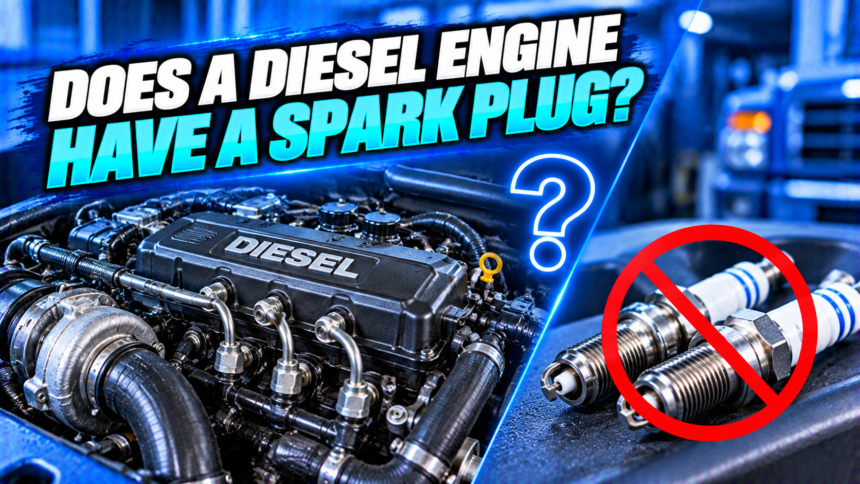
No, a diesel engine does not have a spark plug. Gasoline engines use spark plugs to light their fuel, but a diesel lights its fuel a different way. It squeezes the air inside the cylinder so hard that the air gets hot enough to set the fuel on fire on its own. So if you go looking for a spark plug in a diesel, you will not find one. What you might find instead is a glow plug, which does a related but different job. Here is how it all works, and why the two parts are so easy to mix up.
- Do diesel engines have spark plugs?
- How does a diesel engine light fuel without a spark?
- Why does gasoline need a spark but diesel does not?
- What controls when the fuel burns in a diesel?
- What is a glow plug, and why do diesels have them?
- Glow plug vs spark plug: what is the difference?
- Do all diesel engines have glow plugs?
- What are the signs of a worn glow plug?
- Can you put a spark plug in a diesel engine?
- Conclusion
- Frequently asked questions
- Related Articles
Do diesel engines have spark plugs?
No. Spark plugs belong to gasoline engines, also called petrol engines. A diesel engine has no spark plug anywhere in it, because it never uses an electric spark to start combustion. The part that lights the fuel in a diesel is the hot, highly compressed air inside the cylinder, not a spark. This is the single biggest difference between how the two engine types work, and it shapes almost everything else about them, from how they sound to how they start on a cold morning.
How does a diesel engine light fuel without a spark?
A diesel engine lights its fuel with heat from compression. On the intake stroke the cylinder pulls in plain air, with no fuel mixed in yet. Then the piston pushes up and squeezes that air into a tiny space. Diesel engines use a high compression ratio, usually somewhere between about 14 to 1 and 23 to 1, while a gasoline engine sits closer to 8 to 1 or 12 to 1. Packing the air that tightly makes it very hot, often around 700 to 900 degrees Celsius, which is roughly 1300 to 1650 Fahrenheit.
At that moment the injector sprays a fine mist of diesel into the hot air. Diesel starts to burn at about 210 degrees Celsius, so the air is already far hotter than the fuel needs. The fuel catches fire the instant it meets that air, with no spark involved at all. Engineers call this compression ignition, and the German inventor Rudolf Diesel built the first working engine of this kind in the 1890s. Once a diesel is warm, it can run with no ignition system of any kind, which is one reason these engines are known for lasting a long time.
This setup also explains a few things drivers notice about diesels. Because only air gets compressed, there is no fuel sitting in the cylinder waiting to light too early, so a diesel can squeeze much harder than a petrol engine without trouble. A diesel also does not use a throttle to choke the air the way a gasoline engine does. It pulls in a full load of air every time and controls power by how much fuel is injected. More air and higher compression are a big part of why diesels tend to return better fuel economy and produce strong pulling power at low engine speeds, which suits trucks and towing.
Why does gasoline need a spark but diesel does not?
The answer comes down to the fuel. Gasoline and diesel behave very differently when you heat and squeeze them, and each engine is built around the fuel it burns.
Gasoline is made to resist lighting on its own. Carmakers mix air and gasoline together first, then compress that mixture, and they need it to wait until the spark plug fires at the exact right moment. If gasoline lit early from the heat of compression, the engine would knock and could damage itself. That is what the octane rating on the pump measures: how well the fuel resists lighting under pressure. Because gasoline holds off, it needs a spark to set the timing.
Diesel is the opposite. It is made to light easily under heat and pressure, and its readiness to do so is measured by a number called cetane. A diesel engine takes advantage of this by compressing only air, then adding the fuel at the top, so the fuel lights the instant it arrives. The fuel itself is the reason one engine needs a spark and the other does not.
What controls when the fuel burns in a diesel?
In a gasoline engine, the spark sets the timing. In a diesel, the injector does that job instead. The moment the injector sprays fuel into the hot air is the moment combustion starts, so timing the injection precisely is how a diesel stays smooth and efficient.
Modern diesels use a common rail system that holds fuel at very high pressure and fires it through electronic injectors the computer controls down to fractions of a millisecond. Many split each injection into several tiny bursts per cycle to soften the noise and cut emissions. None of this needs a spark. It only needs hot air and well timed fuel, which is why the injector, not any kind of plug, is the heart of how a diesel runs.
What is a glow plug, and why do diesels have them?
A glow plug is a small electric heater that warms the combustion chamber so a cold diesel will start. It looks a little like a spark plug, which is where much of the confusion starts, but it does not make a spark. It simply gets hot.
Compression ignition needs hot air to work. When the engine and the outside air are both cold, the cold metal of the engine pulls heat out of the compressed air, and there may not be enough heat left to light the fuel cleanly. The glow plug solves this. Turn the key and each glow plug heats up fast, glowing red at well over 1000 degrees Celsius. That extra heat helps the first few sprays of fuel catch, and it keeps the cold engine running smoothly for the first minute or so until it warms up on its own.
On older diesels you had to wait while a light on the dashboard stayed on, sometimes for around 20 seconds, before you could start. Modern glow plugs are much quicker and usually finish their preheating in about 6 to 8 seconds. Many also stay on for a short time after the engine starts, which cuts down on the smoke and rattle a cold diesel can produce.
Glow plug vs spark plug: what is the difference?
The two parts sit in similar spots and look similar, but they do opposite jobs. A spark plug makes a spark, thousands of times a minute, every second the engine runs. A glow plug makes heat, and only for a short stretch around a cold start. Parts makers such as Champion sell them as completely separate products, because a spark plug fits a petrol engine and a glow plug fits a diesel. Here is a side by side view.
| Feature | Spark plug | Glow plug |
| Engine type | Gasoline (petrol) | Diesel |
| Main job | Creates an electric spark to light fuel | Heats the chamber to help cold starting |
| When it works | Constantly, the whole time the engine runs | Briefly, mainly before and just after a cold start |
| Starts combustion? | Yes, it triggers every ignition | No, compression does that |
| Needed to keep engine running? | Yes | No, it only helps with starting |
The pattern is simple. A spark plug is part of how a gasoline engine runs at every moment. A glow plug is only a starting aid for a diesel, and the engine does not need it once things warm up.
Do all diesel engines have glow plugs?
No. Glow plugs are common on smaller diesels, like the ones in cars and light trucks, but plenty of diesel engines skip them. Bigger engines, such as those in heavy trucks, boats, and generators, often use a different cold start helper called an intake air heater or a flame start system, which warms the air on its way into the engine instead of heating each chamber. Some direct injection diesels in warm climates start fine with no heater at all.
Where glow plugs are used, there is normally one per cylinder, so a four cylinder diesel has four glow plugs and a six cylinder has six. Either way, a diesel with no glow plug is perfectly normal, and it still has no spark plug either. The glow plug, when it is there, is about starting, never about keeping the engine going.
What are the signs of a worn glow plug?
Since glow plugs are the ignition-related part diesel owners actually deal with, it helps to know when one is failing. The clearest sign is hard starting in cold weather, often with the engine cranking longer than usual before it catches. You might also see white or grey smoke at startup that clears once the engine warms, or a rough, shaky idle for the first minute.
On many vehicles a glow plug warning light on the dashboard will flash or stay lit when the system has a fault. Glow plugs wear out slowly over tens of thousands of miles, and they are usually replaced as a set rather than one at a time. None of this ever involves a spark plug, because there simply is not one to check.
Can you put a spark plug in a diesel engine?
No, a spark plug will not work in a diesel engine, and there is nowhere proper to fit one. A diesel has no ignition coil to feed a spark plug the high voltage it needs, and no timing system to fire it. The whole engine is built around compression rather than a timed spark. Diesel fuel also does not vaporize and light the easy way gasoline does, so even a spark sitting in the chamber would not run the engine the way hot compressed air does. The two systems are designed from the ground up to work in completely different ways, which is why you cannot swap one part for the other.
There is a small upside for diesel owners in all this. Because a diesel has no spark plugs, there are no spark plugs to change on it, ever. Glow plugs can wear out and may need replacing, but they are not a routine tune up item the way spark plugs are on a gasoline car. That difference alone saves diesel owners a job that petrol owners have to plan for.
Conclusion
A diesel engine has no spark plug. It lights its fuel by squeezing air until the air is hot enough to ignite diesel the moment it is sprayed in, which is why no spark is needed. Many diesels carry glow plugs instead, but those are just heaters that help a cold engine start, not igniters. If you are buying parts or chasing a no start, look for glow plugs on a diesel and save the spark plugs for the gasoline engine.
Frequently asked questions
Do diesel trucks have spark plugs?
No. Diesel trucks have no spark plugs. Most use glow plugs or an intake air heater to help with cold starts, while the fuel itself is lit by compression heat, not a spark.
What do diesel engines use instead of spark plugs?
They use compression. The piston squeezes air until it reaches roughly 700 to 900 degrees Celsius, then fuel is sprayed in and lights on its own. Glow plugs only add heat for cold starting.
Are glow plugs the same as spark plugs?
No. A glow plug heats the chamber to help a cold diesel start, then switches off. A spark plug makes a spark to light fuel in a gasoline engine every time it fires.
How many spark plugs does a diesel engine have?
Zero. A diesel has no spark plugs at all. If it uses glow plugs, there is usually one per cylinder, so a four cylinder diesel has four glow plugs.
Can a diesel engine run without glow plugs?
Yes. Once warm, a diesel runs on compression alone. Glow plugs mainly help cold starting, which is why some warm climate and larger engines use other heaters or none.
Related Articles
How Often Should Spark Plugs Be Changed?
How Much Oil to Put in Your Car: Quarts by Engine?