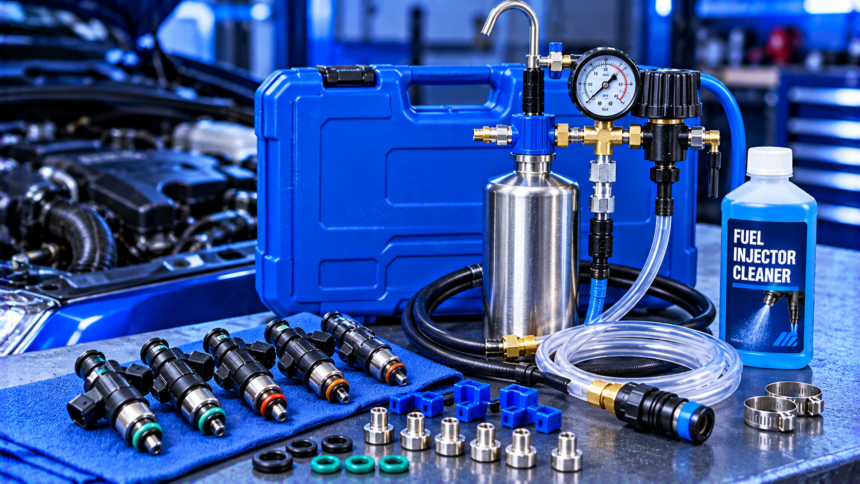
A fuel injector cleaning kit is a set of cleaning solution, and usually the hoses and adapters to apply it, that clears gunk out of your injectors so they spray fuel in a clean, even pattern again. Some kits are just a bottle you pour into the gas tank. Others connect straight to the engine and push cleaner through the injectors under pressure. Both aim to do the same thing: restore a strong, misted spray and get smooth running back. Here is how each type works, what causes the clog in the first place, how to use a kit safely, and how to pick the right one for your car.
- What a fuel injector cleaning kit actually does
- What makes fuel injectors clog
- Signs your injectors need cleaning
- The main types of fuel injector cleaning kits
- How to use a pressurized fuel injector cleaning kit
- How to use an in-tank cleaner
- Do fuel injector cleaning kits really work?
- How to choose a kit and how often to use one
- Conclusion
- Frequently asked questions
- Related Articles
What a fuel injector cleaning kit actually does
Fuel injectors are small electronic valves that spray a fine mist of fuel into your engine. Each one opens and closes thousands of times a minute, and the fuel has to come out as an even, finely broken-up mist so it mixes with air and burns fully. When the spray is right, the engine runs smooth and uses every drop of fuel well.
Over thousands of miles, carbon and a sticky varnish build up on the injector tips and slowly narrow the tiny spray holes. When those holes clog, the spray turns from a soft mist into a weak dribble or an off-center stream. The engine then gets too little fuel, or fuel that does not burn cleanly, and you feel it as a rough idle or a loss of power.
A cleaning kit sends a strong detergent through the injector to dissolve that buildup and open the holes back up. The cleaning agent is doing the real work. The best in-tank cleaners use a detergent called PEA (polyether amine), which can break down baked-on deposits that lighter solvents just slide past. Pressurized kits use a concentrated version of the same idea, run through the injectors directly instead of diluted in a full tank of gas.
What makes fuel injectors clog
Deposits form from normal use, so some buildup is expected on any engine. Gasoline leaves a light residue every time the engine shuts off and heat bakes the last bit of fuel onto the hot injector tip. Short trips make it worse, because the engine rarely gets hot enough for long enough to burn deposits off.
Cheap, low-detergent gas speeds the process up, and so does letting the car sit for long stretches with old fuel in the tank. Knowing this helps you keep injectors clean between treatments: better fuel and longer drives do more for the long run than any single cleaning.
Signs your injectors need cleaning
The clearest signs are a rough idle, hesitation when you press the gas, worse fuel economy, and hard starts. You might also feel a slight shudder at a stop light, notice the engine stumble on acceleration, or see a check engine light with a misfire code.
Each of these traces back to the same cause. A clogged injector delivers an uneven amount of fuel, so one cylinder runs lean while the rest run normally, and that imbalance shows up as a shake or a stumble. Poor mileage follows because the engine’s computer adds extra fuel to make up for the bad spray.
Here is the catch: these same symptoms can come from dirty spark plugs, a clogged fuel filter, or a weak fuel pump. So a cleaning kit is a smart, cheap first step when the car feels down on power, but it is not a guaranteed fix for every rough-running engine. If a cleaning does not help, the problem is likely somewhere else, and it is worth checking those parts before spending more.
The main types of fuel injector cleaning kits
There are three ways to clean injectors, and the right one depends on how clogged they are and how much work you want to do.
| Type | What it is | Effort | Rough cost | Best for |
| In-tank cleaner | A bottle of detergent you pour into the gas tank | Very low | $8 to $20 | Regular upkeep and light buildup |
| Pressurized rail kit | Cleaner fed straight to the fuel rail under pressure | Medium (DIY) | $30 to $80 plus compressor | Moderate to heavy buildup |
| Removal and ultrasonic | Injectors taken out, cleaned in a bath, then flow-tested | High (usually a shop) | Shop pricing | Badly clogged or failing injectors |
In-tank cleaners are the easiest and the most common starting point. You pour the bottle in before a fill-up and drive as normal, and the detergent cleans the injectors and intake valves as the fuel burns. They work best as regular upkeep and for light buildup, and they ask nothing of you beyond opening a bottle.
Pressurized kits skip the tank and feed concentrated cleaner straight to the fuel rail, so the injectors run on pure cleaner for several minutes. That hits heavier deposits a diluted bottle cannot reach, which makes these kits the right call when the car already feels rough rather than just due for maintenance. They take more effort and an air compressor, but they give a deeper clean in one session.
Full removal with an ultrasonic bath is the deepest clean and is usually a shop job. Each injector comes out, gets cleaned in a vibrating cleaning bath, and is flow-tested so you know it sprays evenly again. This is the route for an injector that is badly clogged, or when you want proof that each one is working before replacing it.
How to use a pressurized fuel injector cleaning kit
A pressurized kit runs the engine on cleaner alone while the normal fuel supply is shut off. The job takes about 30 to 45 minutes and needs an air compressor. Work on a cold engine in a well-ventilated spot, keep a fire extinguisher nearby, and wear gloves and eye protection, because you are working with fuel and flammable cleaner.
- Fill the kit’s canister with the amount of cleaner the instructions call for, then hang it from the hood with the hook provided.
- Find and pull the fuel pump relay (your owner’s manual shows its spot) so the pump stops sending gas from the tank.
- Connect the kit’s hose to the fuel rail test port. If your car does not have one, some kits include an adapter that ties into the fuel line.
- Attach your air compressor to the canister’s air inlet, then set the pressure to a few pounds below your engine’s normal fuel rail pressure.
- Start the engine. It now runs on the cleaner alone. Let it run until the canister empties, which can take up to 10 minutes, and it will stall on its own when the cleaner is gone.
- Turn the key off, release the air pressure, and disconnect both the air hose and the fuel rail hose.
- Reinstall the fuel pump relay, start the engine again, and let it idle for a minute so normal fuel flow returns and any roughness clears.
Some light smoke from the exhaust during the process is normal, since the cleaner burns differently from gas and is pushing loosened deposits out. After the job, a short drive helps the engine settle back into its normal fuel delivery.
Safety first: never do this near a flame or spark, keep the area ventilated, and let the engine cool before you start. You are running the engine on flammable cleaner with the fuel pump disabled, so take it slowly and double-check every connection.
If you cannot find the fuel pump relay or a test port on your fuel rail, stop there. Some modern engines, especially direct injection setups, do not offer an easy connection point, and forcing it can cause more harm than the clean is worth. An in-tank cleaner is the safer choice on those cars.
How to use an in-tank cleaner
In-tank cleaners could not be simpler, which is why they are the default for most drivers. Pour the full bottle into your tank just before you fill up with gas, so the fuel mixes the cleaner evenly, then drive normally. The detergent works over that whole tank, cleaning the injectors as the engine burns through it.
Use the dose on the label for your tank size, and do not double up thinking more is better. One treatment per tank is the right amount, and you simply repeat it on a schedule rather than all at once.
Do fuel injector cleaning kits really work?
Yes, for mild to moderate buildup. On engines with port fuel injection, where the injector sprays into the intake, a quality cleaner reliably restores spray quality and smooths out running. Many cars that idle rough or lose a little mileage respond well to a couple of treatments, and the improvement usually shows up within a tank or two rather than instantly.
There are limits worth being honest about. A cleaner cannot repair an injector that has failed electrically or is clogged solid, and it will not undo mechanical wear or fix a problem that was never the injectors to begin with. On gasoline direct injection (GDI) engines, in-tank cleaners help the injectors but reach the intake valves poorly, since fuel never washes over those valves, so heavy valve carbon on a GDI engine often needs a separate intake cleaning.
A fair way to think about it: a kit is a low-cost tune-up and a cheap test, not a rebuild. If a kit does not improve things after two uses, the injector likely needs removal, a flow test, or replacement, and continuing to pour in cleaner will not change that.
How to choose a kit and how often to use one
Match the kit to your engine and your symptoms. For routine upkeep or a mild rough idle, a good in-tank cleaner is enough, and the key is the detergent: look for PEA on the label rather than a cheap carrier solvent. Chevron Techron and similar PEA-based cleaners are the common strong picks, and CRC’s fuel injector cleaner is another widely sold option. For a stubborn case, or if you are comfortable working under the hood, a pressurized kit gives a deeper clean, but check that it comes with the adapter that fits your car’s fuel rail test port before you buy.
Make sure the product matches your fuel. Gasoline and diesel injector cleaners are not interchangeable, and a few are labeled safe for GDI engines specifically, so read the bottle. Running the right fuel also keeps injectors cleaner in the first place: gas that meets the Top Tier detergent standard carries extra additives that slow deposits from forming, which means fewer cleanings over the life of the car.
For frequency, a simple rule works well. Use an in-tank cleaner every oil change, or roughly every 3,000 to 5,000 miles, as cheap insurance against new buildup. Save a pressurized clean for once a year, or for when you actually notice a rough idle, weak throttle, or a dip in mileage. There is no gain in doing a full pressurized service more often than that, and a steady light-maintenance habit beats occasional deep cleans.
Conclusion
A fuel injector cleaning kit restores a clean fuel spray and smooth running, and for most cars it is a cheap fix worth trying before deeper repairs. Reach for an in-tank PEA cleaner for upkeep or a light rough idle, and step up to a pressurized kit for heavier buildup. A good result is a smoother idle, crisper throttle, and steady fuel economy. If two treatments change nothing, the injector likely needs testing or replacement, not more cleaner.
Frequently asked questions
Can I clean fuel injectors without removing them?
Yes. An in-tank cleaner cleans them as you drive, and a pressurized kit cleans them in place by feeding cleaner to the fuel rail. You only need to remove injectors for an ultrasonic clean or a flow test.
How much does a fuel injector cleaning kit cost?
In-tank cleaner bottles usually run about 8 to 20 dollars. A DIY pressurized kit typically costs around 30 to 80 dollars, plus you need an air compressor. A professional service at a shop costs more than either.
Will a cleaning kit fix a clogged injector?
It can clear mild to moderate deposits, but it cannot repair an injector that has failed electrically or is clogged solid. If two treatments do not help, the injector likely needs a flow test or replacement.
Are in-tank cleaners as good as pressurized kits?
For routine upkeep and light buildup, yes. Pressurized kits clean harder because the injectors run on concentrated cleaner instead of cleaner diluted in a full tank, so they handle heavier deposits better.
Can I use a fuel injector cleaning kit on a direct injection (GDI) engine?
Use a cleaner labeled safe for GDI. It will clean the injectors, but it reaches the intake valves poorly on these engines, so heavy valve carbon on a GDI engine usually needs a separate intake cleaning.
Related Articles
Does a Diesel Engine Have a Spark Plug?
How Long Can a Car Sit Before the Battery Dies?