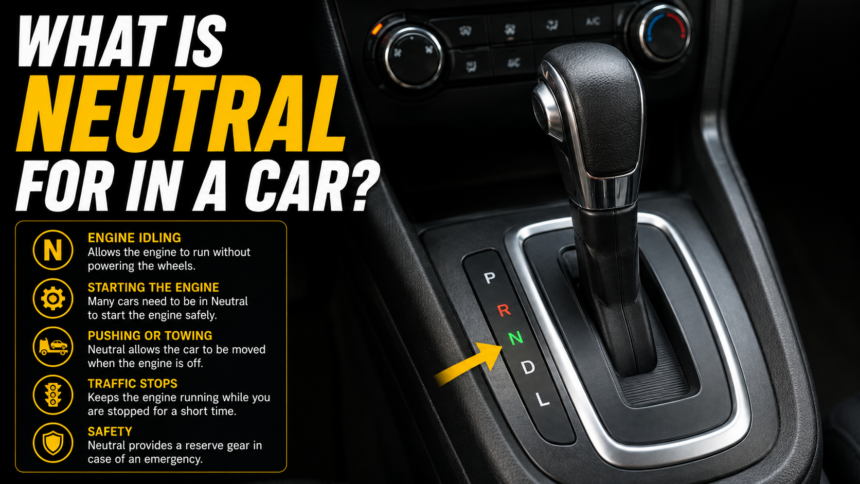
Neutral is the gear position that disconnects your engine from your wheels, letting the car roll freely without any power reaching the transmission. Every driver eventually asks what is neutral for in a car, because it looks simple but plays a real role in how your vehicle starts, idles, and moves.
- The Basics of Car Gears
- How Neutral Works Mechanically?
- Disconnecting the Engine from the Wheels
- Neutral in Manual Transmission Cars
- Neutral in Automatic Transmission Cars
- The Role of the Clutch and Torque Converter
- Main Purposes of Neutral Gear
- Allowing the Car to Roll Freely
- Reducing Engine Load While Idling
- Starting the Engine Safely
- Preventing Unwanted Movement in Certain Situations
- When Should You Use Neutral?
- At Traffic Lights and Stop Signs
- While Towing the Vehicle
- During Roadside Assistance or Pushing the Car
- Parking on a Flat Surface with Caution
- Warming Up the Engine
- When You Should NOT Use Neutral?
- While Driving Downhill
- On Slopes or Inclines Without the Handbrake
- During Normal Driving for Fuel Saving
- Neutral vs Park: What’s the Difference?
- Common Myths About Neutral Gear
- Safety Tips When Using Neutral
- Neutral in Automatic vs Manual Cars: A Comparison
- Conclusion
- Frequently Asked Questions
- Can I shift to neutral while driving?
- Does neutral damage the transmission?
- Is neutral necessary for automatic cars?
- Related Articles
This guide breaks down the mechanics behind neutral, the right and wrong times to use it, and how it compares to Park. By the end, you will understand not just what neutral does, but why using it correctly can protect your transmission and keep you safer on the road.
The Basics of Car Gears
Every car uses a set of gear positions to control how power flows from the engine to the wheels. Neutral sits among these positions as the one gear that sends no power anywhere at all.
What Are Gears in a Vehicle?
Gears are mechanical settings that control the amount of power and speed sent from the engine to the wheels. Each gear changes how the engine’s rotation is converted into wheel movement, which is why a car behaves differently in first gear compared to fifth gear.
Without gears, an engine would either stall under load or spin too fast to be usable for normal driving.
Common Gear Positions
Most vehicles rely on a handful of standard positions, and understanding each one makes it easier to see where neutral fits.
| Gear | Function |
| Park (P) | Locks the transmission so the car cannot roll |
| Reverse (R) | Moves the car backward |
| Neutral (N) | Disconnects engine power from the wheels |
| Drive (D) | Moves the car forward under normal power |
| Low (L) | Provides extra power at lower speeds, often for hills |
Where Neutral Fits Among the Gears
Neutral is unique because it is the only position that sends zero power to the wheels while the engine keeps running. This makes it different from Park, which physically locks the transmission, and different from Drive or Reverse, which actively move the car.
Neutral essentially puts the car in a resting state where the engine idles but nothing else happens.
How Neutral Works Mechanically?
Underneath the gear lever, neutral works by breaking the mechanical connection between the engine and the transmission. The exact method differs slightly between manual and automatic cars, though the outcome is the same.
Disconnecting the Engine from the Wheels
In every transmission type, neutral opens a gap in the power path so the engine’s rotation never reaches the wheels. The engine continues to run and burn fuel, but none of that energy is transferred outward. This is why a car in neutral can be pushed by hand even while the engine is turned on.
Neutral in Manual Transmission Cars
In a manual car, neutral is a physical position between the gear slots where none of the gear teeth are engaged. Pressing the clutch already separates the engine from the transmission, and neutral keeps that separation even after the clutch is released. Drivers often rest in neutral at long stoplights to avoid holding the clutch down continuously.
Neutral in Automatic Transmission Cars
Automatic transmissions use a torque converter instead of a clutch, and neutral here disengages the internal gear sets so no fluid pressure drives the wheels.
The car will not creep forward the way it does in Drive, since there is no power transfer happening. This makes neutral useful when an automatic car needs to be towed or pushed a short distance.
The Role of the Clutch and Torque Converter
The clutch in a manual car and the torque converter in an automatic car both act as the link between engine and transmission. Neutral effectively cancels that link out, regardless of which system the car uses.
Understanding this connection helps explain why neutral feels the same to a driver even though the internal parts are completely different.
Main Purposes of Neutral Gear
Neutral serves a handful of very practical purposes rather than being just an unused middle setting. Each use case relates to letting the car move freely or reducing strain on the drivetrain.
Allowing the Car to Roll Freely
Because neutral removes the connection between engine and wheels, the car can roll in either direction without resistance from the transmission.
This is exactly why neutral is used when a vehicle needs to be pushed, towed, or moved manually in a garage or driveway. Without neutral, moving a car without starting the engine would be far more difficult.
Reducing Engine Load While Idling
Sitting in Drive with your foot on the brake still keeps a slight load on the transmission, even though the car is not moving. Neutral removes that load entirely, letting the engine idle in the lightest possible state. Some drivers prefer neutral at long stops for this reason, especially in older automatic vehicles.
Starting the Engine Safely
Many manual cars require the driver to confirm the car is in neutral before the engine will start, as a safety measure against sudden unwanted movement. This prevents the vehicle from lurching forward or backward the moment the engine turns over. It is a built-in safeguard tied directly to how neutral disconnects power.
Preventing Unwanted Movement in Certain Situations
While Park is the primary gear for preventing movement in automatic cars, neutral combined with a handbrake serves a similar purpose during maintenance or roadside work.
Mechanics often ask for neutral so they can rotate wheels or check components without engine power interfering. This makes neutral a practical tool beyond everyday driving.
When Should You Use Neutral?
Neutral has specific moments where it makes sense, mostly tied to stopping, towing, or engine care rather than active driving.
At Traffic Lights and Stop Signs
Manual drivers commonly shift to neutral at longer stops to rest their leg instead of holding the clutch pedal down. This reduces unnecessary wear on the clutch mechanism over time. It is a small habit that adds up to less strain across the life of the car.
While Towing the Vehicle
Neutral is essential when a car is being towed, since it allows the wheels to turn freely without fighting against the transmission. Towing a car that is left in Park or Drive can cause serious internal damage. Always confirming neutral before a tow protects the drivetrain.
During Roadside Assistance or Pushing the Car
If a car needs to be pushed out of a parking spot or moved a short distance after a breakdown, neutral makes this possible without straining the engine. Anyone attempting this should still use the handbrake carefully to control speed. This use case is one of the most practical everyday examples of what neutral is for.
Parking on a Flat Surface with Caution
Some drivers use neutral briefly on a flat surface, though this should always be paired with the handbrake for safety. Without the handbrake, a car left in neutral can roll unexpectedly even on a surface that looks level. This makes caution essential whenever neutral is used outside of active driving.
Warming Up the Engine
In colder climates, some drivers let the engine warm up briefly in neutral before shifting into gear. This lets the oil circulate and the engine reach a stable idle without any load from the transmission. It is a minor habit, though modern engines generally warm up fine in Park as well.
When You Should NOT Use Neutral?
Just as important as knowing when to use neutral is knowing when it should be avoided, since misuse can affect both safety and fuel efficiency.
While Driving Downhill
Coasting in neutral downhill is a common but risky habit, since it removes engine braking and reduces the driver’s control over speed. Many older drivers believed this saved fuel, but modern fuel-injected engines make this unnecessary and unsafe. Staying in gear downhill keeps the car more predictable.
On Slopes or Inclines Without the Handbrake
Leaving a car in neutral on any incline without the handbrake engaged is dangerous, since nothing is holding the vehicle in place. Even a slight slope can cause the car to start rolling within seconds. This is one of the most important safety rules tied to neutral gear.
During Normal Driving for Fuel Saving
Shifting into neutral while driving to save fuel does not work the way many drivers assume, since modern engines already cut fuel delivery when coasting in gear. Doing this also removes engine braking, making the car harder to control in traffic. This myth is one of the most persistent misunderstandings about neutral.
Neutral vs Park: What’s the Difference?
Neutral and Park are often confused since both feel similar when a car is stationary, but their internal function is very different.
Key Differences Explained
Park physically locks a pin inside the transmission so the car cannot move at all, while neutral simply removes power without locking anything. This is why a car in Park will not roll even on a slope, while a car in neutral can roll freely. The two are not interchangeable despite feeling similar to a driver.
Which One Locks the Wheels
Only Park includes a locking mechanism, since neutral was never designed to hold a car in place. This is why manuals for towing always specify neutral rather than Park, as Park’s lock would damage the transmission during towing. Recognizing this difference prevents costly mistakes.
When to Use Each One
Park should be used whenever the car is left unattended or parked for any length of time, while neutral is reserved for towing, pushing, or brief idling moments. Mixing up these uses, such as leaving a car in neutral overnight, removes the safety of the parking lock entirely. Knowing the distinction keeps both the car and its surroundings safer.
Common Myths About Neutral Gear
Neutral is surrounded by a few persistent myths that many drivers still believe, mostly related to fuel savings and safety.
Neutral Saves Fuel
This myth suggests that idling in neutral or coasting in neutral burns less fuel, but modern engines with fuel cutoff technology make this false in most driving situations. In many cases, staying in gear actually uses less fuel since the engine briefly stops injecting fuel while coasting. This makes the fuel-saving myth outdated for most current vehicles.
It’s Safer to Coast in Neutral
Some drivers believe coasting in neutral gives more control, when in reality it removes engine braking and slows reaction time in emergencies. Staying in gear allows the engine itself to help slow the car naturally. This makes coasting in neutral a habit worth avoiding rather than relying on.
Other Misconceptions Drivers Believe
A few drivers also assume neutral protects the transmission during every stop, though this is only true in specific situations like long idling, not constant shifting at every red light. Constantly shifting in and out of neutral can add unnecessary wear of its own. Understanding the real purpose of neutral prevents these small but common mistakes.
Safety Tips When Using Neutral
Using neutral safely comes down to a few consistent habits that apply across manual and automatic cars alike.
Always Use the Handbrake
Whenever neutral is used outside of active driving, the handbrake should always be engaged to prevent rolling. This single habit avoids the majority of accidents linked to neutral misuse. It should become automatic every time neutral is selected while stationary.
Avoid Neutral on Busy Roads
Shifting to neutral while moving through traffic reduces control and reaction time, making it unsafe on busy roads. Staying in gear keeps the engine connected and ready to respond immediately. This is especially important in stop-and-go traffic where quick reactions matter most.
Precautions During Towing
Before towing any vehicle, confirming neutral and checking the owner’s manual prevents transmission damage during the process. Some four-wheel drive vehicles have additional steps beyond simple neutral engagement. Skipping this check is one of the most common causes of tow-related transmission damage.
Neutral in Automatic vs Manual Cars: A Comparison
Comparing neutral across transmission types highlights how the same gear position can feel different depending on the car.
Similarities
In both manual and automatic cars, neutral disconnects the engine from the wheels and allows the car to roll freely. The core purpose remains identical regardless of transmission type. This consistency is why the answer to what is neutral for in a car stays the same across vehicle types.
Differences in Function and Use
Manual cars rely on the clutch and physical gear positioning, while automatic cars use internal gear sets controlled without a clutch pedal.
Automatic drivers rarely use neutral during daily driving, while manual drivers use it more frequently at stops. These small differences shape how often each type of driver interacts with neutral.
Conclusion
Neutral plays a focused but important role in how a car operates, from allowing safe towing to reducing load during idle moments. Understanding what neutral is for in a car helps drivers avoid common myths, use it safely, and know exactly when Park should be used instead. With the right habits, neutral becomes a small but useful part of everyday driving.
Frequently Asked Questions
Can I shift to neutral while driving?
Yes, though it removes engine braking and is not recommended during normal driving, especially at higher speeds.
Does neutral damage the transmission?
Neutral itself does not damage the transmission, but constantly shifting in and out of it unnecessarily can add extra wear over time.
Is neutral necessary for automatic cars?
Yes, automatic cars still need neutral for towing, pushing, and certain maintenance situations, even though it is used less often during daily driving.
Related Articles
What Does DTE Mean in a Car? Full Meaning & Guide
Can Spark Plugs Cause a Car to Not Start?