Not always. A turbocharged engine needs the octane grade specified by its manufacturer. Some turbo engines require premium gasoline, while others are designed to run on regular fuel. Using the recommended fuel helps maintain engine performance, improve efficiency, and prevent problems such as engine knocking. Always check your owner’s manual to determine which gasoline is best for your vehicle.
- Does every turbo engine need premium gas?
- What does premium gas do for a turbo engine?
- What is the difference between premium required and premium recommended?
- What happens if you use regular gas in a turbo car?
- Can premium gas improve performance or fuel economy?
- How can you find the correct fuel for your car?
- What should you do after using the wrong fuel?
- Why the exact engine matters
- Conclusion
- Frequently asked questions
- Can I use regular gas in a turbocharged engine?
- Does premium gas make a turbo engine last longer?
- Will premium gas give my turbo car more horsepower?
- What happens if I accidentally put regular gas in a car that requires premium?
- Is premium gas better for every turbo engine?
- Related Articles
Does every turbo engine need premium gas?
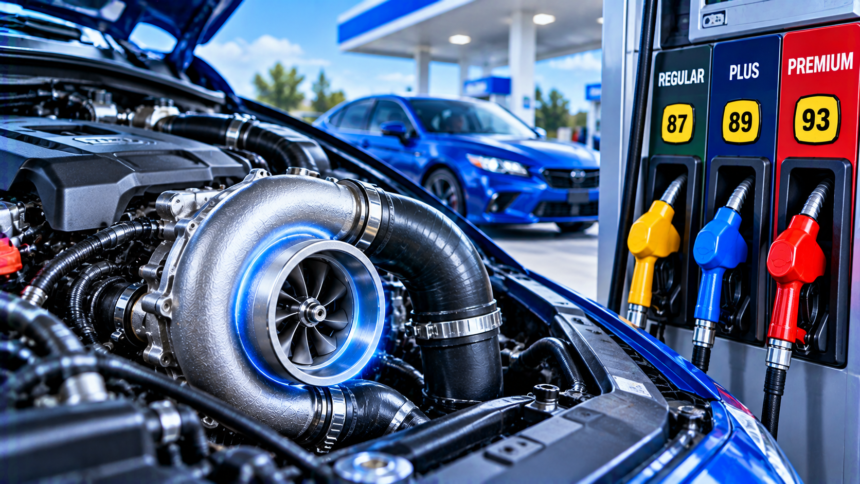
No, a turbo engine does not automatically require premium gas. The correct fuel depends on the engine’s design and the automaker’s specified octane rating. Some turbocharged engines are built to run on regular gasoline, some recommend premium for best performance, and others require premium to meet their intended output and operating limits.
A turbocharger pushes more air into the engine, allowing it to make more power from a given engine size. That extra air can raise pressure and temperature inside the cylinders, which can make the fuel-air mixture more likely to knock. Engineers account for this when they design and tune the engine, so two vehicles with turbochargers can have different fuel needs.
For example, Chevrolet’s owner information for certain Equinox engines distinguishes between a 1.5-liter turbo that uses regular 87-octane fuel and a 2.0-liter turbo for which premium 93-octane fuel is recommended for best performance and economy. Subaru manuals for some turbo models specify premium fuel at 91 AKI or higher. These examples show why the word “turbo” alone cannot tell you what to put in the tank.
The safest rule is simple: follow the fuel grade listed in your owner’s manual or on the label inside the fuel door. Do not assume premium is mandatory just because the vehicle has a turbocharger, and do not assume regular is safe if the manufacturer requires a higher octane rating.
What does premium gas do for a turbo engine?
Premium gasoline has a higher octane rating than regular gasoline. Octane measures a fuel’s resistance to engine knock, an abnormal combustion event that can sound like a metallic ping and can become harmful when severe or persistent.
The octane number does not tell you how much energy the gasoline contains, and premium fuel is not automatically more powerful in every engine. Its main job is to resist knock under the pressure and heat an engine creates. That resistance matters in some turbo engines because boost increases the amount of air entering the cylinders.
If an engine is designed or calibrated to take advantage of higher-octane fuel, premium may let it use more suitable ignition timing or boost while producing its intended power. If the engine is designed for regular fuel, it may gain little or nothing from premium. Paying for a higher grade does not guarantee more horsepower, better mileage, or a cleaner engine.
Premium is therefore useful when the engine’s design calls for it, not simply because it costs more. Use the grade the manufacturer specifies for the exact engine and model year.
What is the difference between premium required and premium recommended?
“Premium required” and “premium recommended” are not the same instruction. Required means you should use fuel that meets the stated minimum octane rating. Recommended usually means the engine can operate on a lower grade that the manual permits, but premium may help it deliver its best performance or fuel economy.
The wording can vary. A manual might say “premium unleaded only,” give a minimum rating such as 91 AKI, or state that premium is recommended for best performance. Read the full fuel section rather than relying on a dashboard label or a general description of the car.
| Fuel instruction | What it means for you |
| Premium required / premium only | Use the specified premium grade. Do not make regular fuel your routine choice. |
| Premium recommended | Use premium for intended performance, but check whether the manual permits regular. |
| Regular unleaded specified | Use regular at or above the stated minimum. Premium may offer no meaningful benefit. |
| Minimum octane rating listed | Meet or exceed that number using the rating system specified in your market. |
In the United States, pump labels generally use AKI, shown as (R+M)/2. Many other countries use RON. The numbers are not directly interchangeable, so compare the rating system in your manual with the rating printed at the pump. If you are unsure, ask the dealer or manufacturer to confirm the correct local fuel grade.
What happens if you use regular gas in a turbo car?
The result depends on whether regular gasoline meets the car’s minimum requirement. If the engine is designed for regular fuel, using it is normal and should not cause a problem. If premium is only recommended, regular may be allowed, but the car could deliver less power or respond differently under heavy acceleration.
When a vehicle detects knock, its engine computer can often adjust ignition timing and, in some designs, boost. These changes help control combustion, but they can also reduce performance. Fuel economy may fall under some driving conditions because the engine is no longer operating at its most efficient settings.
If premium is required, repeatedly using lower-octane fuel can increase the risk of knock, especially when accelerating hard, climbing hills, towing, or driving in high heat. Electronic controls provide protection, but they are not a reason to ignore the fuel specification. Fuel that is below the stated minimum can cause poor running and, in severe conditions, engine damage.
A single accidental fill with regular fuel does not automatically mean the engine has been damaged. Avoid hard acceleration and heavy loads until you can refill with the correct grade, and consult the owner’s manual for model-specific advice. If the engine makes a strong, persistent knocking sound, loses power, or displays a warning light, stop driving when it is safe and contact a qualified mechanic.
Can premium gas improve performance or fuel economy?
Premium gas can improve performance in a turbo engine when the manufacturer has designed the engine to benefit from it. The change may be noticeable during hard acceleration or under heavy load. In other engines, premium may make no measurable difference because the engine’s controls and design are intended for regular gasoline.
Fuel economy is also vehicle-specific. A premium-rated engine may run more effectively on the recommended grade, and using a lower grade that the manual permits may reduce efficiency in some situations. But any mileage gain must be compared with the extra price per gallon. A small improvement in miles per gallon does not necessarily cover the higher fuel cost.
To judge the real cost, compare your own fuel use over several similar tanks. Keep your driving route, tire pressure, load, and driving style as consistent as possible. Calculate cost per mile, not just the number of miles per gallon. If the owner’s manual says regular is acceptable and your results do not show a meaningful improvement with premium, buying the higher grade may not be worth it.
Do not use premium as a repair for rough running, poor mileage, or a check-engine light. Those symptoms can come from worn spark plugs, intake leaks, fuel-system issues, sensors, or other faults that need diagnosis.
How can you find the correct fuel for your car?
You can usually confirm the correct gasoline in a few minutes. Check the following sources in this order:
- 1. Look inside the fuel door. Many vehicles have a label stating the required or recommended octane rating.
- 2. Read the owner’s manual. Find the fuel or specifications section. Make sure the information matches your model year, engine, and trim.
- 3. Check the manufacturer’s official website. Digital manuals and vehicle-specific support pages can help if the printed manual is missing.
- 4. Ask a dealer or qualified service shop. Provide the vehicle identification number (VIN) and engine details if the fuel wording is unclear.
For a useful official example, the Chevrolet owner’s manual library lets owners find information for their vehicle. Mazda’s official owner’s manual site is another place to locate vehicle-specific instructions. Always use the manual for your exact vehicle rather than copying the fuel requirement from a different engine in the same model range.
If you drive an imported vehicle, pay attention to the octane measurement system. A rating printed as RON may look higher than an AKI number even when the fuels are similar in knock resistance. Ask the manufacturer or importer which locally available fuel meets the engine’s stated requirement.
What should you do after using the wrong fuel?
If you put regular gasoline in a car that only recommends premium, first check the manual to confirm whether regular is permitted. If it is, drive normally while paying attention to unusual noise or changes in performance, and return to the recommended grade if you want the engine’s best output.
If the manual says premium is required, avoid hard acceleration, high engine loads, and towing until you can use the specified fuel. Check the manual for instructions about accidental use of lower-octane gasoline. Do not add random fuel additives in an attempt to raise octane unless the automaker explicitly approves the product.
If you hear heavy knocking, experience a sudden loss of power, or see a warning light, pull over when safe and get professional advice. Do not keep pushing the engine to see if the noise disappears. If you are unsure how serious the mistake is, contact the dealer or a mechanic and tell them the vehicle, the fuel grade used, and roughly how much was added.
The next fill-up does not always correct the mixture immediately, because some of the lower-octane fuel remains in the tank. Follow the vehicle-specific advice rather than relying on a fixed number of miles or assuming that topping up with premium instantly restores the intended octane.
Also pay attention to the fuel label used in your country. In the United States, gasoline is commonly marked with AKI, while many other markets display RON. A US manual that asks for 91 AKI should not be matched to a pump showing the same number in RON without checking the conversion. If fuel availability differs where the vehicle is driven, confirm the acceptable local grade with the automaker or its authorized dealer.
Driving conditions can affect how clearly you notice a difference. Hot weather, steep grades, carrying a full load, towing, and repeated hard acceleration put more demand on an engine. When the manufacturer recommends premium for best performance, those conditions may make the benefit easier to feel. They do not, however, change the minimum fuel requirement printed in the manual.
A model name by itself may not be enough to identify the right fuel. One trim can use a small turbo engine designed around regular gasoline, while a higher-output version of the same vehicle may use a different turbo, compression ratio, or engine calibration. The recommended octane can also change between model years, so advice for a friend’s car may not apply to yours.
Why the exact engine matters
Conclusion
A turbo engine does not always require premium gas. Some are designed for regular gasoline, while others require or recommend a higher octane grade to control knock and deliver their intended performance. Check the fuel-door label and the owner’s manual for your exact model and engine. If premium is required, use it; if it is only recommended, follow the manual’s guidance on acceptable alternatives. That simple check is more reliable than judging fuel needs by the presence of a turbocharger alone.
Frequently asked questions
Can I use regular gas in a turbocharged engine?
Yes, if the manufacturer specifies regular fuel or says regular is an acceptable alternative. If premium is required, do not use regular as your routine fuel. Check the manual for your exact engine and model year.
Does premium gas make a turbo engine last longer?
Not automatically. The important thing is using fuel that meets the manufacturer’s minimum octane requirement. Premium can help an engine designed for it avoid knock, but it does not replace proper maintenance.
Will premium gas give my turbo car more horsepower?
Only if the engine is designed to take advantage of the higher octane. Some turbo engines may make more power on premium, while others show little or no benefit.
What happens if I accidentally put regular gas in a car that requires premium?
Avoid hard acceleration and heavy loads, then follow the owner’s manual’s advice. If you hear heavy knocking or notice warning lights or major power loss, stop when safe and contact a mechanic.
Is premium gas better for every turbo engine?
No. Premium is beneficial when the engine requires it or is calibrated to benefit from it. If the manufacturer specifies regular gasoline, buying premium usually offers little or no advantage.
Related Articles
Does a Turbo Improve Fuel Economy?
How Long Do Power Steering Pumps Last?
How Long Does a Car Wrap Last?
Steering Wheel Wrap: Types, Cost, and How to Fit One Yourself