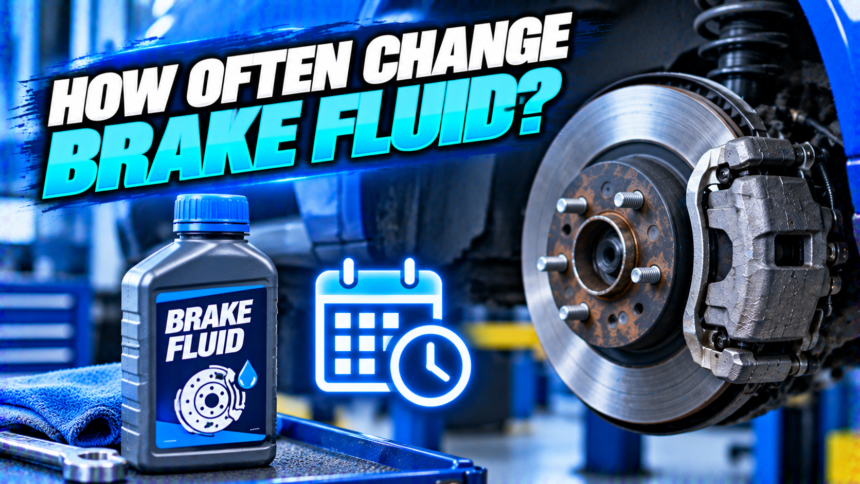
Most cars need their brake fluid changed every two years, no matter how many miles they cover. Some makers set it by distance instead, often somewhere between 20,000 and 45,000 miles, and a few ask you to test the fluid rather than swap it on a fixed date. The safest answer for your car is in the owner’s manual, but two years is a solid rule of thumb if you have nothing else to go on.
- How often should you change brake fluid?
- Why brake fluid needs changing?
- Time or miles: which matters more?
- What your car’s schedule says?
- Signs your brake fluid is due for a change
- How to check your brake fluid at home?
- When to change it sooner?
- Do newer cars and EVs need it less often?
- Brake fluid types and how they change the interval
- Topping up vs a full flush
- Conclusion
- Frequently asked questions
- Related Articles
Brake fluid does a quiet but critical job. It carries the force from your foot to the brakes at each wheel, and it has to stay firm under heat and pressure to do that. Over time it picks up water and breaks down, and that is when stopping power starts to slip. Here is how to know when yours is due, what happens if you leave it too long, and how to check it yourself.
How often should you change brake fluid?
For most cars running the usual DOT 3 or DOT 4 fluid, plan on a change every two years or about 30,000 miles, whichever comes first. That single line covers the majority of daily drivers.
The interval is mostly about time, not mileage. Brake fluid ages even if the car sits in the garage, because it slowly draws in moisture from the air whether you drive or not. A car that covers 5,000 miles a year still needs the same two-year change as one that covers 20,000.
Your manual may list a different number, and it wins. Read that first, since the schedule below explains why the figures move around so much.
Why brake fluid needs changing?
Brake fluid goes bad because it absorbs water. The glycol-based fluids in almost every car (DOT 3, DOT 4, and DOT 5.1) are hygroscopic, which is a fancy way of saying they pull moisture out of the air. Water sneaks in through tiny pores in the rubber hoses, past seals, and every time the reservoir cap comes off.
That water is a problem because of heat. When you brake hard, especially down a long hill or in stop-and-go traffic, the fluid near the brakes gets very hot. Fresh fluid can take it: dry DOT 4 boils at about 446 degrees Fahrenheit (230 Celsius). But water boils at just 212 degrees Fahrenheit (100 Celsius), so even a small amount drags the whole mix down. Once about 3 percent of the fluid is water, it is near the point where it can boil right inside the lines.
When brake fluid boils, it turns to vapor, and vapor squashes down under pressure in a way that liquid does not. Your pedal sinks toward the floor and the brakes stop biting. This is called brake fade, and it tends to show up at the worst moment, under heavy braking.
Water causes a second, slower problem too. It rusts the steel lines and metal parts inside the brake system from the inside out, which can lead to leaks and pricey repairs down the road. A fluid change clears out both the water and the grime that builds up with age.
You often feel the result before you ever see it. Braking gets a little vaguer as the fluid weakens, and the switch back to a firm, reassuring pedal after a fresh flush is usually easy to notice.
Time or miles: which matters more?
Time matters more than miles for brake fluid. Because the fluid absorbs water from the air on its own, the clock keeps ticking even when the odometer does not.
Within about two years of normal driving, the water content creeps toward that 3 percent zone where the fluid loses its edge. That is why so many intervals land on two years flat, with a mileage figure attached only as a backstop for people who drive a lot. If your manual lists both a time and a mileage, act on whichever one you reach first.
What your car’s schedule says?
Carmakers set their own intervals, and they vary more than you might expect. As a rough map of the range:
- Every 2 years, any mileage: the most common recommendation across brands.
- By mileage: some list 20,000 to 45,000 miles instead of, or alongside, a time limit.
- Severe service: many cut the interval to yearly for towing, heavy stop-and-go, or dusty and humid conditions.
- Inspect, do not replace: a few makers ask you to test the fluid’s condition at each service rather than change it on a set date.
Your owner’s manual has the exact number for your make, model, and year, usually in the maintenance schedule near the back. It also tells you which fluid type your car takes, which you should match exactly when it is time for fresh fluid.
Signs your brake fluid is due for a change
The clearest signs are how the fluid looks and how the pedal feels. You do not need any tools for the first check.
Fresh brake fluid is clear to light gold, a bit like cooking oil. As it ages and takes on water and debris, it darkens:
- Clear or light amber: healthy, recently changed.
- Golden brown: aging, worth testing.
- Dark brown or black: overdue, change it.
- Cloudy or milky: water has gotten in, change it now.
Pay attention to the pedal too. A brake pedal that feels soft, spongy, or sinks slowly toward the floor can point to old fluid or moisture in the lines. Longer stopping distances, a pedal that goes soft after repeated hard stops, or a burnt smell after a steep descent are all worth acting on. If your brake warning light comes on, get the system checked, since a low reservoir can mean a leak or badly worn pads as well.
How to check your brake fluid at home?
You can get a good read on your brake fluid in about five minutes:
- Park on level ground and let the engine cool, then pop the hood.
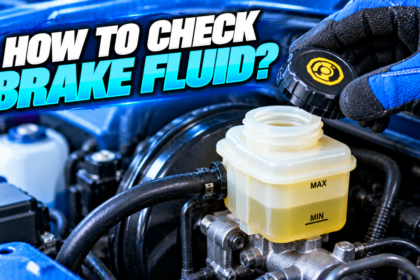
- Find the brake fluid reservoir. It is a small see-through tank near the back of the engine bay on the driver’s side, usually marked with a brake symbol on the cap.
- Check the level against the MIN and MAX lines on the side. A level near or below MIN can mean worn pads or a leak, both worth a closer look.
- Look at the color through the plastic. Light and clear is good, dark and murky is not.
- For a real moisture reading, use brake fluid test strips or an electronic tester. Dip the strip in, wait a few seconds, and match the color to the chart to read the water percentage. Testers give you a quick digital number instead.
Keep the reservoir cap off for as little time as you can while you look, since the fluid starts pulling in moisture the moment it meets open air. If the fluid is dark, the pedal feels off, or a test shows 3 percent water or more, book a change. Checking at every oil change is a good habit, so nothing sneaks up on you.
When to change it sooner?
Hard use ages brake fluid faster, so the two-year rule shortens under certain conditions. Change it earlier if you:
- Tow trailers or haul heavy loads often.
- Sit in stop-and-go traffic every day, which heats the brakes over and over.
- Live somewhere hot and humid, where moisture gets in faster.
- Drive mountain roads or long downgrades, which cook the fluid.
- Take your car to track days, where the brakes see extreme heat.
In any of these cases, checking yearly and changing the fluid when it tests high on water is the safe play.
Do newer cars and EVs need it less often?
The two-year guideline holds up well for newer cars, even ones with anti-lock brakes and stability control. Those systems add extra valves and a pump, and weak, dirty fluid can gum them up, so keeping the fluid fresh matters just as much on a modern car as an old one.
Electric and hybrid cars are a slight twist. They lean on regenerative braking, which slows the car with the motor and spares the friction brakes, so the fluid sees less heat. It still absorbs water from the air on the same timeline, though, so plan on roughly the same two to three years and follow the manual.
Brake fluid types and how they change the interval
The fluid type sets how much heat it can take and, to a point, how it ages. Match the DOT rating your manual lists. You can go up a grade (DOT 4 in place of DOT 3) but never down.
| Type | Dry boiling point | Wet boiling point | Notes |
| DOT 3 | 401 F (205 C) | 284 F (140 C) | Common in older and everyday cars; absorbs water fastest |
| DOT 4 | 446 F (230 C) | 311 F (155 C) | Standard on most modern cars; higher heat tolerance |
| DOT 5.1 | 500 F (260 C) | 356 F (180 C) | Glycol-based, for performance and heavy-duty use |
| DOT 5 | 500 F (260 C) | 356 F (180 C) | Silicone, does not absorb water; rare, not for most cars |
The dry number is fresh fluid; the wet number is fluid that has taken on about 3 percent water, which is roughly where two-year-old fluid sits. You can see the boiling point drop sharply once water gets in, which is the whole reason for the change. These grades and their standard DOT boiling-point ratings come from a federal standard, so a bottle marked DOT 4 meets the same limits whatever the brand. DOT 5 silicone fluid is the odd one out: it does not absorb water, but it is not a drop-in swap for most street cars, so stick with what your manual calls for.
Topping up vs a full flush
Adding fluid to the reservoir is not the same as changing it. Topping up just raises the level; the old, water-heavy fluid is still sitting in the lines doing the work. It can also hide a real problem, since a dropping level often means worn brake pads (the fluid falls as the caliper pistons extend) or a slow leak.
A proper change, sometimes called a brake flush, pushes all the old fluid out through each wheel and replaces it with fresh fluid. That is what actually restores the boiling point and clears the moisture. On cars with ABS, a full flush sometimes needs a scan tool to cycle the pump and clear the fluid trapped in that unit, which is one reason many owners hand this job to a shop. If your level is low, find out why before you simply fill it back up.
Conclusion
Change your brake fluid about every two years, or on the mileage your owner’s manual lists, and sooner if you tow, crawl through traffic, or drive hard hills. The fluid slowly absorbs water, which lowers its boiling point and can cause a soft pedal or fading brakes right when you need them. Check the color at every oil change, test for moisture if it looks dark, and get a full flush rather than a top-up. Fresh fluid means a firm pedal and brakes you can trust.
Frequently asked questions
Can I change brake fluid myself?
You can, but it takes two people or a one-person bleeder kit, and air has to be kept out of the lines. If you are unsure, a shop can flush it in under an hour. Getting air into the system is the main risk of doing it wrong.
What happens if I never change my brake fluid?
Old fluid absorbs water, which lowers its boiling point and rusts the metal parts inside. Over time you get a soft pedal, longer stops, brake fade under heat, and possible leaks or costly repairs.
How much does a brake fluid change cost?
A brake fluid flush usually runs about $80 to $150 at a shop, depending on the car and fluid type. Doing it yourself costs the price of fluid, roughly $10 to $20, plus a bleeder kit.
Does brake fluid go bad if the car just sits?
Yes. Brake fluid pulls in moisture from the air whether you drive or not, so a car that sits still needs its fluid changed on time, roughly every two years.
Is a brake fluid flush the same as a brake fluid change?
In practice, yes. A flush pushes all the old fluid out and replaces it with new, which is what a proper change does. Topping up the reservoir is not the same thing.
Related Articles
Do You Need to Bleed Brakes When Changing Pads?
How Long Will 4mm Brake Pads Last?