



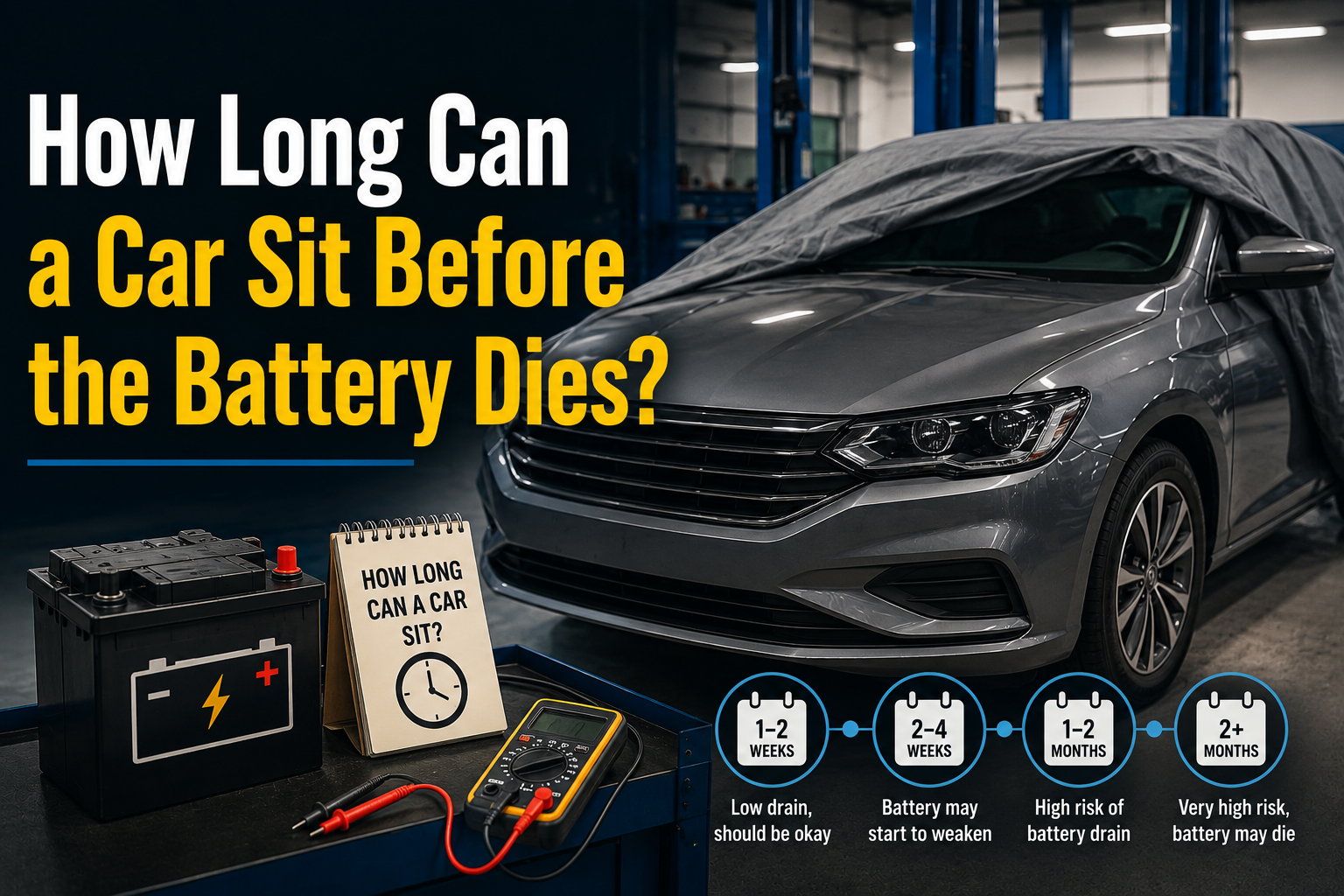
Two to four weeks is the realistic answer for most cars. A healthy battery in a modern car can sit roughly two weeks in winter and up to a month or two in mild weather before it lacks the power to start the engine.
- Why a parked car drains its battery
- The math that gives you a real answer
- Why the car dies sooner than the math suggests
- How weather changes the answer
- What actually kills the battery for good
- How to make a car sit longer safely
- Signs your battery is on the edge
- Conclusion
- Frequently asked questions
- Can a car battery die in two weeks?
- Does starting the car once a week keep the battery charged?
- Should I disconnect my battery if the car will sit for a month?
- How long can a new car battery sit unused?
- Can a battery be ruined by sitting too long?
- Related Articles
That range is wide because the answer depends on arithmetic you can actually do yourself. Your car draws a known amount of current while parked, your battery holds a known amount of energy, and the rest is division. Here is how to work out your own number, and what to do if you need the car to sit longer.
Why a parked car drains its battery
A switched-off car is not switched off. It is asleep, and sleeping still costs energy.
The clock keeps time. The alarm watches the doors. The receiver listens for your key fob. The engine computer holds its settings in memory. Each of these draws a trickle of current, and together they add up to what is called parasitic draw or key-off drain.
On a healthy modern car that draw is typically 20 to 50 milliamps. Cars loaded with memory seats, satellite radio, and connected services often sit closer to 85 milliamps, which is still considered normal by many manufacturers. Anything above 100 milliamps points to a fault.
There is a second, slower loss on top of that. Lead-acid batteries self-discharge through internal chemical reactions even with nothing connected at all, losing a few percent of their charge per month. Disconnecting the battery stops the parasitic draw but not this.
Modern cars complicate this in one more way. Many do not go to sleep the moment you walk away. Control modules stay awake for a shutdown sequence that can run 20 minutes or longer, and some wake periodically to check systems or connect to a mobile network. A car with connected services, remote start, or a built-in modem can pull noticeably more than the figures above while parked, which is why newer vehicles often go flat faster than the older car they replaced.
If you want your own number rather than an average, it takes a multimeter and about fifteen minutes. Set it to measure current, disconnect the negative battery cable, and connect the meter between the cable and the terminal so all the car’s current flows through it. Then wait for the car to finish going to sleep before trusting the reading, because the first few minutes will show a much higher figure than the true resting draw. Under 50 milliamps is healthy, up to 85 is common on a well-equipped car, and anything over 100 is worth investigating.
The math that gives you a real answer
You can calculate your own timeline with two numbers, and it takes about a minute.
Car batteries are rated in amp-hours (Ah), a measure of how much energy they hold. A typical car battery is 50 to 60 Ah. Multiply your parasitic draw in amps by 24 to get the daily loss, then divide the battery capacity by that figure.
A 60 Ah battery with a 50 milliamp draw loses 1.2 Ah per day, which works out to about 50 days to empty. The same battery with an 85 milliamp draw loses roughly 2 Ah per day, giving about 30 days. A 50 Ah battery with that same 85 milliamp draw is flat in just over three weeks.
| Parasitic draw | Daily loss | Days to fully drain a 60 Ah battery |
| 25 mA (low) | 0.6 Ah | About 100 days |
| 50 mA (typical) | 1.2 Ah | About 50 days |
| 85 mA (high but common) | 2.0 Ah | About 30 days |
| 150 mA (fault) | 3.6 Ah | About 17 days |
| 500 mA (bad fault) | 12 Ah | About 5 days |
Those numbers describe a full drain. Your car stops starting well before that point, which is the detail that trips people up.
Why the car dies sooner than the math suggests
Starting an engine takes a violent burst of current, several hundred amps for a couple of seconds. A battery at half charge often cannot deliver it.
That means the practical deadline is not when the battery reaches empty. It is when the battery drops below roughly 50 percent, which happens in about half the time your calculation suggests. A 60 Ah battery with a 50 milliamp draw may take 50 days to flatten completely, but it can fail to start the car somewhere around day 25.
Battery age moves that line further forward. A battery holds less charge every year, and one that is three to five years old has meaningfully less capacity than its rating. If your battery is near the end of its life, halve your estimate again.
The honest planning rule: take your calculated number, cut it in half, and treat that as your deadline.
How weather changes the answer
Cold weather is where estimates fall apart, and it does damage from both directions at once.
A lead-acid battery delivers only about 50 to 65 percent of its rated cranking power at 0°F, because the cold slows the chemical reactions inside it. At the same moment, cold engine oil thickens, so the starter needs considerably more current to turn the engine over. Less supply, more demand, same morning.
This is why a car that sat happily for a month in October fails after ten days in January. The battery did not necessarily lose more charge. It simply has less usable power available and a harder job to do.
Heat is the quieter problem. High temperatures speed up self-discharge and permanently shorten battery life, so a car parked in summer sun loses charge faster than one in a cool garage, even though it usually still starts.
Rough guidance by season:
- Mild weather, healthy battery: three to four weeks is usually safe.
- Freezing weather: plan for two weeks, less if the battery is over three years old.
- Extreme heat: two to three weeks, and expect the battery’s overall lifespan to suffer.
What actually kills the battery for good
Leaving a battery flat is worse than letting it run down, and the damage is permanent.
When a lead-acid battery sits below about 12.4 volts, lead sulfate crystals start forming on the plates. This is called sulfation. Early on it reverses with a proper charge. Left long enough, the crystals harden and become part of the plate, permanently reducing how much charge the battery can hold.
That is the real cost of a car sitting too long. You are not just facing an inconvenient jump start. A battery left flat for weeks can come back with a fraction of its original capacity, and one left flat for months often cannot be recovered at all.
There is also a freezing risk. A fully charged battery survives well below zero, but a discharged one can freeze at around 20°F, which cracks the case and ends the battery immediately.
How to make a car sit longer safely
Three options, in order of how well they work.
A battery maintainer is the right answer. Also called a trickle charger or tender, it plugs into a wall socket and holds the battery at full charge indefinitely, switching itself off when full. It prevents sulfation entirely and costs less than a single replacement battery. If your car regularly sits for weeks, buy one.
Disconnecting the negative terminal is the next best thing if no power outlet is available. It stops the parasitic draw completely, though self-discharge continues, so the battery still needs checking every month or so. Expect to reset your clock and radio presets afterward, and be aware some cars need a relearn period.
Driving it is the weakest option, and only works if you do it properly. A 20 to 30 minute drive at road speed every week or two lets the alternator replace what was lost. Starting the car and letting it idle for ten minutes is worse than useless, because starting costs more energy than a brief idle puts back.
Before storing a car, charge the battery fully first. A battery parked at 80 percent has already given up part of its buffer.
Signs your battery is on the edge
Watch for these when you come back to a car that has been sitting:
- The engine cranks slowly before catching
- Dashboard lights dim noticeably while cranking
- The key fob works but the car clicks instead of turning over
- Resting voltage reads below 12.4 volts on a multimeter
- The car starts after a jump but fails again the next morning
That last one matters. If a battery cannot hold a charge overnight after a jump, it has lost capacity and needs replacing rather than recharging.
Conclusion
Most cars can sit two to four weeks before the battery is too weak to start them, and cold weather or an older battery cuts that closer to one or two. Work out your own limit from your car’s parasitic draw and battery size, then halve it for safety. If the car needs to sit longer than that, a battery maintainer solves the problem permanently for the price of a tank of fuel.
Frequently asked questions
Can a car battery die in two weeks?
Yes, especially in freezing weather or with a battery over three years old. Two weeks is around the point where a car with a high parasitic draw or a weakened battery starts struggling to crank.
Does starting the car once a week keep the battery charged?
Not reliably. Starting the engine uses a large amount of current, and a brief idle does not replace it. Drive for 20 to 30 minutes at road speed instead, or use a battery maintainer.
Should I disconnect my battery if the car will sit for a month?
It helps if you have no access to a power outlet, since it stops the parasitic draw entirely. A battery maintainer is better because it also counters self-discharge and keeps the battery at full charge.
How long can a new car battery sit unused?
A new, fully charged battery in a car with normal parasitic draw can typically manage four to eight weeks in mild conditions. Cold weather roughly halves that, and the car may stop starting well before the battery is empty.
Can a battery be ruined by sitting too long?
Yes. Sitting below about 12.4 volts causes sulfation, which permanently reduces capacity. A battery left flat for several months often cannot be recovered and needs replacing.
Related Articles
How Much Oil to Put in Your Car: Quarts by Engine?
How Many Engine Mounts Does a Car Have?
Do Hybrid Cars Need Oil Changes? Intervals Explained