


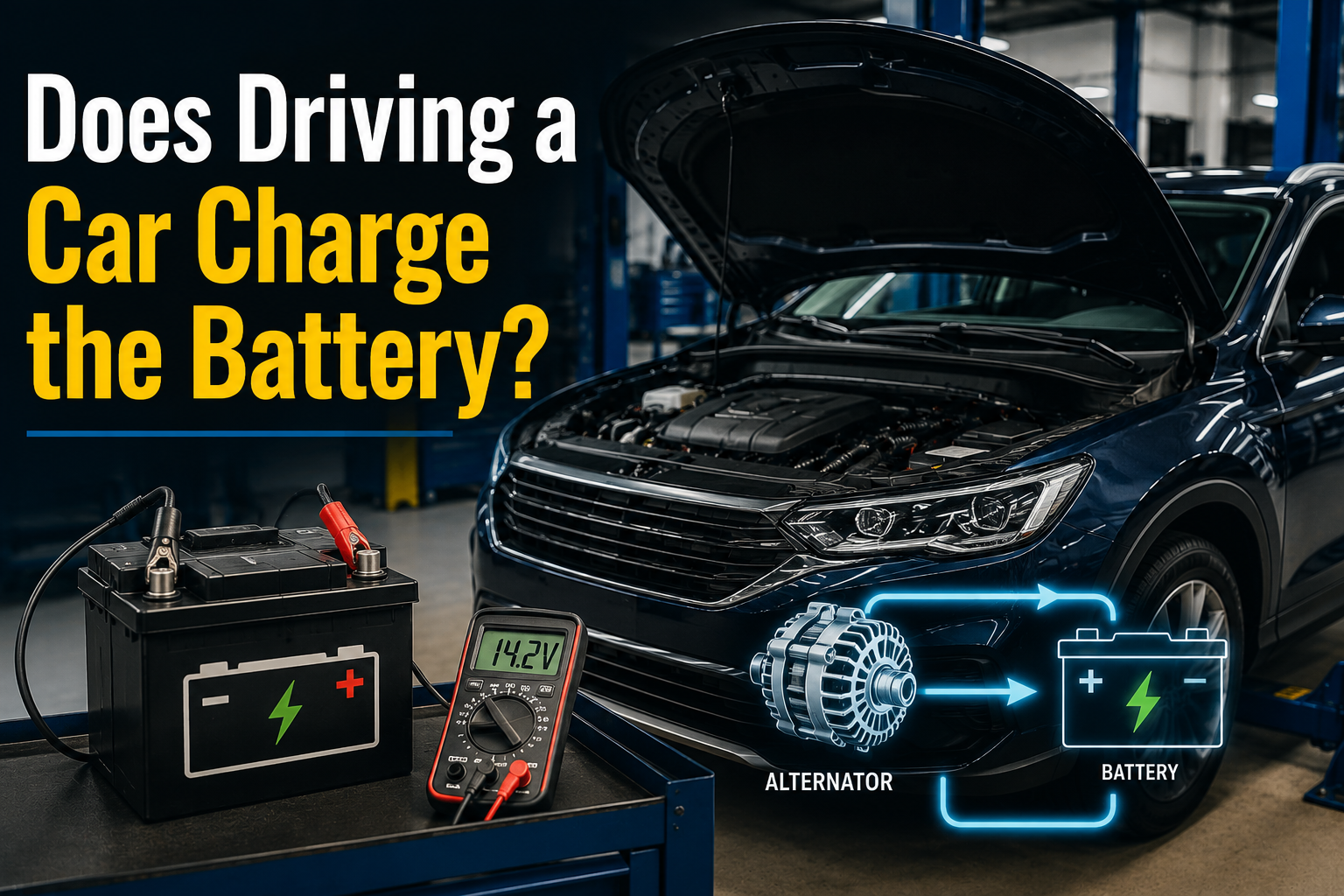
Yes, driving charges your car battery. The alternator turns engine motion into electricity and sends some of it back to the battery. But it charges far more slowly than most drivers expect, and it will never bring a battery to 100 percent.
- How your car charges its own battery
- How long does it take to charge a car battery by driving?
- Why idling barely helps
- The modern complication: smart charging
- Why short trips kill batteries
- When driving will not fix it
- What actually charges a battery properly
- Conclusion
- Frequently asked questions
- How long should I drive after a jump start?
- Does revving the engine charge the battery faster?
- Can a completely dead battery be recharged by driving?
- How often should I drive to keep my battery healthy?
- Why does my battery keep dying even though I drive daily?
- Related Articles
That gap between what people expect and what actually happens is where dead batteries come from. Here is how the charging works, how long it really takes, and when driving will not fix your problem at all.
How your car charges its own battery
The battery has one main job: deliver a huge burst of current to start the engine. After that, it mostly steps aside. The alternator takes over.
An alternator is a small generator bolted to the engine and spun by the serpentine belt. As the engine turns, it produces electricity that runs everything electrical in the car, the headlights, the infotainment screen, the fuel pump, the dozens of control modules. Whatever is left over goes back into the battery.
That last part matters. The battery gets the leftovers, not the priority. If your electrical load is high, there are fewer leftovers to go around.
It helps to see the scale of the competition. A typical alternator produces somewhere between 100 and 150 amps at full output, but it rarely runs at full output. Heated seats, a rear defroster, headlights, the climate fan, and a bright infotainment screen can together pull a large share of that on a cold night. What reaches the battery is whatever survives the queue, which on a dark winter commute with everything switched on can be very little.
This is also why the advice to turn things off while recovering a battery is not superstition. Every amp you are not spending on the heated rear window is an amp available to the battery.
You can see the system working with a cheap multimeter. With the engine off, a healthy battery reads about 12.6 volts. Start the engine and that should climb to somewhere between 13.7 and 14.7 volts. That rise is the alternator pushing current in. If the number never climbs above 13.5, the charging system is not doing its job.
How long does it take to charge a car battery by driving?
Longer than you think. Charging a significantly drained battery to near full takes roughly four to eight hours of continuous highway driving, and even then it stops short of 100 percent.
Eight hours at 65 mph is about 520 miles. That is a full day of road tripping to recover one battery, and the result is closer to 75 or 80 percent than full.
The reason is physics. As a lead-acid battery fills, it accepts current more and more reluctantly, so pushing it the last stretch takes voltage high enough to damage the car’s electronics. The alternator is designed to stop well before that point.
Here is what different driving does:
| What you are doing | Effect on the battery |
| Idling in the driveway | Almost none. Low engine speed means the alternator barely produces spare current |
| Ten minutes of city driving | Roughly break-even. May not even replace what starting the engine cost |
| 30 minutes at highway speed | A useful top-up for a healthy battery, not a fix for a drained one |
| Four to eight hours highway | Gets a drained battery to about 75 to 80 percent |
The “drive it for 30 minutes and it will be fine” advice is the single most repeated thing about car batteries, and it comes from a much older generation of cars with far fewer electronics. A modern car runs heated seats, screens, cameras, and a hundred control modules off that same alternator. The math has changed.
Why idling barely helps
Idling is close to useless for charging, and it can leave you worse off.
At idle the engine turns somewhere around 600 to 800 rpm. Alternators need roughly 1,000 rpm before they start sending meaningful current to the battery, and they do not reach full output until about 2,500 rpm. Below that, the alternator produces just enough to keep the car’s own electronics alive.
Now add the air conditioning, the headlights, and the stereo. Those loads can exceed what the alternator makes at idle, which means the shortfall comes out of the battery. Sit there long enough and you are draining it, not filling it.
If you are trying to recover a battery, moving at highway speed does far more than sitting still ever will.
The modern complication: smart charging
Here is the part that surprises people who know how older cars worked. Many cars built in the last decade or so deliberately stop charging the battery even when everything is working perfectly.
These systems use a sensor on the battery’s negative terminal to track voltage, current, and temperature. The car’s computer uses that to estimate how full the battery is, then adjusts the alternator to match. When the battery is healthy and near full, the system can drop the charging voltage to around 12.4 volts, which stops charging almost entirely.
Why do that on purpose? Spinning an alternator takes engine power, and engine power costs fuel. By backing off when charging is not needed, the car saves fuel and lowers emissions. Better still, it holds the battery around 80 percent so there is room to capture energy during braking and deceleration, when the engine is slowing the car anyway and the electricity is essentially free.
If you put a multimeter on a modern car and watch the voltage swing between roughly 12.3 and 14.8 volts as you drive, that is the system working correctly, not a fault.
The practical takeaway: on a newer car, the alternator is deliberately keeping the battery partly empty. That is fine for daily driving, but it means an occasional top-up from a proper charger is more useful than it used to be.
Why short trips kill batteries
Short trips are the most common reason a battery dies early, and the mechanism is simple arithmetic.
Starting the engine takes a large amount of current. After that, the alternator has to put that energy back before you arrive. On a 10-minute drive to the shops, it often does not manage it. You shut off slightly down. Next trip, slightly down again. Repeat for months and the battery spends its whole life partially discharged.
That state causes real damage. Lead sulfate crystals build up on the plates in a process called sulfation, and they permanently reduce how much charge the battery can hold. A battery treated this way can fail years earlier than it should.
Parked cars have the opposite problem. Even switched off, a modern car draws a small current for the clock, alarm, and keyless entry, typically 50 to 80 milliamps. That is enough to flatten a battery in a few weeks of sitting.
Two habits fix most of this:
- Take one longer drive a week. Twenty to thirty minutes at steady highway speed gives the alternator time to actually get ahead.
- Use a battery maintainer if the car sits. A small plug-in charger holds the battery topped up for pennies and prevents sulfation entirely.
When driving will not fix it
Sometimes no amount of driving helps, and recognising that saves you a breakdown.
If your car needed a jump start, the battery was deeply discharged, and deep discharge causes permanent damage. Driving afterward might get you through the week, but the battery has lost capacity it will not get back. If it struggles to start the next morning after a long drive, it is finished.
Watch for these signs that the problem is not just a low charge:
- The engine cranks slowly even after a long drive
- Headlights dim noticeably at idle, then brighten when you rev
- The battery or charging warning light comes on while driving
- Resting voltage sits below 12.4 volts after a full day of driving
- The battery is more than four or five years old
A failing alternator produces the same symptoms as a failing battery, which is why guessing is expensive. Most auto parts shops will test both for free in a few minutes. Get the test before you buy anything.
What actually charges a battery properly
A plug-in battery charger. That is the honest answer, and it is not close.
A smart charger delivers a controlled multi-stage charge designed for the battery’s chemistry, and it will take a battery to a genuine 100 percent, which your alternator structurally cannot do. AutoZone’s charging guide covers the same ground for specific vehicles. Expect 10 to 24 hours for a full charge on a decent unit. That sounds slow next to a drive, but it is the difference between full and 80 percent, and it is far cheaper than 500 miles of fuel.
For a car that sits for weeks, a maintainer left connected is the simplest way to make a battery last its full life.
Conclusion
Driving charges your battery, but treat it as maintenance rather than a cure. A healthy battery stays healthy with regular drives of twenty minutes or more at road speed. A drained one needs a plug-in charger, because the alternator will never finish the job. If your car needed a jump, get the battery and charging system tested rather than hoping another drive sorts it out.
Frequently asked questions
How long should I drive after a jump start?
Drive at least 30 minutes at highway speed, and expect that to be a partial recovery rather than a fix. If the car struggles to start the next morning, the battery has lost capacity and needs testing or replacing.
Does revving the engine charge the battery faster?
Somewhat. Alternator output rises with engine speed and peaks around 2,500 rpm, so revving beats idling. Actually driving is better still, because you get sustained higher engine speed rather than brief bursts.
Can a completely dead battery be recharged by driving?
Usually not. If it was flat enough to need a jump, it has taken permanent damage and the alternator cannot deliver a full charge anyway. Use a proper charger, then have the battery tested.
How often should I drive to keep my battery healthy?
At least once a week, for twenty minutes or more at steady road speed. If the car sits longer than that regularly, connect a battery maintainer instead of relying on occasional drives.
Why does my battery keep dying even though I drive daily?
Short trips are the usual cause, since starting costs more energy than a brief drive replaces. Other culprits are an old battery, a parasitic drain above about 80 milliamps, or a failing alternator. A free charging system test will identify which.
Related Articles
What to Put Under Tires When Storing a Car?
How to Tell If Your Car AC Compressor Is Bad?
How Much Oil to Put in Your Car: Quarts by Engine?
How Many Engine Mounts Does a Car Have?
How Long Can a Car Sit Before the Battery Dies?