


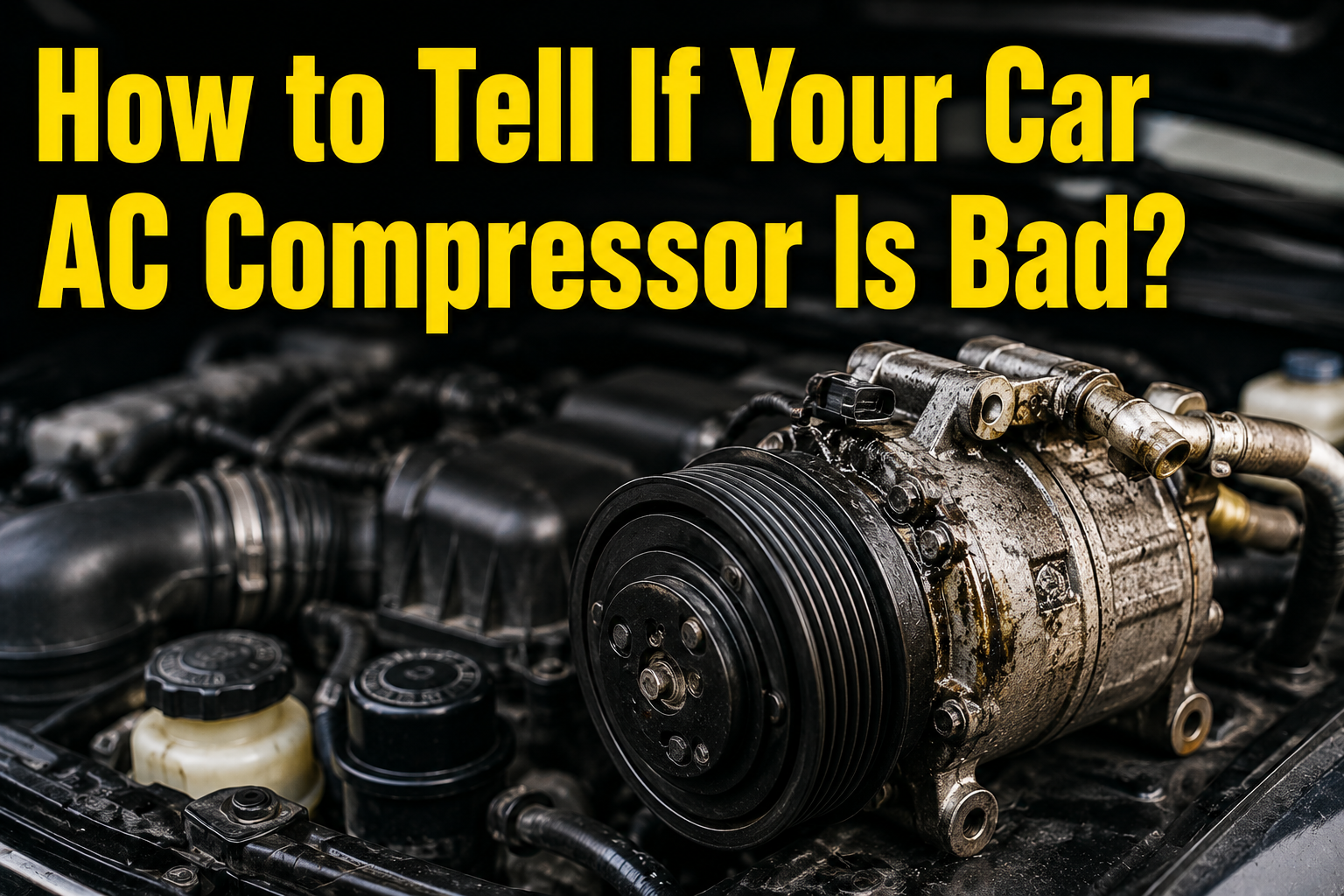
Start the engine, turn the AC to max, and watch the centre of the compressor pulley. If the small plate in the middle spins with the pulley, the clutch is engaging. If the outer pulley spins but the centre stays still, the compressor is not running, and you need to find out why.
- What the compressor does
- Symptoms that point to the compressor
- The five-minute check anyone can do
- What each result actually means
- The cheaper faults that get blamed on the compressor
- Confirming it with gauges
- What replacement involves
- Can you keep driving?
- Conclusion
- Frequently asked questions
- Can a bad AC compressor still turn on?
- How much does it cost to replace a car AC compressor?
- Is it safe to drive with a bad AC compressor?
- Why does my AC blow cold then warm?
- Can I just replace the AC clutch instead of the whole compressor?
- Related Articles
That single check separates a compressor problem from the cheaper faults that look identical. Warm air, odd noises, and an AC that quit are symptoms of a dozen things, and only some of them cost a thousand dollars. Here is how to narrow it down before anyone quotes you for a compressor.
What the compressor does
The compressor is a belt-driven pump that circulates refrigerant around the AC system. Without it moving refrigerant, nothing else in the system can produce cold air.
It does not run continuously. A magnetic clutch on the front of the pulley engages and disengages so the compressor only works when cooling is needed. The pulley itself spins whenever the engine runs, driven by the belt. Only the clutch plate in the centre engages.
That distinction matters for diagnosis. A pulley that spins tells you nothing. The centre plate is what you watch.
The system also protects itself. If refrigerant pressure is too low, a switch cuts power to the clutch so the compressor cannot run dry. Refrigerant carries the compressor’s lubricating oil, so running with no refrigerant destroys it within minutes. This is why a car with a slow leak often shows a completely dead AC rather than gradually warmer air.
Symptoms that point to the compressor
Some symptoms genuinely narrow things down, and others do not.
- Grinding, rattling, or metallic noise when the AC is on. Compressors contain bearings, and those bearings wear or seize. Switch the AC off, then on, and listen for the noise following the AC rather than the engine speed. A noise that appears and disappears with the AC button is a strong compressor signal.
- A squeal at the moment the AC engages. Usually the belt slipping on a compressor that has grown stiff, or a clutch beginning to fail.
- The clutch never engaging. The centre plate stays motionless with the AC on max. This has several possible causes, most of them cheaper than a compressor.
- Oily residue around the compressor body. Refrigerant carries oil, so a leak leaves an oily film that traps dirt. A greasy patch on the compressor itself points at a failed shaft seal.
- The clutch cycling rapidly on and off. Engaging and disengaging every few seconds usually means low refrigerant rather than a failed compressor.
Warm air alone tells you very little. It happens with a refrigerant leak, a blend door fault, a failed blower, a clogged condenser, or a blown fuse. Treat it as a starting point, not a diagnosis.
The five-minute check anyone can do
You need no tools for this, and it rules out a lot.
- Park with the engine running and the hood up. Set the AC to max cold, fan on high, and the recirculate button on.
- Find the compressor. It is a fist-sized pump on the front or side of the engine, driven by the serpentine belt, with two thick hoses attached.
- Watch the centre of the pulley. With the AC on, the centre plate should snap into engagement and spin with the pulley. You often hear a click when it does.
- Note what happens. Engaging and staying engaged is normal. Never engaging points to power, refrigerant pressure, or the clutch. Engaging and dropping out every few seconds usually means a low charge.
- Check the belt while you are there. A cracked, glazed, or loose belt can stop a healthy compressor turning properly.
- Look for oily grime on the compressor and the hose fittings.
Write down what you saw. That description is worth more to a shop than “the AC stopped working.”
One more measurement is worth taking if you have a cheap thermometer. Put it in a centre dash vent, run the AC on max with recirculate on for five minutes, and read the temperature. A healthy system on a warm day should deliver air roughly 30 to 40 degrees Fahrenheit below the outside temperature. If it is only a few degrees cooler than ambient, the system is not cooling meaningfully, which confirms a real fault rather than an unusually hot day.
What each result actually means
| What you observed | Most likely cause |
| Clutch engages, air still warm | Low refrigerant, condenser or airflow problem, or blend door fault |
| Clutch never engages | Blown fuse, failed relay, low refrigerant tripping the safety switch, or clutch coil |
| Clutch cycles rapidly | Low refrigerant charge |
| Grinding or rattle with AC on | Compressor bearings or internal wear |
| Pulley wobbles or seized, belt squealing | Compressor seizing, bearing failure |
| Oily film on compressor body | Shaft seal leaking |
Notice how many rows do not say compressor. That is the point. Most AC failures are not the compressor, and most of the cheap causes produce the same warm air.
The cheaper faults that get blamed on the compressor
Before condemning a compressor, four things are worth checking, because all of them are far cheaper.
A blown fuse or failed relay. The clutch runs on an electrical circuit with its own fuse and relay, usually in the under-hood fuse box. Both are inexpensive, and swapping the relay with an identical one elsewhere in the box is a two-minute test.
Low refrigerant. The most common cause of AC problems overall. If pressure falls too low, the safety switch keeps the clutch off, so the symptom looks exactly like a dead compressor. A gauge set reading well under about 25 to 30 PSI on the low side explains a clutch that will not engage.
A failed pressure switch. The switch that protects the compressor can itself fail and cut the circuit when pressure is fine.
The serpentine belt. Worn, glazed, or loose, it may not spin the compressor properly. Broken, and nothing driven by it works.
There is one trap worth knowing about. Refrigerant is only low because it leaked, since the system is sealed. Topping it up with a can from a parts store may restore cooling for a few weeks, but the leak is still there, and running low on refrigerant is what kills compressors in the first place.
Confirming it with gauges
Beyond the visual check, a proper diagnosis needs manifold gauges on the high and low service ports.
With the engine off, both gauges should read roughly the same static pressure, in the region of 70 to 120 PSI depending on how warm it is. A reading near zero means the system is empty and has a significant leak.
With the engine running and the AC on, a healthy system shows a low side well below the high side. A compressor that cannot build a pressure difference between the two sides is not pumping, which is the clearest evidence of internal failure.
Most people do not own gauges, and refrigerant handling is regulated, so this is usually the point to hand the car to a shop. What you save by arriving with your own observations is the guesswork.
What replacement involves
Compressor replacement is expensive, and the reason is what has to go with it.
Expect roughly $800 to $1,500 for parts and labour on a common vehicle, and more on luxury or newer models. The compressor itself is a few hundred, plus two to four hours of labour, plus recovery and recharge of the refrigerant.
The extras matter. The receiver-drier or accumulator should be replaced whenever the system is opened, because its desiccant absorbs moisture and is saturated. The expansion valve or orifice tube is usually replaced too.
If the old compressor failed internally and shed metal, the picture changes. Debris travels through the system, and a new compressor fitted into a contaminated system can fail within weeks. That means flushing the lines and often replacing the condenser, since many modern condensers cannot be flushed effectively. Add several hundred dollars.
Two things to ask any shop: whether they found evidence of contamination, and what they are replacing alongside the compressor. A quote covering only the compressor is a quote to do the job twice.
Can you keep driving?
Usually yes, if the compressor simply is not engaging and everything still turns quietly. You lose cooling and demisting, but nothing is being damaged.
Stop driving if you hear grinding, the pulley wobbles, or the belt is squealing badly. A seizing compressor can shred or throw the serpentine belt, and on most cars that belt also drives the alternator and water pump. A failed AC becomes a breakdown.
Conclusion
Watch the centre of the compressor pulley with the AC on max, because that one observation separates a compressor fault from the cheaper causes. If the clutch engages but the air is warm, suspect refrigerant or airflow. If it never engages, check the fuse, relay, and charge before anything else. Grinding, a wobbling pulley, or an oily compressor body are the symptoms that genuinely point at the compressor, and those are worth acting on quickly.
Frequently asked questions
Can a bad AC compressor still turn on?
Yes. A compressor with worn internals can engage and spin while failing to build enough pressure to cool. That is why gauge readings matter: if the low and high sides stay close together while running, it is not pumping properly.
How much does it cost to replace a car AC compressor?
Typically $800 to $1,500 including parts and labour, more on luxury vehicles. That normally covers the receiver-drier and expansion device too. Contamination from an internally failed compressor can add several hundred more.
Is it safe to drive with a bad AC compressor?
Usually, if it is quiet and the belt turns normally. Stop driving if you hear grinding or the pulley wobbles, because a seizing compressor can throw the serpentine belt and disable the alternator and water pump.
Why does my AC blow cold then warm?
Often low refrigerant, which makes the clutch cycle rapidly. It can also be an evaporator freezing over and restricting airflow. Both are worth checking before suspecting the compressor.
Can I just replace the AC clutch instead of the whole compressor?
Sometimes, if the coil or clutch plate failed and the compressor is otherwise sound. Many shops replace the whole unit because the labour is nearly identical and a partially worn compressor tends to fail soon after.
Related Articles
How Much Oil to Put in Your Car: Quarts by Engine?
How Many Engine Mounts Does a Car Have?
How Long Can a Car Sit Before the Battery Dies?