


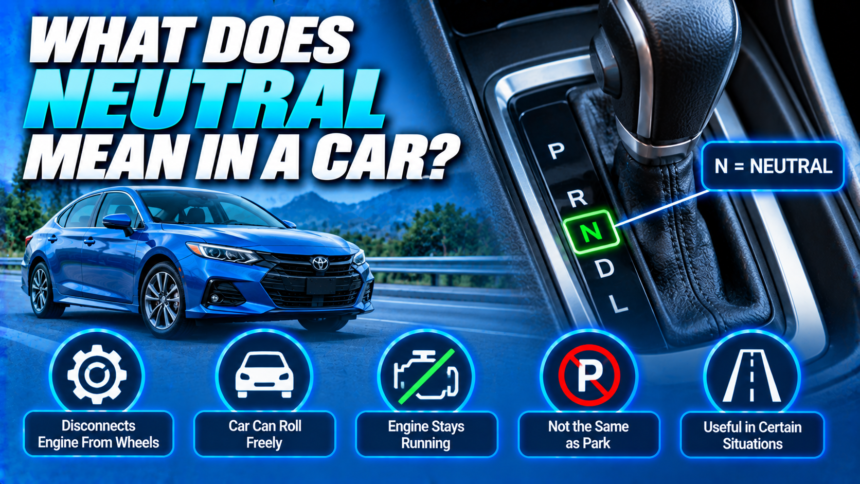
Neutral means the transmission is disconnected from the wheels. The engine can be running, you can press the accelerator and hear it rev, and none of that power reaches the road.
- What neutral actually does?
- Neutral and Park are not the same thing
- When you actually need neutral?
- The emergency use: a stuck accelerator
- Towing in neutral, and the trap inside it
- Coasting in neutral
- Does neutral save fuel?
- Can using neutral damage the transmission?
- Neutral in electric cars and modern selectors
- The neutral safety switch
- Conclusion
- Frequently asked questions
- Is it bad to shift into neutral while driving?
- Should I put my car in neutral at a red light?
- What is the difference between neutral and park?
- Can I tow a car in neutral?
- Why won’t my car start in Park but starts in Neutral?
- Related Articles
On an automatic it is the N sitting between R and D on the selector. On a manual it is the position the lever rests in when no gear is engaged, the slot you pass through on the way from one gear to another.
The important thing about neutral is not what it does but what it does not do. It does not hold the car still. That is a different position entirely, and confusing the two is how cars end up rolling across car parks.
What neutral actually does?
Inside an automatic gearbox, gears are selected by clamping sets of clutch packs. In neutral, none of them are clamped. The engine turns the input side, the wheels turn the output side, and there is no connection between the two.
A manual is simpler. Every gear is engaged by sliding a collar to lock a gear to the output shaft. In neutral, no collar is engaged, so the input shaft spins freely and nothing is driven.
In both cases the result is the same. The engine is free to idle or rev without moving the car, and the wheels are free to roll without turning the engine.
That last half is what makes neutral useful, and what makes it dangerous if you forget to set the parking brake.
Neutral and Park are not the same thing
This is the single most useful distinction on the whole selector.
Park engages a parking pawl, a metal pin that drops into a toothed wheel on the transmission output shaft and physically locks it. The car cannot roll, because the driveline is mechanically jammed.
Neutral does none of that. There is nothing holding the car. On any gradient, a car left in neutral without the parking brake will move, and it will keep moving.
Two practical rules follow. Always set the parking brake before selecting neutral if you are leaving the car unattended, and never rely on neutral as a substitute for Park. A manual has no Park at all, which is why leaving a manual in gear with the handbrake on is standard practice.
When you actually need neutral?
Neutral has a handful of genuine uses, and most drivers go months without touching it.
| Situation | Why neutral |
| Automatic car wash | The conveyor pulls the car through and needs the wheels free |
| Being towed or winched | The wheels have to turn without fighting the driveline |
| Pushing a stalled car | Nothing to overcome except the car’s own weight |
| Stuck in mud or snow | Lets someone rock or push the car free |
| A stuck accelerator | Cuts engine power to the wheels immediately |
| Roll-starting a manual | The lever passes through neutral as part of the procedure |
Everything else on the list of things people use neutral for is either unnecessary or actively unhelpful, which the rest of this covers.
The emergency use: a stuck accelerator
This is the one worth knowing before you need it.
If the accelerator sticks or the car starts accelerating on its own, the recommended response is to brake firmly and shift into neutral. Federal guidance issued during the sudden acceleration investigations was direct about it: steadily apply the brake, put the car in neutral, bring the car to a stop somewhere safe, and get it looked at.
The reason is arithmetic. Braking while the engine is still driving the wheels means fighting the engine, and brakes overheat and fade doing that. Neutral removes the engine from the equation, and then the brakes only have to stop a coasting car.
The engine will race loudly when you do this. That noise is alarming and it does not matter. An engine hitting its rev limiter is a repair. A car you cannot stop is not.
State licensing authorities publish the same sequence. Rhode Island’s DMV guidance on a stuck accelerator pedal adds two useful details: in a manual, press the clutch, and leave the ignition on until you are off the road, because switching the engine off costs you power steering and brake assist.
Practise finding neutral in your own car while parked. Shift-by-lever, rotary dial, and push-button selectors all reach neutral differently, and an emergency is a poor time to work it out.
Towing in neutral, and the trap inside it
Neutral is the position for being towed, but it does not make every car safe to tow with its wheels on the ground.
In many automatic transmissions the fluid pump is driven by the engine. Engine off, no pump. No pump, no fluid circulating. With the engine off and the wheels turning, internal parts spin without lubrication, and a long tow can destroy the gearbox.
This is why flat-towing behind a motorhome comes with strict manufacturer rules, and why many vehicles cannot be flat-towed at all regardless of what the selector says. Some require a specific procedure, some require a speed and distance limit, and some require a driveshaft disconnect.
Check the owner’s manual before towing any vehicle on its own wheels. If in doubt, a flatbed avoids the question entirely.
Short distances at low speed, such as being pulled out of a parking space, are a different matter and are generally fine.
Coasting in neutral
Rolling downhill in neutral is a bad idea for three separate reasons, and it is worth being clear about each.
You lose engine braking. In gear, a closed throttle makes the engine slow the car. In neutral, the only thing slowing you is the brakes, and on a long descent that is how brakes overheat and fade.
You lose the ability to accelerate. Getting out of trouble sometimes means adding speed, and from neutral there is a delay while you select a gear and the driveline takes up.
And it is illegal in a good number of US states, which have specific statutes prohibiting coasting with the transmission in neutral on a downgrade. Enforcement is rare, but the laws exist because the practice caused crashes.
Does neutral save fuel?
At a red light, no, or not enough to measure. The engine idles in D and it idles in N, burning much the same fuel either way.
Coasting is where the answer becomes genuinely counterintuitive. A modern fuel-injected engine cuts fuel entirely when you lift off the throttle while in gear and moving, because the wheels are turning the engine and it does not need to burn anything to keep spinning. Injection stops until you either press the accelerator or slow to near idle speed.
Put the car in neutral to coast, and that stops. The engine has to idle to stay running, so it burns fuel the whole way down the hill.
Coasting in neutral therefore uses more fuel than coasting in gear, not less. On a carburettor-era engine the two were roughly equivalent, because a coasting engine still drew fuel. Fuel injection changed the arithmetic entirely.
If your car has automatic stop-start, it is already handling the traffic-light case for you.
Can using neutral damage the transmission?
Not in normal use, and the worry is more common than the risk.
Shifting between Drive and Neutral at a standstill is what the selector is designed for. Doing it at every red light adds a little wear to the shift mechanism over many thousands of cycles, but it does not hurt the gearbox.
Selecting neutral while moving is also harmless. The transmission releases its clutch packs and the car coasts, which is exactly what happens for a fraction of a second during every gear change anyway.
Revving the engine in neutral does nothing useful and nothing harmful, provided you stay off the rev limiter. There is no load on the engine, so it climbs and falls quickly.
The genuinely damaging move is different: selecting Drive while the car is still rolling backwards, or Reverse while it is still rolling forwards. That asks the transmission to reverse direction under load. Come to a complete stop first, every time.
Neutral in electric cars and modern selectors
Electric cars have an N position too, even though there is no clutch, no gearbox in the conventional sense, and no idle.
Selecting it disconnects the motor from the wheels so the car can be rolled or towed, and it is the setting car washes ask for. Most EVs will not creep in neutral and will not regenerate either, so the car freewheels.
Modern shift-by-wire selectors add a wrinkle. Rotary dials and buttons often need a firm, deliberate action to reach N, and many will refuse to leave Park unless your foot is on the brake. Some cars also drop themselves out of neutral into Park automatically after a period, which matters at a car wash. Check whether yours has a specific car wash or neutral hold mode.
The neutral safety switch
There is one more piece worth knowing, because it explains a common no-start.
Cars are built so the starter only works with the transmission in Park or Neutral, through a switch that confirms the selector position. It exists so a car cannot lurch forward when you turn the key.
That gives you a free diagnostic. If your automatic will not start in Park but starts normally in Neutral, the transmission is fine and the fault is almost certainly the switch or the shifter linkage, not the starter or the battery.
It is worth trying before anyone quotes you for a starter motor.
Conclusion
Neutral disconnects the engine from the wheels, so the car can roll freely and the engine can run without driving anything. It is not Park, it holds nothing, and it needs the parking brake behind it. Use it for car washes, towing, pushing, and above all for a stuck accelerator, where shifting to neutral and braking is the recommended response. Do not use it to coast, which costs you engine braking and burns more fuel rather than less.
Frequently asked questions
Is it bad to shift into neutral while driving?
No. The car coasts and the engine drops to idle. It is a normal, safe action, and it is the correct response to a stuck accelerator. Shifting to Park or Reverse while moving is the dangerous one.
Should I put my car in neutral at a red light?
There is no real benefit on a modern car. Fuel use is essentially the same, and holding the brake in Drive is fine. Set the parking brake if you are stopped for a long time on a hill.
What is the difference between neutral and park?
Park mechanically locks the transmission with a parking pawl so the car cannot roll. Neutral simply disconnects the drive and holds nothing at all, so the car will roll on any slope.
Can I tow a car in neutral?
For short, slow distances, usually yes. For longer tows with the wheels on the ground, check the manual. Many automatics have no fluid circulation with the engine off and can be damaged.
Why won’t my car start in Park but starts in Neutral?
That points to the neutral safety switch or the shifter linkage rather than the starter. It is a common fault and worth mentioning to a mechanic before paying for other parts.
Related Articles
What Happens If a Car Belt Breaks? Serpentine vs Timing
What to Put Under Tires When Storing a Car?