


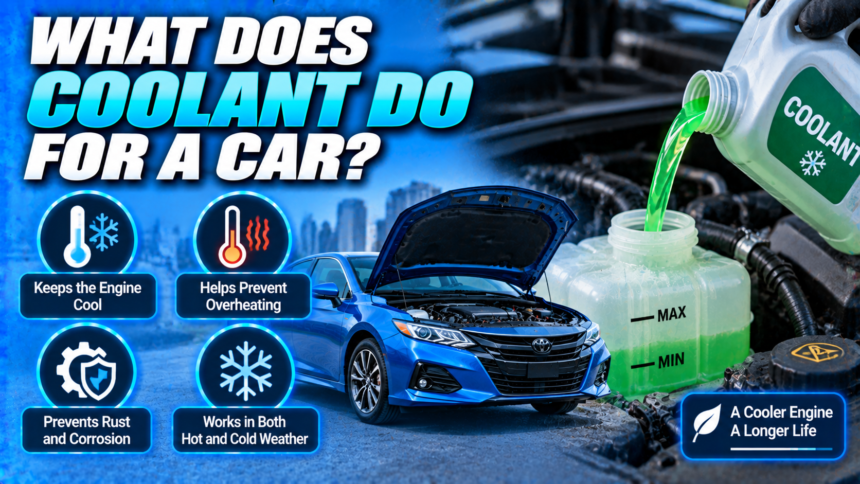
Coolant carries heat away from the engine so it does not overheat, and that is its main job. But it does more than that. The same fluid also stops itself from freezing in winter and boiling in summer, protects the metal parts inside the engine from rust, and even feeds the heater that warms the cabin. In short, coolant keeps the engine at a safe temperature all year and protects the cooling system while it does it.
- Job 1: carrying heat away from the engine
- Job 2: stopping the fluid freezing and boiling
- Job 3: protecting against rust and corrosion
- Job 4: heating the cabin
- The five jobs at a glance
- How coolant moves through your car?
- Coolant vs antifreeze: the difference
- Signs of low or old coolant
- Conclusion
- Frequently asked questions
- Related Articles
A running engine makes a huge amount of heat, and without coolant that heat would quickly cause serious damage. Here is a closer look at each job coolant does, how it moves through the car, and how to tell when it is running low.
Job 1: carrying heat away from the engine
Burning fuel to make power also makes a lot of heat, far more than the engine can handle on its own. Coolant is the fluid that soaks up that heat and moves it somewhere safe to get rid of it.
As the engine runs, coolant flows through passages inside it and absorbs the heat. It then carries that heat to the radiator at the front of the car, where airflow cools the fluid back down before it loops around to do it again. This constant circulation is what keeps the engine sitting at a safe operating temperature instead of climbing until parts warp or fail. Preventing overheating is the single most important thing coolant does.
Roughly a third of the heat energy an engine produces is carried away by the coolant. Without that, the engine would cook itself in minutes.
Job 2: stopping the fluid freezing and boiling
Plain water would seem like an obvious way to cool an engine, but it fails at both extremes. Water freezes at 32F and boils at 212F, and an engine can run outside both of those in real weather. This is why coolant is a mix of water and antifreeze rather than just water.
The antifreeze changes those limits dramatically. A standard 50/50 mix of antifreeze and water lowers the freezing point to around minus 35F and raises the boiling point to about 223F or higher. That keeps the fluid liquid in a hard winter and stops it boiling over on a hot day. According to AutoZone, the base chemical (usually ethylene glycol) is what prevents the water from freezing or boiling.
This matters more than it sounds. If the fluid froze, it would expand and could crack the engine block or split the radiator. If it boiled, it would turn to steam, stop cooling properly, and let the engine overheat. Coolant widens the safe range at both ends.
Job 3: protecting against rust and corrosion
The cooling system is full of metal parts, the radiator, the water pump, the engine passages, and metal plus water plus heat is a recipe for rust and corrosion over time. Left unchecked, that corrosion eats away at components and leaves behind scale and grit that clog the system.
Coolant contains corrosion inhibitors, special additives whose whole purpose is to protect those metal surfaces. They keep the radiator, water pump, and other parts clean and working, which is a big reason coolant lasts for years rather than needing constant attention. It is also why using the right type of coolant matters, and why old coolant should be replaced, since those additives wear out over time and the fluid gradually turns acidic and less protective.
Job 4: heating the cabin
Here is a job most people never think about: your car’s heater runs on coolant. When you turn on the heat in winter, you are not using a separate heating system. You are borrowing warmth from the engine.
Some of the hot coolant coming off the engine is routed through a small radiator behind the dashboard called the heater core. A fan blows air across it, and that warmed air is what comes out of the vents. So the same fluid that stops the engine overheating is also what keeps you warm on a cold morning. If your heater ever blows cold, a coolant problem is one of the possible causes.
The five jobs at a glance
Put together, here is everything coolant quietly does and why each part matters:
| What coolant does | Why it matters | What happens without it |
| Carries heat away from the engine | Keeps the engine at a safe running temperature | The engine overheats and can be badly damaged |
| Lowers the freezing point | Stops the fluid freezing in winter | Frozen coolant expands and can crack the engine or radiator |
| Raises the boiling point | Stops the fluid boiling on hot days | Coolant boils over and the engine overheats |
| Fights rust and corrosion | Protects the metal parts inside the system | Rust and scale build up and clog the cooling system |
| Warms the cabin | Feeds the heater that warms you in winter | No heat inside the car |
How coolant moves through your car?
It helps to picture the loop. Coolant does not sit still; it is pumped around a circuit whenever the engine runs. Understanding the path makes the whole system make sense.
The water pump pushes coolant through the passages inside the hot engine, where it picks up heat. A part called the thermostat controls the flow: when the engine is cold it holds the coolant back so the engine warms up quickly, and once it is up to temperature it opens to let the coolant flow to the radiator. At the radiator, air passing through cools the fluid down, and then it returns to the engine to start over. A small branch of that hot coolant also runs to the heater core to warm the cabin. It is a simple, continuous cycle that runs the entire time you are driving.
Coolant vs antifreeze: the difference
People use these two words as if they mean the same thing, and often it does not matter, but there is a real difference. Antifreeze is the concentrated glycol fluid on its own. Coolant is antifreeze mixed with water, usually about half and half, which is the fluid that actually goes into your car.
You can buy antifreeze as a concentrate to mix yourself with distilled water, or buy it pre-mixed as ready-to-use coolant. Either way, it is the blend of the two that does the work: the water carries heat well, and the antifreeze adds the freeze protection, boil protection, and corrosion inhibitors. Neither is as effective alone as the mixture is together.
Signs of low or old coolant
Because coolant is doing so much, running low or letting it go bad causes real problems. Watch for these signs:
- The temperature gauge creeping up or an overheating warning light, the clearest sign the engine is not being cooled properly.
- A sweet smell or colored puddles under the car (green, orange, or pink), which point to a coolant leak.
- The heater blowing cold, which can mean the coolant is low or not circulating.
- Coolant that looks rusty, murky, or has bits floating in it, a sign the additives are spent and it is time for a flush and refill.
A low coolant level can let the engine overheat, which can cause severe and expensive damage. Check the level when the engine is cold and top it up if it is near the minimum mark.
Keeping the coolant at the right level and replacing it on your car’s schedule is cheap insurance. It lets every one of those jobs keep happening, and it protects one of the most expensive parts of your car from overheating damage.
Conclusion
Coolant does far more than its name suggests. It carries heat away from the engine to prevent overheating, keeps itself from freezing in winter and boiling in summer, protects the cooling system’s metal from rust, and even warms the cabin. All of that comes from one fluid quietly circulating whenever you drive. Keep it topped up and replace it on schedule, and it will keep your engine at a safe temperature and protect it for years.
Frequently asked questions
What is the main job of coolant? To carry heat away from the engine and keep it at a safe operating temperature, preventing overheating. It also stops the fluid freezing or boiling and protects against rust.
Is coolant the same as antifreeze? Not quite. Antifreeze is the concentrated glycol fluid. Coolant is antifreeze mixed with water, usually about 50/50, which is what actually goes into the car.
Can I use just water instead of coolant? Only in an emergency. Water freezes and boils within the range an engine sees, and it offers no corrosion protection. Replace it with proper coolant as soon as you can.
What happens if my coolant is low? The engine can overheat, which risks serious and costly damage. Low coolant can also mean the heater blows cold. Check the level cold and top it up if needed.
How often should coolant be changed? It varies by car, but many are flushed and refilled somewhere around every 50,000 miles, with some newer models sooner. Your owner’s manual has the exact interval.
Related Articles
What Does Neutral Mean in a Car?
How Many Engine Mounts Does a Car Have?
How Long Can a Car Sit Before the Battery Dies?
Does Driving a Car Charge the Battery? What to Know