


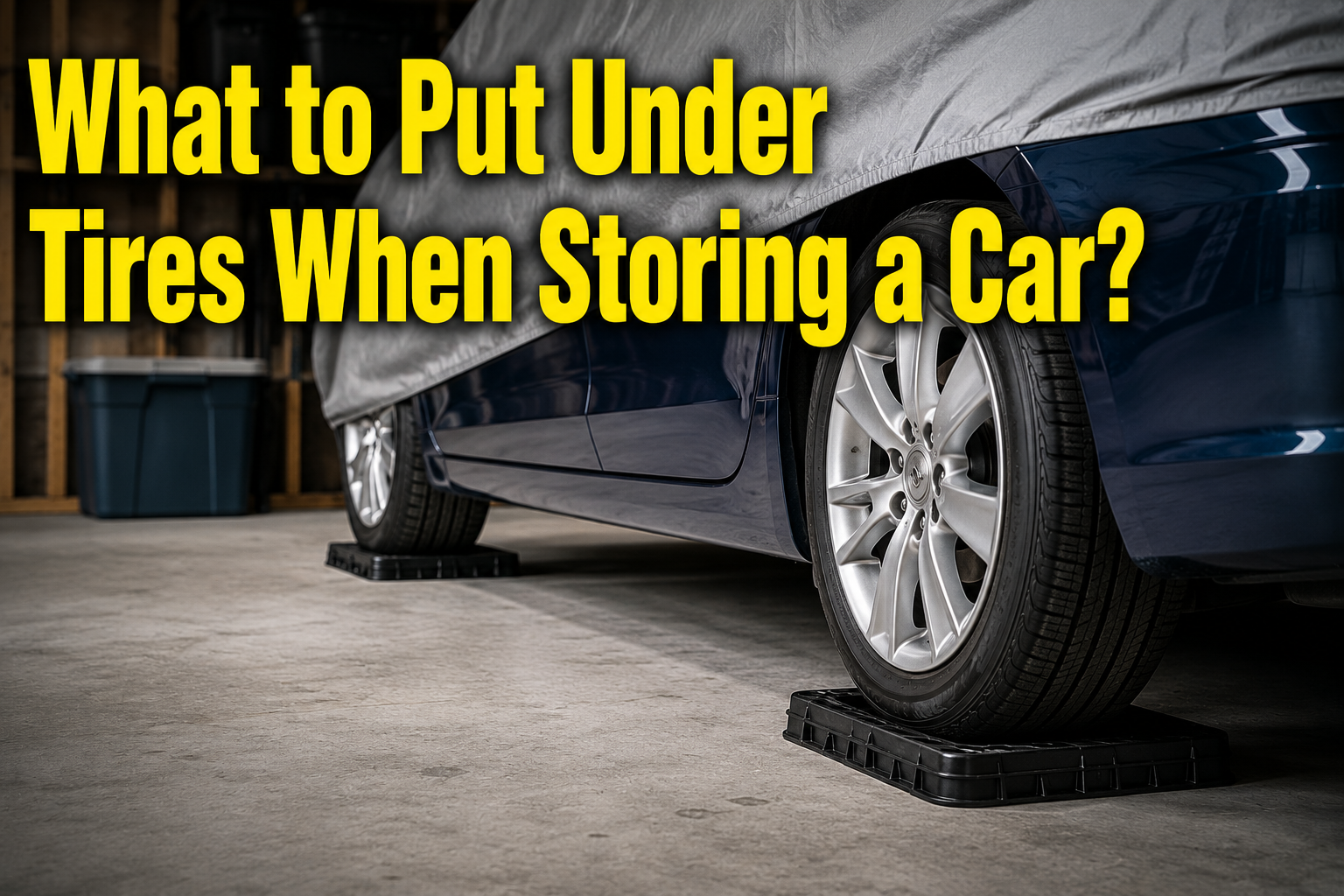
Put down a rubber tire mat, a piece of plywood, or a carpet square under each tire. Any of these creates a barrier between the tire and a damp floor, and they cost very little.
- What you are protecting against
- The options, compared
- Sizing and placement
- The concrete question
- What actually prevents flat spots
- Which tires actually care
- How long before it matters
- Things not to put under your tires
- Conclusion
- Frequently asked questions
- Is it bad to store a car on concrete?
- Should I put my car on jack stands for winter storage?
- How much should I inflate tires for storage?
- Will flat spots go away on their own?
- Is cardboard okay to put under tires?
- Related Articles
But here is the thing worth knowing before you buy anything: what you put under the tires matters far less than tire pressure and how long the car sits. A car on plywood with underinflated tires will fare worse than one on bare concrete inflated properly. Here is what each option actually does, and what to prioritise instead.
What you are protecting against
Two separate problems get mixed together in storage advice, and they need different solutions.
Flat spotting is the real one. Parked tires flatten slightly where they meet the ground. The nylon reinforcement under the tread takes a set in that flattened shape and, given long enough, stops springing back. In most cases this is temporary and drives out in twenty minutes. Left for months, especially in cold conditions, it can become permanent.
Ground moisture is the smaller one. A concrete slab, particularly one without a vapour barrier under it, passes moisture upward. Rubber sitting in that damp is exposed to constant humidity, and the alkalinity of concrete is not kind to rubber compounds over long periods.
Notice which of these a mat actually solves. It addresses moisture. It does nothing for flat spotting, which is caused by the weight of the car, not the surface underneath.
The options, compared
| What to use | Cost | Good for | Limitations |
| Rubber tire mats or parking pads | Moderate | Moisture barrier, easy to position | Does nothing for flat spots |
| Plywood, half inch or thicker | Low | Moisture barrier, spreads load slightly | Can absorb damp itself over time |
| Carpet squares or offcuts | Very low | Moisture barrier, insulates from cold slab | Holds moisture if the floor is genuinely wet |
| Cradle-style tire savers | Higher | Curved surface supports the tire shape | Only worthwhile for long storage of performance tires |
| Jack stands (nothing under tires) | Low to moderate | Removes load entirely, the only real fix for flat spots | Requires safe lifting points and care |
| Bare concrete | Free | Fine for short storage in a dry garage | No moisture barrier |
For most people storing a car over one winter in a normal garage, carpet squares or plywood are enough. They are cheap, they break the contact with a cold damp slab, and they do no harm.
Sizing and placement
Whatever you use, make each piece bigger than the contact patch. A square roughly 18 by 24 inches per tire covers a normal car with room to spare, and larger is fine. A pad the tire overhangs is worse than nothing, because the edge presses a line into the rubber.
Lay the pieces down first, then drive slowly onto them, or position them one corner at a time with a jack. Driving onto loose plywood tends to shoot it out from under the wheel, so a helper spotting each tire saves some frustration.
Half-inch plywood is the usual minimum thickness. Thinner sheets flex and crack under the weight of a car, and offer little insulation from a cold slab. If the garage floor is ever genuinely wet rather than merely damp, seal the plywood or use rubber mats instead, since bare wood will soak it up.
Storing outdoors or on gravel changes the calculation. Loose surfaces let tires sink unevenly and hold water against the rubber, so a solid pad under each wheel matters more there than it does in a garage. Rubber mats or thick plywood are the better choice, and a tire cover to block direct sunlight is worth adding, since UV does more damage to sidewalls than anything happening underneath.
The concrete question
Concrete gets blamed for pulling the oils out of tires. It is worth being precise about what the surface actually does.
Rubber compounds contain oils and anti-ozonant waxes that keep them flexible. Those compounds do migrate out over time, but the main drivers are age, heat, UV, and ozone. A tire parked in a cool dark garage loses them slowly regardless of what it is resting on.
What concrete genuinely contributes is moisture and alkalinity. A slab poured without a vapour barrier wicks ground water upward continuously, and that constant damp against one patch of rubber is not ideal over a season. Cold concrete also holds a lower temperature than the air above it, and cold rubber flat spots more readily.
So a barrier is worth putting down, but for the moisture and the cold rather than any dramatic chemical attack. The dark patches on garage floors under long-parked tires are largely surface residue transferring the other way.
There is a related point about sealed floors. An epoxy-coated or sealed garage floor already blocks most moisture transfer, so a barrier adds far less on that surface than on raw concrete. If your floor is sealed and the garage is dry, bare floor with correct tire pressure is a perfectly reasonable choice for a single season.
What actually prevents flat spots
If flat spots are your concern, and for most stored cars they should be, three things matter far more than the surface underneath.
Overinflate the tires. This is the single highest-value step and it costs nothing. Raise pressure above your normal setting, commonly to somewhere around 40 to 50 PSI, staying below the maximum printed on the sidewall. Higher pressure reduces the contact patch and gives the tire more support, so it deforms less. Reset to the door-placard pressure before you drive.
Take the weight off entirely. Putting the car on jack stands is the only method that fully solves flat spotting, because the tires carry no load at all. Tire Rack recommends driving the car until it is thoroughly warmed up and then putting it on blocks immediately on arrival at the storage location. Use proper stands on the manufacturer’s lifting points, never a jack alone.
Move the car occasionally. Rolling it even a quarter turn every few weeks changes which part of the tire is loaded. If you can drive it properly for twenty minutes once a month, better still, since that also helps the battery, brakes, and seals.
Check pressure monthly during storage. Tires lose air slowly, and cold weather drops pressure by roughly 1 PSI per 10 degrees Fahrenheit. The +10 PSI cushion you set in October may be gone by January, exactly when the cold makes flat spotting most likely.
Which tires actually care
The risk is not equal across cars, and this is where the disagreement comes from.
Performance and low-profile tires flat spot most readily. Short sidewalls flex less, tread compounds are softer, and the nylon reinforcement in high-speed-rated tires holds a shape well. Some develop noticeable flat spots after a single cold night.
Ordinary all-season tires on a normal sedan are far more forgiving. Plenty of people store a daily driver for four months on bare concrete and notice nothing. Both outcomes are real; they just involve different tires.
Cold storage raises risk considerably. An unheated garage that swings below freezing is much harder on tires than a temperate one, because stiff rubber holds deformation.
Heavier vehicles press harder on the same contact patch, so trucks and larger SUVs are worse than light cars.
If you drive a performance car in a cold climate, take the flat spot advice seriously. If you have an ordinary car in a mild garage for three months, a carpet square and correct pressure will do.
How long before it matters
Roughly, and with plenty of variation between tires:
- Under a month: temporary at most, drives out in the first few miles.
- One to three months: temporary to semi-permanent. Overinflation is worthwhile.
- Three to six months: real risk on performance tires, particularly in cold storage. Consider jack stands.
- Over six months: get the weight off the tires.
Coming out of storage, expect some thumping. Drive gently at first, then twenty to thirty minutes at highway speed. The heat generated softens the rubber and the nylon layer, and the tire returns to round. If vibration persists after that, the flat spots have set and the tires need inspecting.
Things not to put under your tires
A few popular choices cause more harm than good.
Plastic sheeting across the whole floor traps moisture underneath rather than blocking it, and condensation collects on top. If you want a floor barrier, use it under the tires only, not as a wall-to-wall tarp.
Cardboard absorbs damp, holds it against the rubber, and disintegrates. It is fine for a weekend, not a season.
Anything with sharp edges or embedded grit, including old pallets with protruding nails. Tire manufacturers warn against storing rubber in contact with things that can penetrate it.
Petroleum-based tire dressings before storage. They look good and they strip the protective waxes that slow rubber ageing. Wash the tires, dry them, and leave them alone.
Conclusion
Put plywood, rubber mats, or carpet squares under the tires as a moisture barrier, since all three work and none costs much. Then spend your attention on the parts that matter more: raise the tire pressure well above normal, check it monthly, and move the car occasionally. For storage beyond a few months, particularly with performance tires in a cold garage, get the car on jack stands so the tires carry no weight at all.
Frequently asked questions
Is it bad to store a car on concrete?
Not particularly, for a few months in a dry garage. Concrete passes moisture upward and stays cold, so a mat or plywood under each tire is worthwhile, but the surface matters far less than tire pressure and storage duration.
Should I put my car on jack stands for winter storage?
It is the only method that fully prevents flat spots, and worth doing for storage beyond about three months or with performance tires. Use the manufacturer’s lifting points and proper stands, never a jack alone.
How much should I inflate tires for storage?
Above your normal pressure, commonly around 40 to 50 PSI, but never above the maximum on the sidewall. Check monthly, since tires lose air and cold weather drops pressure further. Reset to normal before driving.
Will flat spots go away on their own?
Usually. Twenty to thirty minutes at highway speed warms the rubber and the tire returns to round. If vibration remains after a good drive, the flat spot has set and the tire should be inspected.
Is cardboard okay to put under tires?
Not for long storage. Cardboard absorbs moisture and holds it against the rubber, which is the opposite of what you want. Plywood, rubber mats, or carpet squares are better and barely cost more.
Related Articles
How to Tell If Your Car AC Compressor Is Bad?
How Much Oil to Put in Your Car: Quarts by Engine?
How Many Engine Mounts Does a Car Have?
How Long Can a Car Sit Before the Battery Dies?