



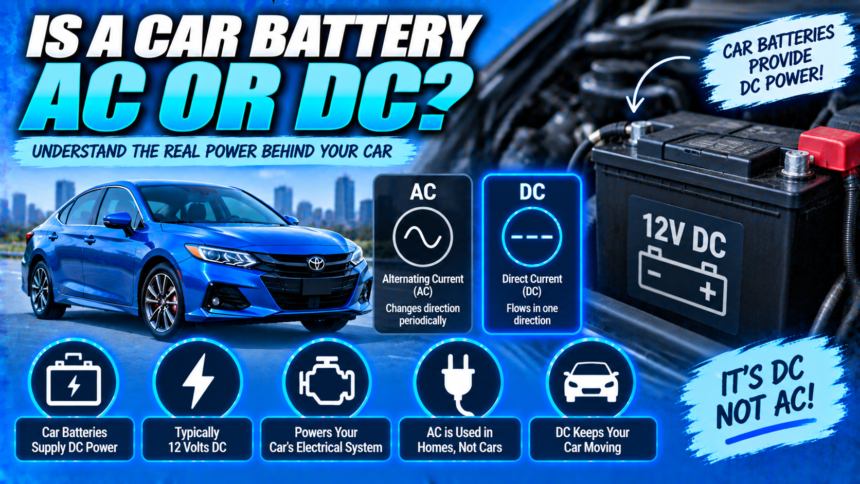
A car battery is DC. Direct current, flowing steadily in one direction, at a nominal 12 volts. Every lead-acid, AGM, gel, and lithium car battery works this way, and no automotive battery of any type produces alternating current.
- What DC means in practice?
- Why cars use DC and houses use AC?
- The alternator generates AC, then converts it
- Ripple: the AC that survives the conversion
- How to test for it yourself?
- Where AC does appear in a car?
- What this means for you?
- Conclusion
- Frequently asked questions
- Is a 12V car battery AC or DC?
- Does the alternator produce AC or DC?
- Should I test a car battery on AC or DC setting?
- Why does my multimeter show AC voltage at the battery?
- Are electric car batteries AC or DC?
- Related Articles
The reason people ask is usually the alternator. It generates AC, then converts that to DC before the battery ever sees it. So there is real alternating current in your engine bay, and one of the most useful electrical tests you can run on a car measures exactly how much of it leaks past that conversion.
What DC means in practice?
Direct current flows one way, from the negative terminal through the circuit and back to the positive. The voltage stays essentially constant instead of rising and falling.
Alternating current reverses direction on a cycle, 60 times a second in North America and 50 times a second across most of Europe and Asia. Its voltage swings from a positive peak, down through zero, to a negative peak, and back again.
That difference is why the two are not interchangeable in a car:
- A battery stores chemical energy, and chemistry has a direction. Inside a lead-acid cell, a reaction between lead plates and sulfuric acid pushes electrons out of one terminal and pulls them into the other. There is no mechanism for that to reverse itself sixty times a second.
- Electronics need a steady reference. Sensors, control modules, and the network they talk over all assume a stable voltage to measure against. A swinging supply would make their readings meaningless.
- DC stores; AC does not. You cannot fill a tank with a current that empties it half the time.
Why cars use DC and houses use AC?
Both systems are the right answer to different problems.
AC won the grid because voltage is easy to change with a transformer, and transformers only work on changing current. Power stations send electricity at hundreds of thousands of volts to cut losses across long distances, then step it down near your home. A car has no long distances and no transformers.
DC won the car because the car carries its own power source. A battery is inherently DC, the loads sit a few feet away, and the whole system needs to work with the engine off. Storage is the deciding factor. Your house does not need to store electricity overnight, and your car does nothing else while parked.
The quick version: AC is good at travelling. DC is good at sitting still in a battery waiting to be used. A car needs the second one.
The alternator generates AC, then converts it
Here is where the confusion starts, and the answer is more interesting than it first looks.
Your alternator is a generator. Spin a magnetic field inside a set of coils and you induce a current, and that current is inherently alternating. As the magnet’s north pole sweeps past a coil, current flows one way; as the south pole follows, it flows the other. A device that produces direct current straight out would need brushes and a commutator to mechanically flip the connection twice per rotation, which is what old DC dynamos did before alternators replaced them in the 1960s.
Alternators are simpler, lighter, and last longer precisely because they skip that mechanical step. They produce AC, then rectify it electronically.
Most automotive alternators use a three-phase stator: three sets of windings spaced 120 degrees apart, each producing its own AC waveform slightly out of step with the others. Those three phases feed a diode bridge, typically six diodes, three connected to the positive output and three to ground.
A diode is a one-way valve for electricity. It passes current in one direction and blocks it in the other. Arranged as a bridge, six of them catch both the positive and negative halves of all three phases and steer everything the same way. The output is DC.
Three phases matter here. With one phase you would get gaps between pulses. With three overlapping phases, one peak takes over as the last one falls, so the output stays much closer to a flat line.
Ripple: the AC that survives the conversion
Rectified output is not perfectly flat. Small waves remain where the phase peaks meet, and that leftover AC riding on top of the DC is called ripple.
A healthy charging system keeps ripple tiny. The battery itself helps, acting as a large capacitor that absorbs the bumps and smooths the supply for everything else.
When a diode fails, one slice of the waveform stops being redirected. That phase’s negative half now leaks through as genuine AC into a system designed for steady DC, and ripple climbs.
The symptoms are distinctive:
- Headlights or dash lights that pulse or flicker rhythmically, often in time with engine speed
- A battery that keeps going flat despite the alternator apparently charging
- A whine from the alternator
- Odd, intermittent electronic faults, or communication trouble codes across several modules at once
That last one is why this matters more on modern cars than old ones. When the whole vehicle is a network of computers sharing a power supply, AC noise on that supply corrupts the signals they use to talk to each other. A single failed diode can produce a scatter of unrelated-looking fault codes.
How to test for it yourself?
This is the practical payoff of the AC-versus-DC question, and it takes about a minute with a multimeter.
- Start the engine and let it idle, then switch on the headlights, blower, and rear defogger to load the system.
- Set the meter to AC volts on its lowest range.
- Touch the red probe to the battery positive post and the black probe to the negative post. In AC mode the meter ignores the 14 volts of DC and shows only the AC component.
- Read the display.
Fluke’s guidance on testing alternator ripple voltage puts the desirable figure at 50 millivolts AC or less at idle under load, treats 0.05 to 0.10 volts as a caution zone worth watching, and flags 0.30 to 0.50 volts AC or higher as a likely bad diode or stator fault. Some sources accept up to 100 millivolts on certain vehicles, so check what your manufacturer specifies before condemning a part.
Then raise engine speed to about 2,000 to 2,500 rpm. A healthy alternator holds ripple steady or drops it slightly. Ripple that climbs sharply with revs or added load points to an internal fault.
Two things worth knowing before you act on a reading. A weak or partly discharged battery can distort the result, so test with a good battery. And poor ground connections raise ripple on their own, so check that the ground straps are clean and tight before replacing an alternator.
| Reading at idle with load | What it suggests |
| 50 mV AC or less | Normal |
| 0.05 to 0.10 V AC | Watch it, especially if it grows under load |
| 0.30 V AC or more | Likely a failed diode or stator winding |
While the meter is out, switch to DC volts. Around 12.6 volts with the engine off means a charged battery, and roughly 13.5 to 14.8 volts with the engine running means the alternator is charging.
Where AC does appear in a car?
The battery is DC and the 12-volt system is DC, but a modern vehicle contains several places where AC exists on purpose.
| Component | What the current does |
| Alternator stator | Generates three-phase AC, rectified to DC before leaving the unit |
| Ignition coil | Steps 12V DC up to tens of thousands of volts using rapid switching |
| Power inverter accessory | Converts 12V DC to household AC for a laptop or small appliance |
| EV traction motor | Runs on AC produced by an inverter from the battery’s DC |
Electric vehicles make the picture richer without changing the answer. The high-voltage traction pack is DC, often somewhere between 200 and 800 volts. An inverter turns that into three-phase AC to spin the motor, and during regenerative braking the motor acts as a generator and the process runs backward, AC back to DC into the pack.
EVs also keep a conventional 12-volt DC battery for lights, modules, and locks. Instead of an alternator, a DC-to-DC converter steps the high-voltage pack down to about 13.5 to 14 volts to keep it charged. The naming of charging levels follows the same logic: AC charging feeds the car’s onboard charger, which rectifies to DC, while DC fast charging skips that step and delivers DC straight to the pack, which is a large part of why it is faster.
What this means for you?
Set your multimeter to DC volts to check a car battery. AC volts will read close to zero on a parked car, which is correct, not a fault.
Jump starters, battery chargers, and trickle chargers are all DC devices. A wall charger contains a rectifier converting household AC to DC, which is why you cannot connect a battery to mains power directly.
If you want to run household electronics from your car, you need an inverter, which converts 12V DC to 120V or 230V AC. Sizing matters: a small unit for a laptop is fine, while anything with a heating element or motor draws far more than a cigarette lighter socket can supply.
Conclusion
A car battery is DC, at a nominal 12 volts, in every battery chemistry used in vehicles. The alternator generates AC and converts it with a diode bridge before it reaches the battery, so both currents exist under the hood but only DC reaches the electrical system. The practical use of knowing this is the ripple test: set a multimeter to AC volts across the battery with the engine running, and a reading above roughly 50 millivolts points to a failing diode well before the charging system quits.
Frequently asked questions
Is a 12V car battery AC or DC?
DC. A 12V car battery supplies direct current at around 12.6 volts when fully charged and resting. This is true for lead-acid, AGM, gel, and lithium batteries alike.
Does the alternator produce AC or DC?
It generates AC in its stator windings, then a diode bridge rectifies that to DC inside the alternator housing. Only DC leaves the unit, which is why the battery never sees alternating current.
Should I test a car battery on AC or DC setting?
Use the DC volts setting. Around 12.6 volts means charged, and 13.5 to 14.8 volts with the engine running means the alternator is working. The AC setting is only for checking ripple.
Why does my multimeter show AC voltage at the battery?
A small amount, under 50 millivolts, is normal ripple from the alternator. Higher readings usually mean a failed rectifier diode, and can also come from a poor ground connection.
Are electric car batteries AC or DC?
DC, like every other automotive battery. An inverter converts the pack’s DC into AC to drive the motor, and a separate DC-to-DC converter keeps the 12-volt accessory battery charged.
Related Articles
Is Doing a Burnout Bad for Your Car? What It Costs
How Long Can a Car Sit Before the Battery Dies?
Can You Weld on a Car Without Removing the Battery or Fuel?