


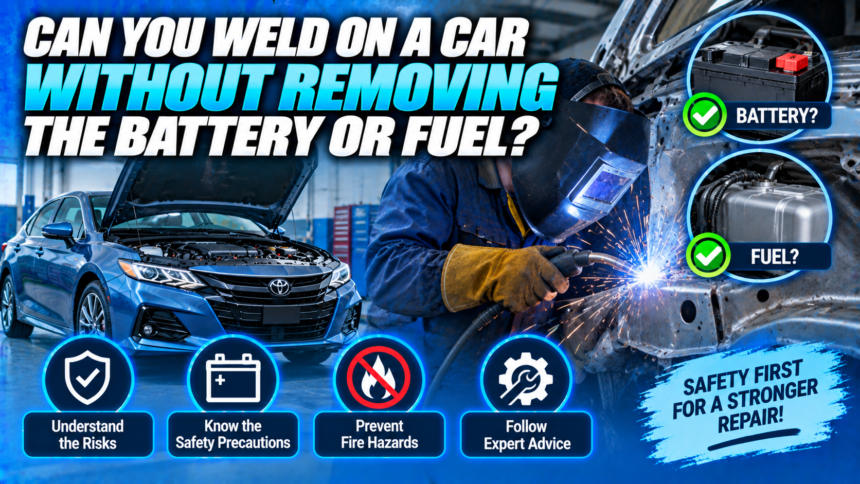
In many cases, yes. If you are welding on a part of the car that is well away from the battery and the fuel system, plenty of people do it without disconnecting the battery or draining the tank. But that short answer hides an important point: the battery and the fuel are two very different risks, and they are not equally forgiving.
- Two different risks, not one
- The battery and electronics: what really matters
- Fuel: where the real danger is
- A safe step-by-step approach
- When you must remove the battery or fuel
- Conclusion
- Frequently asked questions
- Do I have to disconnect the battery to weld on my car?
- Is it safe to weld near a fuel tank?
- Can you weld on a fuel tank that had gas in it?
- Why is grounding close to the weld so important?
- Will welding damage my car’s computer?
- Related Articles
Leaving the battery connected risks damaging electronics. Getting careless around fuel risks a fire or explosion. One can cost you an expensive repair; the other can cost you your life. So the real question is not a single yes or no, but knowing how to handle each one and where the hard lines are. Here is how to think it through.
Two different risks, not one
The keyword lumps the battery and the fuel together, but they threaten you in completely different ways, and it helps to keep them separate in your head:
- The battery and electronics are an electrical risk. Welding sends current and voltage spikes through the car, which can damage the battery or, more often, the sensitive computers and modules onboard. The worst realistic outcome is a fried control unit and a big repair bill.
- The fuel system is a fire and explosion risk. Sparks, heat, and an open arc near fuel or fuel vapor can ignite them. The worst outcome here is not a repair bill. It is a fire, a serious injury, or worse.
Because the fuel risk is the one that can hurt you, treat it with far more caution than the electrical one. The rest of this guide handles each in turn.
The battery and electronics: what really matters
Here is the part that surprises people. Disconnecting the battery helps, but on its own it does not fully protect your car’s electronics, and it is not the most important step. The reason is that the car’s metal body and frame carry welding current, and most electronic modules are grounded to that body in several places. So current can still flow through sensitive circuits even with the battery unhooked.
What matters most is where you attach the welder’s ground clamp. Electricity takes the path of least resistance, so if you clamp the ground right next to where you are welding, on clean bare metal on the same piece you are working on, the current has a short, easy path back and little reason to travel through the wiring. Clamp it far away, on the other side of the car, and the current hunts for a route back through whatever it can find, including your electronics. Grounding close is the single biggest thing you can do to protect the car.
With that in mind, here is a sensible order of protection, from minimum to most cautious:
- Always: ground close. Clamp the work lead on bare metal within about a foot of the weld, on the same panel. This alone prevents most problems.
- Standard: disconnect the negative battery terminal. It is quick, it opens the electrical system, and it reduces the chance of a voltage spike reaching the battery and modules. Just tuck the loose cable so it cannot touch metal.
- For welds near electronics: unplug the modules. If you are welding within roughly a foot of a control unit, airbag module, or sensor, the safest move is to unplug or remove that component so no induced current can reach it.
One more habit worth keeping: never clamp the ground onto suspension parts, wheel bearings, or brake components, because the current can arc across the moving surfaces and pit them. Clamp to solid body or frame metal instead.
The trade-off with disconnecting the battery is minor but real: many cars will forget radio codes, seat and mirror positions, or climate settings, and may need a quick reset afterward. That is a small price next to a damaged module.
Fuel: where the real danger is
This is the part to take seriously. The danger from fuel is not the liquid, it is the vapor. Fuel vapor mixed with air is what ignites and explodes, and it does not take much. This leads to a fact that catches people off guard: a nearly empty fuel tank is far more dangerous to weld near than a full one, because an empty tank is full of exactly the vapor-and-air mix that explodes.
Welding on the tank itself
Welding directly on a tank that has held fuel is a genuinely dangerous job, and for most people the honest advice is not to do it. Even a tank that looks and smells empty holds vapor in the metal and the air inside. Doing it safely means fully draining the tank, thoroughly cleaning it, and purging the vapor with water or an inert gas like argon or nitrogen so there is nothing left to ignite. This is specialist work, and if the damage is bad, replacing the tank is often safer and cheaper than repairing it.
Never purge a tank with engine exhaust. It is a persistent myth that running exhaust into a tank makes it safe to weld. It does not. Exhaust can form its own explosive mixture, and this exact mistake has caused serious accidents and deaths. If you take one thing from this article, take this.
Welding elsewhere on the car, near the tank or lines
More often, the real question is welding on a body panel or frame section that happens to be near the fuel tank or fuel lines, not on the tank itself. This can be done with care, but it demands respect for how far sparks and heat travel:
- Check for leaks first. If there is any smell of fuel, a damp spot, or a weeping line near your work, stop. Do not weld until it is dry and sound.
- Shield the tank and lines. Cover the fuel tank, filler neck, and any nearby lines with a welding blanket or a sheet of steel so sparks and heat cannot reach them. Sparks can fly several feet.
- Move or protect fuel lines. Where lines run behind the panel you are welding, move them clear or shield them. Remember to check the far side of the metal, where heat transfers through.
- Clear the vapor. Work in a well-ventilated space, and a small fan directing any stray fumes away from the weld is a cheap, sensible precaution.
- Keep a fire extinguisher within reach. Not across the garage. Right next to you, before the first spark.
If protecting the fuel system properly is not possible where you are working, that is your signal to remove the tank rather than risk it. And if you remove the tank, plug the fuel line so it cannot drip.
A safe step-by-step approach
Putting both risks together, here is a reasonable order of operations for welding on a car without automatically pulling everything out:
- Assess the location. How close is the weld to the fuel tank, fuel lines, or electronic modules? The answer decides how much you remove or shield.
- Handle the fuel first. Check for leaks, then shield the tank and lines, or remove the tank if you cannot protect it. This is the non-negotiable step.
- Disconnect the negative battery terminal and tuck the cable away from metal.
- Unplug nearby electronics if the weld is close to a control unit, airbag module, or sensor.
- Clear and shield flammables. Remove or cover carpet, trim, insulation, and undercoating near the weld, including on the back side of the panel.
- Ground close. Clamp the work lead on clean bare metal within a foot of the weld, on the same piece, avoiding bearings and brakes.
- Weld, keep an extinguisher at hand, and let the metal cool between passes to limit heat spread.
- Reconnect and reset. Reattach the battery, plug the modules back in, and reset any codes or settings the car lost.
When you must remove the battery or fuel
Some situations move from optional to mandatory. Remove or fully isolate the battery and electronics, or the fuel, when any of these are true:
- You are welding on or very close to the fuel tank or a fuel line. Proximity to fuel is always the deciding factor. When in doubt, remove the tank.
- You cannot properly shield the fuel system from sparks and heat where you are working.
- The weld is right next to a control unit or airbag module that you cannot ground away from, in which case unplug or remove it.
- The manufacturer says so. Some vehicles have specific instructions in the service manual, and a few even say certain modules must not be disconnected. Check it if you can.
And if any of this feels beyond your comfort or setup, there is no shame in handing it to a body shop. Welding near fuel is one of the areas where paying a professional is money well spent, not a failure of nerve.
Conclusion
You can often weld on a car without removing the battery or draining the fuel, as long as the weld is well clear of both. Protect the electronics mainly by grounding the welder right next to the weld, and disconnect the battery as a sensible extra step. Treat the fuel with real caution: shield the tank and lines, never weld on a tank that held fuel without proper purging, and never purge with exhaust. Judge every job by how close it sits to fuel and electronics, and when either is too close to protect, remove it. Done thoughtfully, the job is safe. Rushed, it is not worth the risk.
Frequently asked questions
Do I have to disconnect the battery to weld on my car?
Not always, but it is a smart, quick precaution. More important is grounding the welder right next to the weld so current does not travel through your electronics. For welds near control units, unplug those modules as well.
Is it safe to weld near a fuel tank?
Only with care. Check for leaks, shield the tank and lines from sparks and heat, ventilate the area, and keep an extinguisher close. If you cannot protect the fuel system where you are working, remove the tank instead.
Can you weld on a fuel tank that had gas in it?
Not without fully draining, cleaning, and purging it of vapor first, and even then it is specialist work. An empty-looking tank still holds explosive vapor. Replacing a badly damaged tank is often the safer, cheaper choice.
Why is grounding close to the weld so important?
Because electricity takes the shortest path back. A ground clamp within a foot of the weld gives current an easy route that avoids your wiring and modules. A distant clamp lets it hunt for a path through the electronics instead.
Will welding damage my car’s computer?
It can, through voltage spikes and induced current, even with the battery off. Grounding close prevents most of this, and unplugging or removing modules near the weld protects them fully. Reset any lost settings after you reconnect.
Related Articles
What Could Cause Overheating in a Car?
How Long Can a Car Sit Before the Battery Dies?