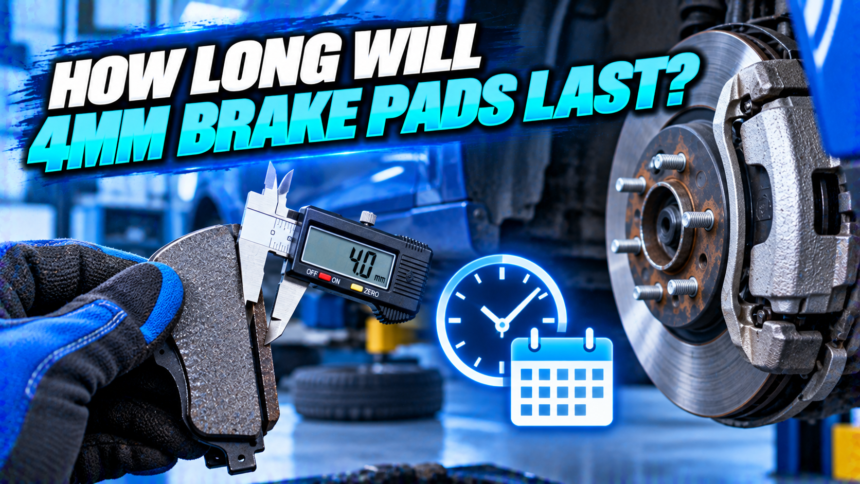
A set of brake pads sitting at 4mm usually has somewhere between 8,000 and 20,000 miles of life left, and often around 6 to 18 months of normal driving. That is a wide range on purpose, because how long 4mm lasts depends almost entirely on how and where you drive. The number itself is a useful checkpoint. It means your pads are worn but not urgent, and it is the point to start watching them rather than the point to slam on the brakes and book a garage that afternoon.
- How long will 4mm brake pads last?
- Is 4mm on brake pads still safe to drive on?
- What affects how fast 4mm pads wear down?
- How to check your brake pad thickness?
- When you actually need to replace them?
- How to make your 4mm pads last longer?
- Front vs rear: which wears first?
- Conclusion
- Frequently asked questions
- Related Articles
The simplest way to think about it: a new pad starts at roughly 10 to 12mm of friction material, wear becomes a real concern around 3mm, and the pad is done well before it hits bare metal. At 4mm you are near the “keep an eye on this” stage, with one or two more mm of comfortable driving before replacement moves from planned to needed.
How long will 4mm brake pads last?
At 4mm, expect roughly 8,000 to 20,000 miles before the pads reach the point where they should be swapped. Pads wear at very roughly 1mm for every 8,000 to 12,000 miles under average driving, so going from 4mm down to the 3mm action point covers a fair chunk of that. The gentler you are on the brakes, the more of that range you get.
That range holds because the pad does not vanish all at once. It sheds a thin layer of friction material every time you brake, and 4mm still leaves a healthy slice of that material in place. The reason the low end and high end sit so far apart is simple: the same 1mm of wear can take a calm highway commuter a full year and a city courier only a couple of months.
Here is how that shakes out by driving style, using a drop from 4mm to about 3mm as the working window:
| Driving style | Rough miles left at 4mm | Typical setting |
| Gentle / mostly highway | 15,000 to 20,000+ miles | Steady cruising, light braking, few stops |
| Average / mixed | 10,000 to 15,000 miles | A normal blend of town and highway |
| Heavy / stop-and-go city | 5,000 to 10,000 miles | Constant braking, traffic, hills, or towing |
Treat these as ballpark figures, not a promise. A light hatchback driven calmly on open roads can stretch 4mm surprisingly far. A heavy SUV crawling through city traffic can chew through the same 1mm in a few thousand miles. The measurement tells you the material left; your driving decides how fast it disappears.
Is 4mm on brake pads still safe to drive on?
Yes, 4mm is safe to drive on for now. Your brakes will still stop the car normally and the pads have real material left. What 4mm signals is that you have moved past “fresh” and into the second half of the pad’s life, so this is the moment to start planning rather than to worry.
The reason 4mm gets flagged so often is what comes next. Once pads drop to about 3mm, many cars begin to warn you. Some have a small metal tab, a wear indicator, that starts to scrape the rotor and make a light squeal when you are not braking. Others trigger a dashboard light. Below 3mm the pad heats up faster and stops a little less confidently, and near 1.5mm you risk metal-to-metal contact that scores the rotor and turns a cheap pad job into an expensive pad-and-rotor job.
Quick rule: 4mm means plan it. 3mm means do it. Below that, you are gambling with your rotors.
What affects how fast 4mm pads wear down?
Two cars with 4mm pads can be months apart in when they need new ones. A handful of factors explain almost all of that gap.
Driving style is the biggest one. Hard, late braking loads the pads with heat and pressure every stop. Easing off early and coasting into stops can double how long a set lasts.
Where you drive matters just as much. City driving means constant stop-and-go, so the pads work far more often than they do on a highway run where you might barely touch the brakes for miles. Stop-and-go traffic is one of the fastest ways to wear pads down.
Vehicle weight adds up over time. A heavier car, a loaded truck, or an SUV full of people asks the brakes to shed more energy at every stop, so the pads wear quicker. Towing a trailer pushes this further.
Terrain plays a part too. Living somewhere hilly or mountainous means riding the brakes on long descents, which heats and wears the pads more than flat driving does.
Pad material sets the baseline. There are three common types, and they wear at different speeds. Organic pads are soft, quiet, and gentle on rotors, but they wear the fastest. Semi-metallic pads are tougher and handle heat well, so they last longer and suit heavier vehicles, though they can be a touch noisier. Ceramic pads sit at the premium end: they run cool, stay quiet, produce less dust, and usually last the longest. Which type you have was decided when the pads went on, so it quietly shapes the whole range above.
Brake habits you might not notice add up too. Resting a foot lightly on the pedal, braking and accelerating in quick bursts, or carrying speed into every stop all keep the pads working harder than they need to. None of these ruin a set overnight, but over 4mm of remaining life they can shave thousands of miles off the total.
How to check your brake pad thickness?
You can usually eyeball pad thickness in a couple of minutes without taking anything apart. On many cars the pad is visible through the spokes of the wheel or through the opening in the brake caliper, so you can see how much friction material sits against the rotor.
For a clearer look, take the wheel off. With the wheel removed, the pad thickness can usually be seen through the edge of the caliper, and you do not need an exact measurement to judge it. Compare the pad against a rough scale: a new pad is around 12mm, 4mm means it is worn and worth watching, and 3mm is the point to act. A tyre-tread depth gauge or even a coin can help if you want a closer read. Haynes has a clear walk-through in its guide to checking brake pad thickness if you want the full step-by-step.
If you would rather not touch the wheels at all, most garages will measure your pads for free during a routine service or tyre change, and many quote the reading in mm, which is exactly the number this whole question turns on.
When you actually need to replace them?
Plan to replace your pads once they reach 3mm, and treat anything below that as overdue. Three millimetres is roughly 75 percent worn, and it is where the warning signs and wear indicators are designed to kick in. Replacing at 3mm rather than waiting for a squeal keeps you clear of rotor damage and keeps braking crisp.
Do not wait for a hard legal floor to force your hand. Rules vary by country, and in the UK the legal minimum is 1.5mm, which is far thinner than you want to run in practice. By the time a pad is that thin it is already braking poorly and close to biting into the rotor. The mm number is your friend here: it lets you act on a measurement instead of guessing from feel.
Beyond thickness, a few signs tell you the moment has arrived: a steady squeal when you are not braking (that is often the wear indicator), a grinding noise (that is usually metal on metal, and past due), a longer stopping distance, or a brake pedal that vibrates. Any of those with pads already near 3mm means book the replacement now. For a plain-English rundown of the warning signs, Kelley Blue Book’s brake pad guide covers the common ones well.
How to make your 4mm pads last longer?
You cannot add material back to a worn pad, but you can slow how fast the last few millimetres disappear. Most of it comes down to easing the load on the brakes.
Brake earlier and softer. Looking further up the road lets you lift off the accelerator and coast toward a stop, so the pads do less work and stay cooler. Engine braking, letting the car slow in a lower gear before you press the pedal, takes even more strain off them. Leaving a bigger gap in traffic means fewer sudden stops, which is where pads take the hardest hits.
Lighten the load where you can. Clearing heavy items out of the boot, avoiding needless towing, and keeping tyres at the right pressure all reduce how hard the brakes have to work. On long hill descents, shift down and let the engine hold your speed instead of riding the brakes the whole way, which keeps the pads from overheating and glazing.
None of this turns 4mm into 8mm. What it does is push you toward the higher end of the mileage range rather than the lower one, buying you comfortable time before the 3mm mark.
Front vs rear: which wears first?
Front pads almost always wear faster than rear ones. When you brake, the car’s weight shifts forward, so the front brakes do most of the work, often 60 to 70 percent of it. That means front pads at 4mm are usually closer to replacement than rear pads at the same reading.
So if a garage tells you your fronts are at 4mm but your rears are at 6mm, that is normal, and the fronts are the ones to watch. It also explains why many people replace front and rear pads on different schedules rather than all four at once. Check both, but expect the front pair to set the timetable.
There is a cost angle to this as well. Catching the fronts at the 3mm mark and replacing just the pads is a fairly cheap, routine job. Letting them run to bare metal chews into the rotor, and once a rotor is scored or warped you are often paying for pads and rotors together, which can more than double the bill. Acting on the 4mm reading now, while it is still just a heads-up, is what keeps the eventual job small.
Conclusion
At 4mm your brake pads are worn but not urgent, with roughly 8,000 to 20,000 miles left depending on how and where you drive. Use it as a planning signal: keep an eye on the pads, expect fronts to wear out before rears, and aim to replace once they hit 3mm, before the squeal or the dashboard light appears. Acting at 3mm rather than waiting protects your rotors and keeps stopping power where it should be.
Frequently asked questions
Should I replace brake pads at 4mm?
Not yet, in most cases. At 4mm the pads are safe and have a few thousand miles left. Start watching them and plan to replace at 3mm, or sooner if you hear a squeal or notice weaker braking.
How many miles is 1mm of brake pad?
Very roughly, 1mm of pad lasts about 8,000 to 12,000 miles under average driving. Gentle highway driving stretches it further; heavy city stop-and-go wears it much faster.
Is 3mm too low for brake pads?
3mm is the point to replace, not to keep driving on for long. It is about 75 percent worn, and wear indicators and warning lights are built to trigger around here. Book the replacement once you reach it.
How do I know if my 4mm pads are the front or rear?
Front pads wear faster because the car’s weight shifts forward when braking. If one axle reads lower, it is usually the front. When in doubt, a garage can tell you which pair is at 4mm during a check.
Can I drive long distances on 4mm brake pads?
Yes, a long trip on 4mm pads is generally fine, since they still have material left. If the drive is very mountainous or you are towing, check them before you go and carry a plan to replace if they reach 3mm.
Related Articles
Are Rear Brake Pads the Same as Front?
How Do You Know If Your Fuel Pump Is Out? Signs & Checks