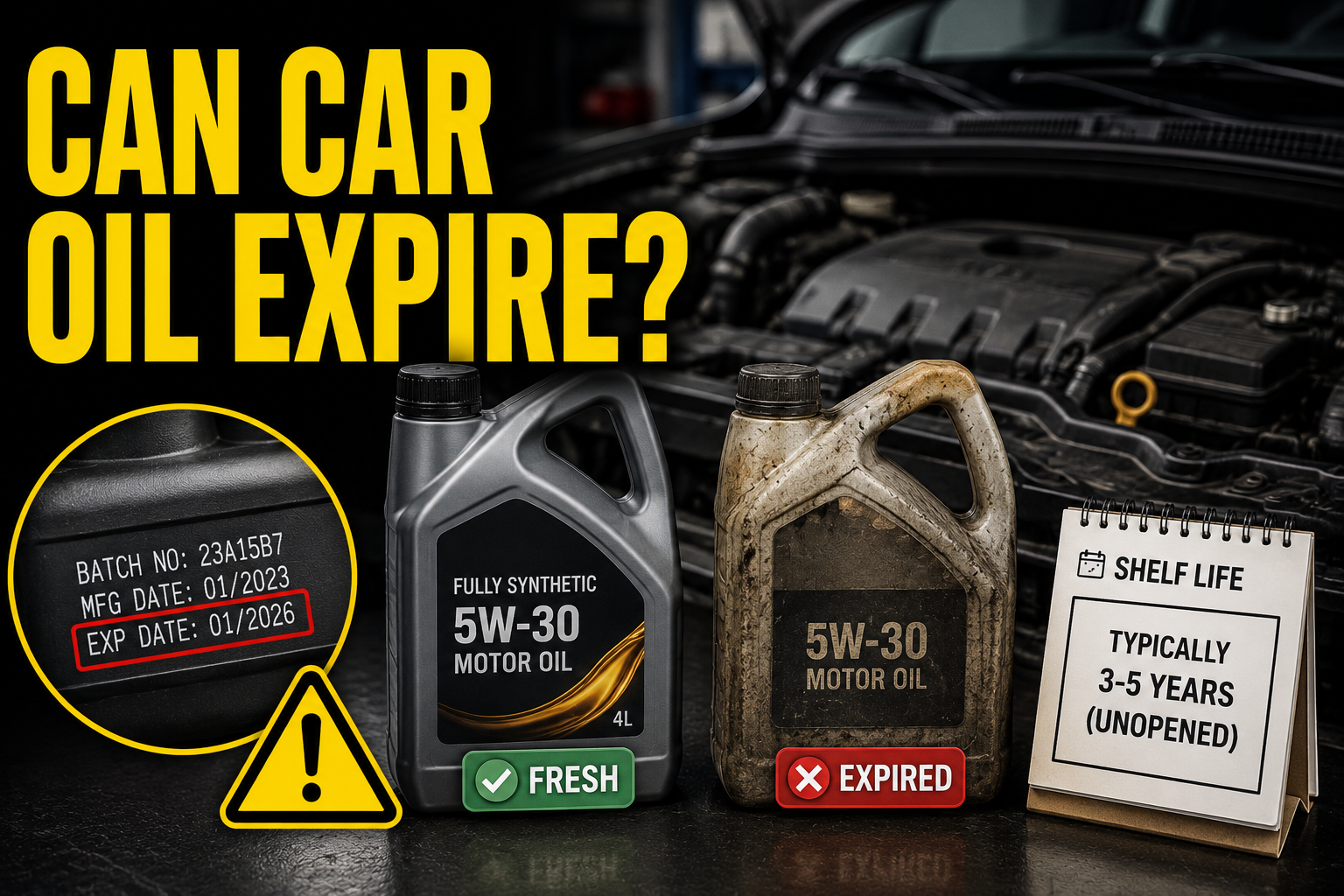
Yes, though not in the way food does. A sealed bottle of motor oil stored somewhere cool and dry is usually good for around five years, and often longer for synthetic. Once opened, treat it as having about a year. And oil already sitting in your engine ages on the calendar whether or not you drive the car.
Those are three different situations, and the question hides all three. Which one you are in decides the answer.
Three different questions in one
People arrive at this question from different directions. Some have found a dusty bottle at the back of the garage. Some have a part-used container from the last top-up. Some drive two thousand miles a year and wonder whether the annual oil change is really necessary.
| Situation | Rough working life | What limits it |
| Sealed bottle, cool dry storage | Around 5 years, often longer for synthetic | Slow additive separation |
| Sealed bottle, hot shed or sunlight | Considerably less | Heat and temperature cycling |
| Opened bottle, resealed | Roughly a year | Air and moisture ingress |
| In the engine, driven normally | The interval in your handbook | Heat, soot, fuel dilution |
| In the engine, barely driven | 6 to 12 months | Condensation and acids |
Notice the bottom two rows. Oil in an engine has a much shorter working life than oil in a bottle, because an engine is a hostile environment: heat, combustion byproducts, and moisture all attack it. That is why a handbook interval is measured in months and miles rather than years.
What actually goes off?
Motor oil is two things: a base oil, and a package of additives blended into it.
The base oil is remarkably stable. Left sealed and cool, it does not meaningfully deteriorate over the sort of timescales we are discussing. If that were the whole story, oil would keep almost indefinitely.
The additives are the perishable part. Detergents, dispersants, anti-wear agents, corrosion inhibitors, and viscosity improvers are dissolved into the base oil, and over long periods some of them can come out of solution and settle. That is called additive dropout, and it is the main thing that limits shelf life.
An old bottle of oil has not usually turned into something harmful. It has turned into something uneven: base oil at the top, and the additives that were meant to protect your engine sitting at the bottom.
Two other processes matter. Oxidation happens slowly as oxygen reaches the oil, and even a sealed container permits a little exchange over years. And moisture absorption matters because oil draws water vapour from the air, which is why an opened bottle in a damp garage ages far faster than a sealed one.
Heat accelerates all of it. A bottle in a sunlit shed that swings between freezing nights and hot afternoons will be finished long before an identical bottle on a cool indoor shelf.
Oil in a sealed bottle
Manufacturers generally suggest around five years for a sealed container kept in reasonable conditions, and synthetic oils often tolerate longer because their base stocks are more uniform and stable.
You will occasionally see the argument that a properly stored, factory-sealed lubricant has no real expiry at all. There is something to that: in a temperature-controlled warehouse, oil keeps a very long time. But most people are not storing oil in a temperature-controlled warehouse. They are storing it in a garage, and that is exactly where the temperature swings and humidity that shorten its life are found.
So treat five years as a sensible working figure rather than a hard deadline, and weight it by where the bottle has been. A bottle that has sat in a cool cupboard is in far better shape at five years than one that has spent two summers next to a window.
There is a second consideration that has nothing to do with degradation: specification. Oil standards are revised over time, and an oil that met the current specification when it was made may no longer meet what your car requires. On a bottle that is several years old, check the specification on the label against your handbook before you think about the condition of the liquid inside.
Oil in an opened bottle
Once the seal is broken, the clock speeds up considerably. Air and moisture can now reach the oil every time the cap comes off, and any dust that gets in stays in.
A year is a reasonable rule for an opened bottle that has been tightly resealed and kept somewhere sensible. Beyond that, inspect it carefully rather than assuming.
This matters more than people realise because the classic scenario is the half-litre top-up bottle handed over at a service, which then lives in the boot. A car boot is one of the worst places to store oil: it heats up in sun, cools overnight, and cycles through that every day. Oil kept there ages quickly.
How to inspect a bottle before using it?
A few seconds of looking tells you most of what you need.
- Check the label first for a production or expiry date, and for the specification. Many bottles carry a batch code rather than a plain date, and manufacturers publish how to read theirs.
- Look at the colour. Fresh oil is a clear, translucent amber. Cloudiness is a warning sign.
- Check for separation. Hold the bottle up and look for distinct layers, or sediment settled at the bottom.
- Shake it and look again. Mild settling that redisperses evenly is common and not necessarily a problem. Separation that persists, or sediment that will not remix, means the additive package has dropped out.
- Look for a milky appearance, which indicates water contamination. Do not use it.
- Smell it. Fresh oil smells mildly of petroleum. A sour or acrid smell suggests it has oxidised.
If any of those checks fail, the economics are simple. A bottle of oil is inexpensive, and an engine is not. Nobody has ever regretted throwing away a doubtful bottle of oil.
Oil already in your engine
This is where the stakes are higher, because degraded oil in an engine is actively doing damage rather than sitting in a cupboard.
In an engine, oil faces conditions a bottle never sees. It runs hot, cools, and reheats with every journey. It picks up soot from combustion, small amounts of unburnt fuel, and water produced as a byproduct of burning petrol or diesel. The additive package is not just separating here; it is being consumed doing its job.
This is why service intervals are quoted as mileage or time, whichever comes first. The mileage limit covers the wear from use, and the time limit covers the chemistry that happens regardless. AutoZone’s explanation of oil change time versus mileage makes the point that oil degrades and oxidises even in a car driven only a hundred miles.
Worth separating two things that often get confused: dark oil is not the same as expired oil. Oil darkens because its detergents are lifting soot and deposits off internal surfaces and holding them in suspension, which is the additive package working. Colour is a poor indicator. Texture, smell, and the calendar are better ones.
The low mileage trap
If you drive very little, this is the section that matters.
A car that covers three thousand miles a year will not reach a ten thousand mile service limit for over three years. In that time the oil will have degraded substantially, and the odometer will have said nothing about it.
The mechanism is condensation. Burning fuel produces water, and some of it reaches the crankcase. On a long drive the engine gets hot enough for that water to evaporate off. On short trips it never does, so moisture accumulates in the oil, combines with combustion byproducts, and forms acids that corrode internal surfaces. A car doing school runs and shopping trips is working its oil harder than one doing motorway miles, despite covering a fraction of the distance.
So for a low-mileage car, use the time half of the interval and treat six to twelve months as the working figure, following whatever the handbook specifies. Most handbooks also list a severe service schedule that shortens the interval for short journeys, frequent idling, and dusty conditions, and everyday urban driving fits that description more often than owners assume.
If you are laying a car up for months, change the oil before storage rather than after. Leaving used, acidic oil sitting in an engine for a long period is exactly the condition that causes corrosion.
Storing oil so it lasts
- Keep it indoors if you can. A cool cupboard beats a garage, and a garage beats a shed. Stable temperature matters more than a low one.
- Keep it out of sunlight. Ultraviolet light and the heat that comes with it accelerate degradation.
- Seal it properly and store it upright. This limits both air exchange and the chance of leaks.
- Get it off a concrete floor. Concrete holds moisture and encourages condensation on the container.
- Write the date on it. The date you opened it, in marker pen on the bottle. It removes all the guesswork later.
Disposing of oil you cannot use
Do not pour it down a drain, onto the ground, or into household waste. Used and unusable motor oil is a pollutant, and a small quantity contaminates a large volume of water.
Take it to a recycling centre or a garage that accepts waste oil. Many parts retailers accept it too, usually free, and this applies to unused oil that has gone off as much as to oil drained from an engine. Keep it in its original container with the cap on for transport.
Conclusion
A sealed bottle stored somewhere cool and dry is usually fine for around five years, an opened bottle for about a year, and both figures shrink sharply if the oil has lived somewhere hot.
Check the label for the specification as well as the date, then look for cloudiness, separation, or sediment that will not remix. For oil in your engine, follow whichever comes first out of mileage and time, and if you drive very little, the time limit is the one that applies to you.
Frequently asked questions
How long does unopened motor oil last?
Around five years stored somewhere cool, dry, and out of sunlight, and often longer for synthetic. Storage conditions matter more than the calendar, so a bottle kept in a hot shed will be finished well before one on an indoor shelf.
Can I use motor oil that is ten years old?
Inspect it carefully first. Check for cloudiness, separation, or sediment that will not remix when shaken, and check the specification on the label still matches your car. If anything looks doubtful, replace it rather than risk an engine.
Does synthetic oil last longer in storage than conventional?
Generally yes. Synthetic base stocks are more uniform and resist oxidation better, so they tolerate imperfect storage somewhat better. They are not immune, and the same additive dropout eventually affects them.
Do I still need an oil change if I barely drive?
Yes. Oil degrades on the calendar through oxidation and condensation, and short trips never get the engine hot enough to evaporate that moisture off. Follow the time half of your service interval, typically six to twelve months.
Does dark oil mean it has expired?
No. Oil darkens because its detergents are lifting deposits off engine surfaces and holding them in suspension, which is the oil working properly. Judge it by texture, smell, and the service interval rather than colour.