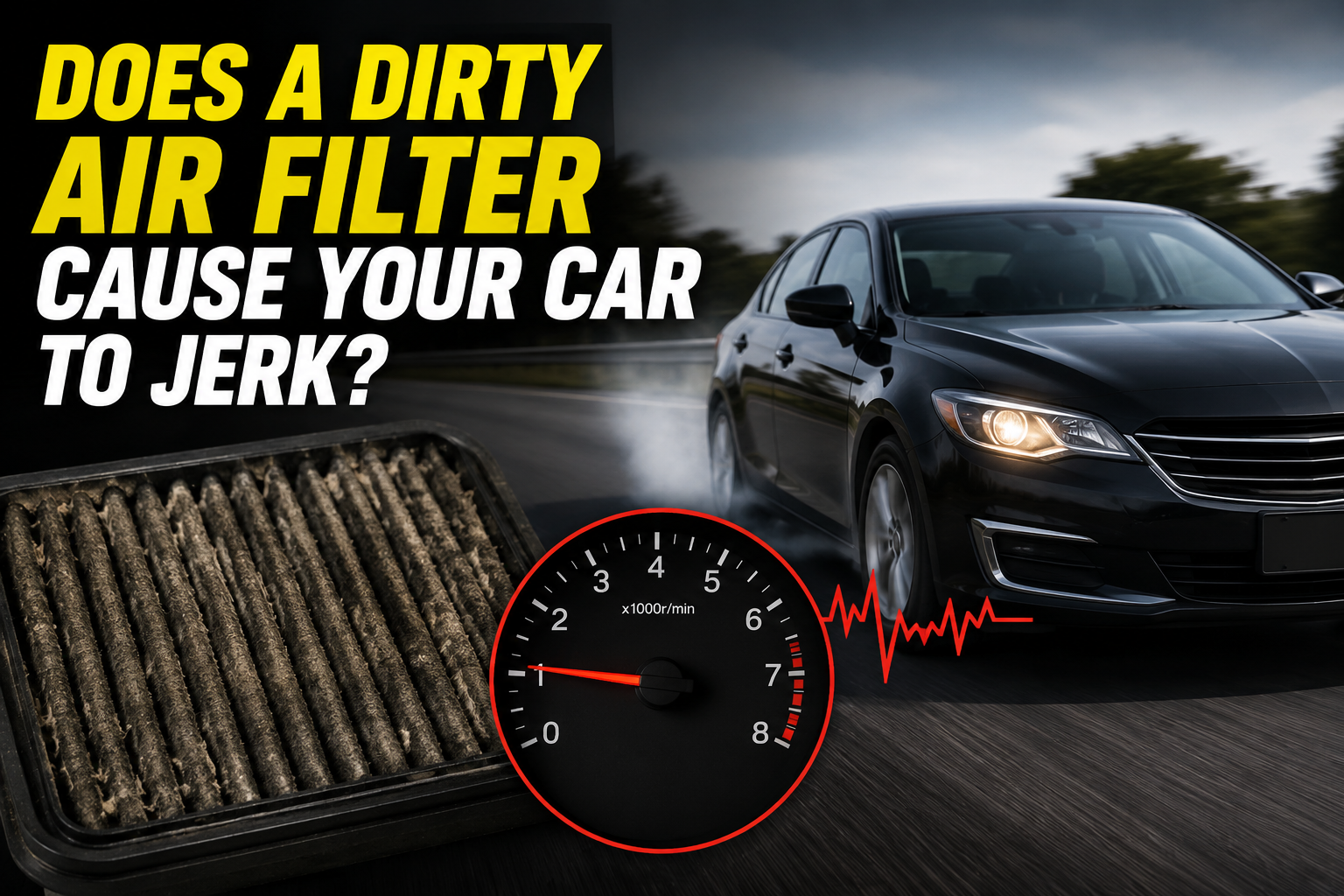
Rarely. A clogged air filter mostly makes a car feel sluggish and gutless, not jerky. If your car is genuinely jerking or stumbling, the cause is far more likely to be ignition, fuel delivery, or the transmission.
- Sluggish and jerky are different symptoms
- Why a dirty filter usually does not cause jerking
- What actually makes a car jerk
- How to tell them apart
- When the jerk happens narrows it further
- Actually checking your air filter
- What a dirty filter actually does cause
- When it is worth replacing anyway
- Conclusion
- Frequently asked questions
- Related Articles
That distinction is worth getting right, because a new air filter costs about $20 and fixing the actual cause usually costs more. Here is what a dirty filter does, what jerking actually indicates, and how to tell which one you have.
Sluggish and jerky are different symptoms
These two words get used interchangeably, and they point at completely different faults.
Sluggish means the car pulls weakly but smoothly. You press the accelerator, and the response is soft, delayed, or underwhelming, especially climbing a hill or merging. Power delivery is continuous, just reduced.
Jerking means the power delivery is interrupted. The car surges and drops, stumbles, bucks, or hesitates in distinct moments. Something is cutting in and out rather than simply being weak.
A restriction produces less power. An interruption produces jerking. A dirty air filter is a restriction.
Why a dirty filter usually does not cause jerking
Modern engines are much better at handling restricted airflow than older ones, and the reason is worth understanding.
Your engine has a mass airflow sensor measuring exactly how much air enters, and oxygen sensors measuring what comes out of combustion. The computer uses both to adjust how long the fuel injectors stay open, keeping the air-fuel ratio correct. That adjustment is called fuel trim.
When the filter gets clogged, less air arrives. The sensors detect this, and the computer reduces fuel to match. The mixture stays correct. What you lose is power, because less air plus less fuel equals a smaller combustion event.
This is a smooth, continuous adjustment across all cylinders at once. It does not produce jerking. It produces a car that feels like it has gone flat.
Carburetted engines behaved differently. Without electronic control, a restricted filter made the mixture progressively richer, which could cause genuine stumbling and rough running. If your car is from the 1980s or earlier, the old advice applies. On anything fuel-injected, the computer absorbs most of the restriction.
There is a limit to this. Fuel trim has a range, and a filter clogged badly enough to push the computer past that range will set a code and can produce real driveability problems. But that means a filter so blocked you cannot see light through it, not one that simply looks dusty.
What actually makes a car jerk
Jerking is an interruption in power delivery, and these are the usual sources.
Ignition faults are the most common. A worn spark plug or failing ignition coil means one cylinder stops contributing, briefly and repeatedly. That is felt as a stumble or buck, most obviously under load. It usually sets a misfire code, and a flashing check engine light means an active misfire serious enough to damage the catalytic converter.
Fuel delivery problems produce the same feel from the other direction. Clogged injectors spray unevenly, a weak fuel pump cannot hold pressure under demand, and a blocked fuel filter starves the engine when you ask for more. All of these cause power to arrive inconsistently.
A failing mass airflow sensor is a genuinely airflow-related cause, and it is worth separating from the filter itself. A dirty or faulty MAF sends wrong readings, so the computer calculates the wrong amount of fuel. Unlike a restricted filter, this produces erratic mixture rather than a consistently reduced one, and that does cause jerking.
Transmission issues cause jerking that coincides with gear changes rather than with engine speed. Low or degraded fluid, a failing torque converter, or a control module fault will make shifts harsh or slipping.
Vacuum leaks let unmetered air into the engine after the sensor, so the computer never accounts for it. The mixture goes lean and idle becomes unstable.
How to tell them apart
You can narrow this down considerably in a few minutes.
| What you notice | Points toward |
| Smooth but weak, worst under load | Air filter restriction, or general lack of maintenance |
| Rhythmic stumble that tracks engine speed | Ignition misfire, spark plugs or coils |
| Jerk that happens at gear changes only | Transmission |
| Erratic, unpredictable surging | MAF sensor, vacuum leak, or fuel delivery |
| Rough idle plus hesitation | Vacuum leak, injectors, or ignition |
| Check engine light flashing | Active misfire, stop driving and get it diagnosed |
Two other quick checks help. Read the codes with a cheap OBD-II reader, because misfire codes such as P0301 through P0304 point at specific cylinders, and a lean code such as P0171 points at unmetered air. And ask when the jerking started, since a symptom that appeared suddenly points at a component failure, while one that crept in over months points at wear or a gradual restriction.
When the jerk happens narrows it further
Pay attention to the conditions, because each pattern has a short list of suspects.
- Only when cold, clearing after a few minutes, suggests a temperature sensor feeding the computer bad data, or plugs weak enough to struggle with a cold, rich mixture.
- Only under hard acceleration or load points at fuel supply, since that is when demand peaks. A weak pump or blocked fuel filter copes fine at light throttle and falls short when you ask for everything.
- At steady cruise on a light throttle often means a lean condition, typically a vacuum leak or a failing MAF.
- Only at idle, smoothing out as you drive, points at ignition or a vacuum leak, because idle is the lowest power state and has the least momentum to hide a misfire.
- At a specific speed every time, regardless of engine load, usually is not the engine at all. That pattern points at the transmission or torque converter.
Actually checking your air filter
This takes about two minutes and settles the question directly.
- Open the airbox. It is a black plastic box on top of or beside the engine, held by clips or a few screws. No tools needed on most cars.
- Lift the filter out and note which way up it sits.
- Hold it up to a light source. A serviceable filter lets light through the pleats. If you cannot see light at all, it is due for replacement.
- Look for the obvious. Leaves, insects, or a rodent nest mean it has been there a long time.
- Check the housing seals. A cracked airbox or a filter that does not seat properly lets unfiltered air past the sensor, and that causes real running problems.
A slightly grey filter is normal and is still doing its job. Filters do not need replacing because they look used. Most manufacturers specify somewhere between 15,000 and 30,000 miles, shorter if you drive on dust or gravel regularly.
One thing to confirm while you are there: make sure you are looking at the right filter. Cars have two, and they do unrelated jobs. The engine air filter sits in the airbox under the bonnet and feeds the engine. The cabin air filter usually sits behind the glovebox and filters the air coming through your vents. A blocked cabin filter makes the vents weak and the car smell musty. It has no connection to the engine at all and cannot affect how the car drives.
Also worth knowing: cleaning a paper filter is not a real fix. Tapping out loose debris is harmless, but blowing compressed air through the pleats damages the media and creates gaps that let dust through. Reusable oiled filters are different and have their own washing procedure, but over-oiling one after cleaning is a common way to contaminate the airflow sensor downstream.
What a dirty filter actually does cause
None of this makes the filter unimportant. It just causes different symptoms than jerking.
- Reduced power, most obvious when accelerating hard, merging, or climbing.
- Slightly worse fuel economy, since the engine works harder for the same output.
- A strained or louder intake note as air is pulled through the restriction.
- Engine wear if the filter is damaged rather than merely dirty, because unfiltered air carries abrasive dust straight into the cylinders. This is the real reason to keep the filter in good condition.
- A check engine light in severe cases, once the restriction pushes fuel trim beyond its correction range.
Replacing it is one of the cheapest jobs on a car, usually $15 to $40 for the part and a few minutes of work. Worth doing on schedule regardless of your jerking problem.
When it is worth replacing anyway
Change the filter first if any of these apply.
- You cannot remember when it was last done, or the car has passed its service interval.
- Light does not pass through it.
- You drive regularly on unsealed roads or in heavy dust.
- The symptom is genuinely sluggishness rather than jerking.
It is cheap, it is quick, and it eliminates one variable before you spend money on diagnosis. Just do not expect it to cure a stumble, and do not let it delay proper diagnosis if the check engine light is flashing.
Conclusion
A dirty air filter can contribute to poor running, but on a modern fuel-injected engine it typically causes smooth power loss rather than jerking, because the computer compensates by reducing fuel. Genuine jerking points at ignition, fuel delivery, the MAF sensor, or the transmission. Check the filter first because it takes two minutes and costs almost nothing, then read the trouble codes. If the check engine light is flashing, get it diagnosed rather than replacing parts.
Frequently asked questions
Can a dirty air filter cause a check engine light?
Yes, in severe cases. A heavily restricted filter can push fuel trim past its correction range and set a lean or rich code. A moderately dusty filter will not. If the light is flashing, that indicates an active misfire and needs immediate attention.
How do I know if my air filter needs changing?
Hold it up to a light. If light passes through the pleats it is still working; if it does not, replace it. Most manufacturers specify 15,000 to 30,000 miles, sooner for dusty or unsealed roads.
Will replacing my air filter fix jerking?
Usually not. A restricted filter causes smooth power loss rather than interrupted power delivery. Replace it anyway if it is overdue, since it is cheap, but expect to look at ignition, fuel, or the transmission for the actual jerk.
Can a dirty air filter damage my engine?
A dirty filter is doing its job. A damaged or badly fitted one is the risk, because it lets abrasive dust reach the cylinders. Always check that the filter seats properly and the airbox is undamaged when you fit a new one.
What is the most common cause of a car jerking when accelerating?
Ignition faults, particularly worn spark plugs or a failing coil, causing a cylinder to misfire under load. Fuel delivery problems and a faulty MAF sensor are the next most common. Reading the trouble codes narrows it down quickly.
Related Articles
What to Put Under Tires When Storing a Car?
How to Tell If Your Car AC Compressor Is Bad?