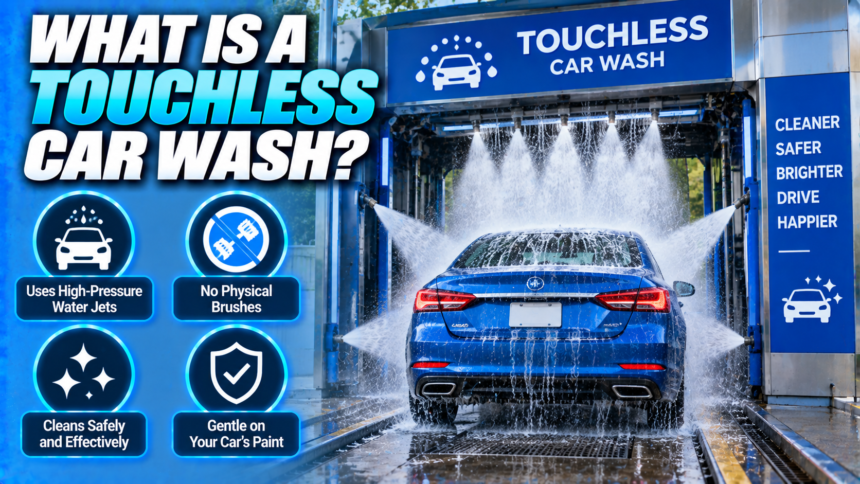
A touchless car wash cleans your vehicle using only high-pressure water and chemical detergents. Nothing physically contacts the paint: no brushes, no cloth strips, no foam rollers. The chemistry does the job that friction does in a conventional automatic wash.
That trade is the entire story of touchless washing. You give up mechanical agitation and get it back in stronger detergent, and understanding what that swap actually costs is how you decide whether it suits your car.
How it works
The cleaning happens in a specific sequence, and the order is not arbitrary. Most touchless systems use what the industry calls two-step chemistry.
First comes a low-pH acidic presoak, which dissolves the inorganic material on the surface: mineral deposits, brake dust, and the grey road film that builds up in traffic. Then comes a high-pH alkaline detergent, which breaks down the organic material: bugs, bird droppings, tree sap, and grease. Two opposite chemistries because contamination on a car is not one thing, and no single detergent handles both well.
Between the chemicals and the rinse there is a dwell period, usually under a minute, where the detergents break the bond holding grime to the clear coat. That pause is doing real work, and it is why a touchless wash cannot simply be run faster.
Then the high-pressure rinse. Oscillating nozzles mounted on a gantry, or on fixed arches in a tunnel, blast the loosened material off the surface. Many systems finish with a spot-free rinse using reverse-osmosis or deionized water, which has the dissolved minerals removed so it evaporates without leaving spots, followed by forced-air dryers.
Modern in-bay systems use sensors or laser profiling to map the shape of the vehicle as the gantry travels, which keeps the nozzles at a consistent distance from a hatchback and an extended-cab pickup alike.
How it compares to the alternatives
| Type | How it cleans | Main risk | Best suited to |
| Touchless | High-pressure water plus aggressive two-step chemistry | Harsher detergents, and bonded grime often survives | Wraps, ceramic coatings, dark or new paint, aftermarket trim |
| Soft-touch (friction) | Cloth strips or closed-cell foam with mild detergent | Swirl marks if the media is not kept clean | Heavy soiling, road salt, mud, work vehicles |
| Hand wash | Manual contact with a mitt and mild soap | Entirely dependent on technique | The best possible result, if done with two buckets and a grit guard |
What touchless genuinely does better
There is one real advantage and it is a significant one: nothing that touched the last vehicle touches yours. Swirl marks and fine scratches are the most common paint defect on daily-driven cars, and they come from contact, whether that is a poorly maintained wash brush, a dirty wash mitt, or a dry towel. Remove the contact and you remove that entire category of damage.
That makes touchless the sensible default for anything where surface contact is a particular problem: vinyl wraps, ceramic coatings, aftermarket spoilers and pinstriping, roof racks, loose or aged trim, and older cars with fragile clear coat.
It also carries manufacturer backing in some cases. Tesla’s owner’s manual instructs owners to use touchless washes only when using an automatic wash, on the explicit grounds that they have no parts that contact the vehicle’s surfaces. When a manufacturer writes that into the owner’s manual, it is worth taking seriously.
The practical advantages are the obvious ones as well: three to five minutes, typically $10 to $20, no appointment, and no effort.
What it does badly
Because chemistry has to do the entire job, touchless detergents are considerably stronger than anything you would use on a driveway. That has consequences.
- Bonded contamination often survives. Brake dust baked onto wheels, week-old bug residue on a bumper, road tar, and tree sap frequently come out the other end still attached.
- Anything the jets cannot reach at a useful angle stays dirty. Lower rocker panels, the area behind mirrors, and the rear of the vehicle on some systems are the usual survivors.
- Wax and sealant strip faster than they would under gentle friction washing, because high-pH detergent is very good at removing exactly that kind of surface layer.
- The undercarriage is harder to clean thoroughly without contact, which matters in salt regions. Look for a wash with a dedicated undercarriage rinse rather than assuming it is included.
The trim question
This is the part that gets left out of most explanations, and it comes from the manufacturers rather than from anywhere else.
Touchless washing does not eliminate risk. It exchanges a mechanical risk for a chemical one. The high-pH detergents that make touchless work can, with repeated exposure, dull or discolor certain finishes: anodized and satin-black trim, unsealed aluminum, and some plastic surfaces are the vulnerable ones.
Tesla’s own guidance is a useful illustration precisely because it recommends touchless in the same breath. The manual tells owners to use touchless washes only, and then warns that some touchless washes use caustic solutions which over time cause discoloration of decorative exterior trim, advising owners to avoid exposure to chemicals above pH 13. Both things are true simultaneously: safer for the paint, potentially harder on the trim.
For most modern vehicles that remains a good trade, since paint damage is permanent and expensive while trim discoloration is slower and more limited. But the accurate framing is a swap rather than the absence of risk, and it is worth asking a wash what chemistry it runs if your car has a lot of satin or anodized exterior detailing.
Which one to use, and when
- Touchless makes sense for new or dark paint, ceramic coatings, vinyl wraps, aftermarket trim, and generally for maintaining a car that is already clean.
- Soft-touch makes sense when the car is genuinely dirty: heavy salt, caked mud, months of neglect, or a work vehicle where getting it clean matters more than a flawless finish.
- Hand washing produces the best result when done properly, with two buckets and a grit guard, and the worst result when done with one bucket and a household sponge.
- The realistic middle ground most people land on: touchless routinely through the year, plus a proper hand wash and decontamination two or three times annually to remove what touchless leaves behind.
Getting a better result from one
- Knock heavy mud off at a self-serve bay first. Touchless chemistry is designed for road film, not for agricultural quantities of dirt.
- Choose a wash with a real undercarriage rinse if you drive on salted roads through winter.
- Keep a clean microfiber in the car. The dryers never fully clear door jambs, mirror housings, or the seams around the trunk lid.
- Go regularly rather than occasionally. Touchless keeps a clean car clean far more effectively than it rescues a filthy one, and frequency is the single biggest factor in the result you get.
- Reapply a wax or sealant periodically, because the detergents are steadily removing it. A protected surface also releases dirt more easily, so the wash works better.
- Fold the mirrors, retract or remove aerials where applicable, and check that any roof accessories are secure.
What the add-ons actually do
Every touchless menu has an upsell tier, and the names rarely describe the product. Broadly there are three things being sold.
- Spray wax or clear coat protectant. A thin polymer layer applied in the rinse stage. It genuinely helps water sheet off and adds some gloss, and it lasts days to a couple of weeks rather than months. Useful, not a substitute for a real sealant.
- Ceramic or graphene sealant. A more durable version of the same idea, typically lasting several weeks. Worth the upgrade if you use the wash routinely, since it partially offsets the wax stripping the detergents cause.
- Undercarriage rinse. The one add-on that is unambiguously worth buying if you drive on salted roads, because salt sitting in seams and on suspension components is what actually rots a car.
Tire shine and similar cosmetic extras are exactly what they sound like and change nothing about how clean the vehicle is.
The environmental side
Commercial washes are required to send their wastewater to the sanitary sewer for treatment, rather than to storm drains. That distinction matters more than it sounds, because in most municipalities storm drains do not go to a treatment plant at all. They discharge directly into the nearest creek, river, or lake.
Washing a car on a driveway sends detergent, oil, grease, brake dust and heavy metals across an impervious surface, into the gutter, and out of a pipe into local water untreated. The EPA treats vehicle washing as a recognized source of stormwater pollution and its best practice guidance calls for wash water to be contained and directed to the sanitary sewer rather than allowed to reach a storm inlet.
Many commercial facilities also reclaim and recycle water between vehicles, which means the water used per car is often lower than running a hose at home for twenty minutes. If the environmental question matters to you, the commercial wash is generally the better option regardless of which type you choose.
Conclusion
A touchless wash uses high-pressure water and two-step chemistry, acidic first for road film and alkaline second for organic matter, with nothing physically touching the car. That removes the risk of swirl marks entirely, which is why several manufacturers specify it, and it introduces a chemical risk to trim instead. It is the right routine choice for wrapped, coated, new or dark-painted cars, it will not remove heavily bonded contamination, and it works far better as regular maintenance than as a rescue for a car that has not been washed since spring.
Frequently asked questions
Is a touchless car wash safe for my paint?
Safer than any wash that touches the paint, since swirl marks and fine scratches come from contact. The trade is stronger detergent, which strips wax faster and can dull certain trim finishes over repeated use.
Does a touchless wash actually get a car clean?
For ordinary road film, yes. For bonded contamination like baked-on bugs, tar, tree sap, or brake dust welded to wheels, often not. Chemistry alone struggles where friction would remove it in one pass.
Is touchless better than a soft-touch wash?
Better for paint condition, worse for cleaning power. Touchless suits a car you are maintaining; soft-touch suits a car you are rescuing. Well-maintained modern friction equipment is far gentler than older brush systems were.
Will a touchless car wash remove my wax?
It will shorten its life. The high-pH detergents that make touchless work are effective at removing surface layers, wax and sealant included. Reapply protection periodically if you use touchless washes routinely.
Can I take a wrapped or ceramic-coated car through a touchless wash?
Yes, and it is generally the recommended automatic option for both, since no brushes contact the film or coating. Avoid aiming high pressure directly at wrap edges and seams, where lifting starts.
Related Articles
Where to Put Jack Stands on a Car: Safe Placement Points
Why Is My Car Shaking? How to Find the Cause
How Do the Fins Help in Radiator Cooling? A Complete Guide for Drivers