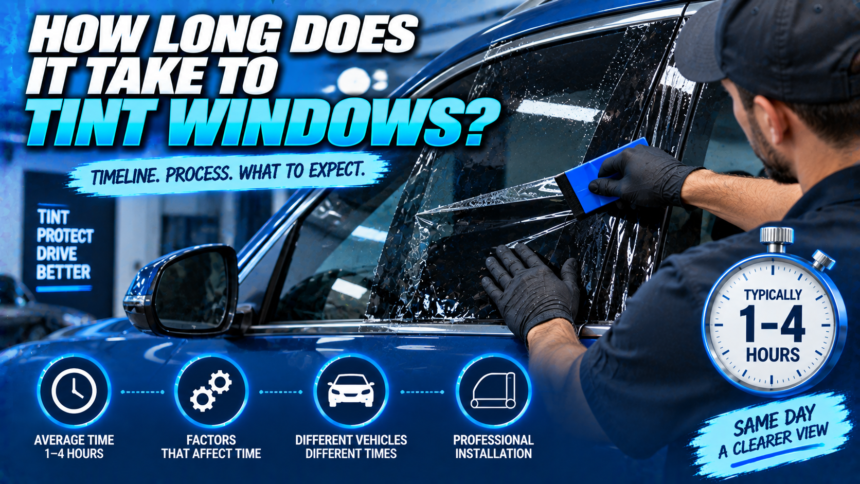
Tinting a car’s windows takes about 1.5 to 4 hours for most vehicles. A standard sedan usually runs 1 to 2 hours, while a larger SUV or truck with more glass can take 3 to 4. That is the time your car sits in the shop. There is a second clock most people forget: after the install, the film needs 3 to 5 days to cure before you can roll the windows down.
- How long does it take by vehicle type?
- What makes a tint job take longer
- What actually happens during the job
- Does a shop, mobile service, or DIY change the time?
- Curing: the wait that isn’t install time
- How weather and season change the timing
- Aftercare so the time pays off
- Conclusion
- Frequently asked questions
- Related Articles
So the honest answer has two parts. Plan to be without the car for a few hours on the day, then treat the windows gently for the rest of the week. This guide walks through both, plus the things that make a job faster or slower so you can plan around it.
How long does it take by vehicle type?
The biggest factor is simply how many windows you have and how curved they are. More glass means more film to cut, shape, and fit. Here is what to expect for a full tint job in 2026, using precut, computer-cut film, which is standard at good shops now.
| Vehicle | Windows tinted | Typical time |
| Front two windows only | 2 | 30 to 45 minutes |
| 2-door coupe | 5 to 6 | 1.5 to 2.5 hours |
| 4-door sedan | 7 | 1 to 2 hours |
| SUV / minivan | 8+ | 2 to 4 hours |
| Pickup truck | 4 to 6 | 1 to 2 hours |
A quick surprise in that table: a two-door coupe can take longer than a four-door sedan. Coupes have big, deep side windows and tight rear quarters that are awkward to reach, so the installer spends more time shaping film in a cramped space. Trucks are often the quickest full job because they have the fewest windows.
It’s also worth knowing that many SUVs, trucks, and even some sedans already come with dark “privacy glass” in the rear from the factory. That glass is tinted in the manufacturing itself, not with film, so you may only need the front windows done. Tinting just the front two is the fastest job on the list and a common choice for used cars that already have shaded rear glass. If you’re not sure whether your car has it, the installer can tell you in seconds.
What makes a tint job take longer
Two cars of the same size can still take different amounts of time. A few things push the clock up, and it helps to know them before you book so the quoted time makes sense.
Removing old tint is the big one. If your car already has film that is bubbling or peeling, the installer has to strip it off and scrape away the old adhesive before anything new goes on. That alone can add 30 minutes to several hours, depending on how baked-on the old film is. If your windows are bare glass, you skip this entirely.
Film type matters too. Ceramic and carbon films are thicker and stiffer than basic dyed film, so they take a little more care to position and smooth out. The difference is small, usually minutes, not hours, but it is real on a full car.
Glass complexity is the quiet time-sink. Curved rear windows, defroster lines, frameless door glass, and steep windshields all add steps. A flat, simple window goes fast; a sharply curved rear hatch on an SUV needs the film heat-shaped to fit, which takes patience.
- Number of windows: the more you tint, the longer it takes, which is obvious but adds up fast on a three-row SUV.
- Shop workflow: a busy shop juggling several cars may quote a longer window even if the hands-on time is short.
- A windshield or sunroof: these are large, curved, and add real time, especially a full windshield film.
Electric cars and some luxury models deserve a mention here. A Tesla and similar EVs often have large, one-piece rear glass or a big glass roof that is tricky to film in a single clean piece, and they carry sensors and antennas the installer works around. None of that is a problem for an experienced shop, but it can nudge the time up, so ask when you book if you drive one.
The single biggest swing in timing is old tint removal. If you’re replacing existing film, ask the shop to factor removal into the estimate so you’re not caught off guard by a longer wait.
What actually happens during the job
Knowing the steps makes the time make sense. A careful install is not slow because someone is dawdling; each stage has to be done right or the film bubbles later. Here is the usual order.
- Consultation and film choice: you pick the film type and the darkness level (measured as VLT, the percent of light let through). This takes a few minutes up front.
- Cleaning: the installer deep-cleans every window inside and out. A single speck of dust trapped under film shows as a bump forever, so this stage is not rushed.
- Cutting: the film is cut to your exact windows, usually on a computer plotter using your car’s make and model, which is faster and cleaner than hand-cutting.
- Shaping: for curved glass, the film is heat-shrunk on the outside of the window first so it hugs the curve without wrinkles.
- Application: using a spray of slip solution, the installer positions the film on the inside of the glass, then squeegees out the water and air.
- Final check: they inspect edges and corners, clear any last bubbles, and let you know the aftercare rules before you drive off.
That wet application in step five is why curing exists. The film goes on with water underneath it, and that moisture has to evaporate out through the film over the next few days. Which brings us to the second clock.
Does a shop, mobile service, or DIY change the time?
Where and how the film goes on changes the clock quite a bit. A dedicated tint shop is usually the fastest and cleanest option. The installers do this all day, they have a dust-controlled space, and they use a plotter to cut film to your exact car, so a sedan is in and out in an hour or two.
Mobile installers who come to your home or office are convenient, but the job can run a little longer. They are working in your driveway or a parking lot, so they spend extra care controlling dust and wind, and a garage is strongly preferred over open air. The hands-on time is similar, but the setup and cleanup add a bit.
Doing it yourself is the slowest path by far. A first-timer can spend a full day on a single car and still end up with bubbles or lifted edges on curved glass, which then have to be redone. DIY kits are cheap, but the time cost and the risk of a poor result are why most people leave it to a shop. If you do try it, budget several hours per car and pick a warm, still day.
Curing: the wait that isn’t install time
Curing is the time the adhesive needs to fully bond to the glass after the install. Most quality films need 3 to 5 days before it is safe to roll the windows down, and full curing, where every last bit of trapped moisture is gone, can take up to 30 days.
The first few days are the sensitive part. Roll a window down too early and the film can peel, bubble, or curl at the edge as it slides into the door, and you may have to pay to redo it. So the rule is simple: leave the windows up for the first few days, even if the tint looks dry. It often looks finished on the surface while the adhesive underneath is still setting.
The wait length shifts with the film and the conditions. Thicker ceramic and multi-layer films can need a little longer than thin dyed film. Hot, dry, sunny weather can have you safe in as few as 2 to 3 days, while cold or humid conditions can stretch it past 5. When in doubt, give it an extra day; there is no downside to waiting, and a redo costs far more time than patience does.
One thing that throws people: light haze and tiny water bubbles are normal in the first week. They are trapped moisture working its way out, not a bad job, and they clear on their own as the film cures. If bubbles are still there after about a week, that is when to call the shop. For the manufacturer’s own take on how film bonds and cures, 3M’s window film care page is a solid reference.
How weather and season change the timing
The install itself is indoors, so weather barely touches it. Curing is a different story, because it depends on heat and moisture evaporating. Warm, dry, sunny conditions cure film faster. Cold, cloudy, or humid weather slows it down and can push the safe wait toward the full five days or a bit longer.
Season plays into it too. Summer speeds up curing, but shops are busiest then, so you may wait longer for an appointment. Winter slows the drying and traps more moisture in cold, damp air. Spring and fall tend to hit the sweet spot: enough warmth to cure well without the summer crowds. Where you park matters as well, since a car left in the sun cures faster than one tucked in a shaded garage. If you have flexibility, booking in the milder months can mean both a quicker appointment and a cleaner cure.
Aftercare so the time pays off
You waited the hours and the days; a little care in the first week protects all of it. None of this is hard, it is mostly about leaving the film alone while it sets.
- Keep the windows up for 3 to 5 days, longer in cold or humid weather.
- Don’t clean the inside of the glass for at least a week; wiping can lift a soft edge.
- When you do clean, use an ammonia-free cleaner and a soft microfiber cloth, since ammonia breaks tint down over time.
- Avoid parking under trees or in dusty spots during curing, so debris doesn’t stick to damp edges.
- Washing the outside of the car is fine right away; it’s only the inside glass that needs a break.
- Using the AC or defroster is fine and can even help the film cure by keeping the cabin warm and dry.
Follow the specific instructions your shop gives you, since they know the exact film you got. If they offered an express or fast-cure option at booking, the wait before rolling windows down can be shorter, so ask what applies to your car. Do that, and a job that took an afternoon plus a quiet week will look clean and last a decade.
Conclusion
Budget about 1.5 to 4 hours for the install, with a sedan on the short end and a big SUV on the long end, plus more time if old tint has to come off first. Then give the film 3 to 5 days to cure before rolling the windows down, and keep the inside glass untouched for a week. Plan for both clocks, follow the aftercare, and you’ll end up with clean, bubble-free tint that holds up for years.
Frequently asked questions
How long does it take to tint just the front two windows?
Usually 30 to 45 minutes, since it’s only two windows and no complex rear glass. It’s the quickest common tint job and a popular add-on for cars that already have factory privacy glass in the back.
How long before I can roll my windows down?
Wait 3 to 5 days. The adhesive is water-based and needs time to dry and bond. Rolling down too soon can peel or bubble the film, so give it longer in cold or humid weather.
Does removing old tint make it take much longer?
Yes. Stripping old film and scraping off the adhesive can add 30 minutes to several hours, depending on how stuck-on it is. Bare glass skips this step entirely, so the job goes faster.
Can I get my windows tinted the same day?
Usually yes. Most full jobs finish in a few hours, so many shops do same-day service with an appointment. Call ahead, especially in summer when tint shops are busiest.
Is it normal to see haze or bubbles right after tinting?
Yes. Light haze and small water bubbles are trapped moisture and are normal during curing. They clear on their own within a few days. If bubbles remain after about a week, contact the installer.
Related Articles
How Long Can a Car Sit Before the Battery Dies?
How Many Engine Mounts Does a Car Have?
Does Driving a Car Charge the Battery? What to Know
Does Driving a Car Charge the Battery? What to Know