


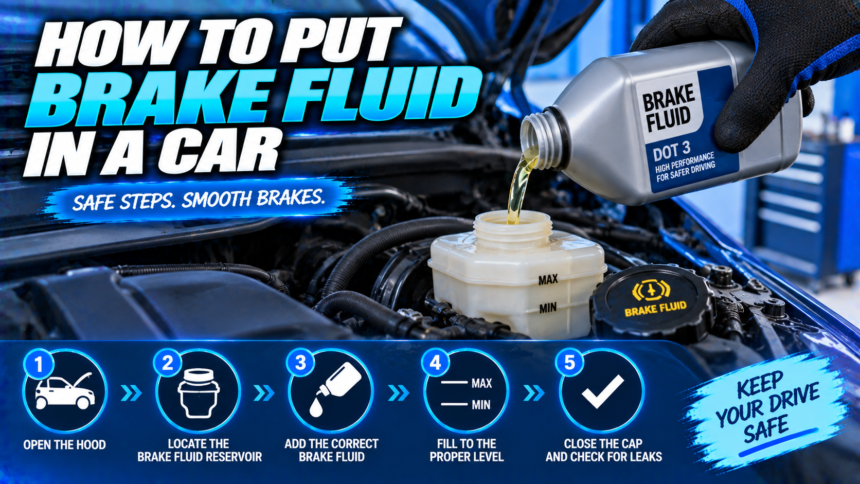
Park on level ground with the engine off and cool, find the brake fluid reservoir in the engine bay, wipe the area around the cap clean, and add the exact fluid specification printed on that cap until the level sits just below the MAX line.
- Read this before you pour anything in
- Working out why the level dropped
- Getting the right fluid
- What you need
- How to add brake fluid, step by step
- Why you must not overfill
- Handling the fluid safely
- Topping up is not a repair
- When to change the fluid rather than add to it
- Conclusion
- Frequently asked questions
- Related Articles
That is the mechanical answer, and it takes about five minutes. But there is something to establish first, because brake fluid is not like screenwash or oil, and topping it up without asking why it dropped can leave you with a genuine safety problem.
Read this before you pour anything in
Your brakes are a sealed hydraulic circuit. The fluid is not burnt, not consumed, and does not evaporate in normal use. In a healthy system with new pads the level should stay essentially where it is.
If the level has dropped, something caused it. There are only two realistic explanations, and one of them means the car should not be driven.
The benign explanation is brake pad wear. As pads thin, the caliper pistons have to extend further to reach the disc, and the extra space behind them fills with fluid drawn from the reservoir. The fluid has not gone anywhere; it has moved out into the calipers. A level that has crept down gradually over a year is often just telling you your pads are getting thin.
The serious explanation is a leak. Brake lines, flexible hoses, caliper seals, wheel cylinders, and the master cylinder can all leak, and a hydraulic system that is losing fluid can lose braking capability. A master cylinder can also leak internally into the brake servo, where nothing appears on the driveway at all.
So the first job is not pouring. It is working out which of those two you are looking at.
Working out why the level dropped
The pattern of the drop tells you most of what you need.
| How the level dropped | Most likely cause | What to do |
| Slowly, over many months | Brake pads wearing down | Check pad thickness. Do not top up to MAX |
| Suddenly, since last month | A leak in the system | Do not drive. Get it inspected |
| Right after a brake repair | Air in the system, or a fitting not sealed | Back to whoever did the work |
| Level fine, fluid very dark | Moisture and age, not a level problem | Book a fluid change rather than topping up |
Check for a leak before you add anything. Look on the ground where the car normally sits for a clear, oily fluid that feels slippery. Then look behind each wheel for wet, oily residue on the inside of the rim, and run a finger along the flexible hoses near the wheels feeling for dampness. Fluid pooling behind the brake servo on the bulkhead points at the master cylinder.
Then check your pads. On many cars you can see the pad through the wheel spokes and judge the friction material thickness against the metal backing plate. If it looks thin, that explains the level and the answer is new pads rather than more fluid.
Two symptoms mean stop entirely: a pedal that feels soft or spongy, or one that sinks slowly towards the floor when you hold steady pressure at a standstill. Both suggest air or a loss of hydraulic integrity, and neither is fixed by topping up.
Getting the right fluid
Brake fluid comes in specifications, and using the wrong one can damage the system.
DOT 3, DOT 4, and DOT 5.1 are all glycol-based and share the same basic chemistry, with higher numbers offering higher boiling points. Many cars specify DOT 4. DOT 5 is the exception and the trap: it is silicone-based, incompatible with the others, and must never go into a system designed for glycol fluid. The similar name catches people out.
The specification is printed on the reservoir cap, and repeated in your handbook. Use exactly what it says. Do not assume a higher number is an upgrade unless the manufacturer lists it as acceptable.
One more rule that surprises people: use a fresh, sealed bottle. Brake fluid is hygroscopic, meaning it pulls moisture out of the air, and a part-used bottle that has been open in a garage for a year has already absorbed water. Water in brake fluid lowers its boiling point, and fluid that boils under heavy braking produces vapour, which compresses. That is how a pedal goes to the floor on a long descent.
What you need
- The correct fluid, unopened. Matching the specification on the cap. A small bottle is plenty for topping up.
- Clean lint-free cloths. For cleaning around the cap and dealing with any spill immediately.
- A small funnel. Reservoir openings are narrow and this is the difference between a clean job and paint damage.
- Gloves and eye protection. The fluid is an irritant and you are working at eye level.
How to add brake fluid, step by step
- Park on level ground and apply the handbrake. A slope gives a false reading. Switch the engine off and let it cool, since you will be working near hot components.
- Open the bonnet and find the reservoir. It is a small translucent plastic tank, usually at the back of the engine bay on the driver’s side, mounted on the master cylinder against the bulkhead. The cap is normally marked with a circle and exclamation mark, and often the fluid specification.
- Read the level through the plastic before opening anything. The MIN and MAX marks are on the side, and most of the time you can see exactly where you stand without removing the cap at all.
- If it is at or above MIN and the fluid looks clean, you do not need to add any. Close the bonnet.
- If it is below MIN, clean thoroughly around the cap and the top of the reservoir with a dry cloth. Any grit that falls in will circulate through the system and damage seals.
- Remove the cap by unscrewing it or releasing its clip, and lift it straight up. Some caps have a level sensor wire attached, so do not pull it away by force. Set it upside down on a clean cloth.
- Using the funnel, pour slowly, stopping frequently to check. Bring the level to just below MAX, never above it.
- Wipe the inside of the cap clean, refit it firmly, and make sure any sensor connector is reattached.
- Before driving, press the pedal several times. It should feel firm and consistent. If it feels soft or travels further than usual, do not drive the car.
Keep the bottle capped between pours. Even a few minutes open to a humid day starts the fluid absorbing moisture.
Why you must not overfill
This is the warning almost every guide leaves out, and it matters most in exactly the situation where people are tempted.
If the level is low because your pads are worn, that fluid is sitting out in the calipers behind extended pistons. Fill the reservoir to MAX now and you have added fluid the system does not have room for. When new pads are fitted, the mechanic pushes those pistons back into their bores, which forces all that fluid back up into a reservoir that is already full. It overflows, and brake fluid strips paint on contact.
So if the pads are the reason, have them replaced and check the level afterwards, rather than filling to MAX today. The fluid also needs headroom to expand as it heats up in normal use. AutoZone’s guide to checking your brake fluid makes the same point about inspecting pads before deciding the fluid is the problem.
Handling the fluid safely
Brake fluid is more aggressive than most fluids under the bonnet.
It strips paint quickly and thoroughly, so lay a cloth over the surrounding bodywork before you start. If you spill any on paint, flush it with plenty of water immediately rather than wiping it, since wiping spreads it. It also irritates skin and eyes, which is why gloves and eye protection are worth the trouble.
Store what is left sealed and upright, and treat an opened bottle as having a short life. Dispose of old fluid properly at a recycling centre rather than down a drain.
Topping up is not a repair
Adding fluid restores the level. It does not fix whatever caused the level to fall, and in the leak case it actively hides the evidence for a while.
It also cannot help with air in the system. If air has entered, the pedal feels spongy because air compresses where fluid does not, and the only fix is bleeding the brakes to push that air out. No amount of fluid in the reservoir addresses it.
If the warning light returns after you have topped up, treat that as confirmation of a leak rather than a faulty sensor. A system that keeps losing fluid is a system that will eventually lose braking.
When to change the fluid rather than add to it
Because brake fluid absorbs moisture from the air over time, it degrades on a calendar rather than by mileage. Most manufacturers specify a change every two years or so, and a low-mileage car needs it just as much as a high-mileage one.
Fresh fluid is a clear pale honey colour. Fluid that has gone dark brown, looks murky, or feels gritty between finger and thumb has absorbed moisture and contamination, and its boiling point has fallen. Topping up dark fluid with clean fluid does not undo that; the old fluid is still in the lines and calipers where it matters.
A brake fluid change is inexpensive relative to almost anything else on a brake system, and it is one of the more genuinely worthwhile services on a maintenance schedule.
Conclusion
Check why the level dropped before you top it up, because brake fluid is never consumed and a falling level means either worn pads or a leak. Look under the car and behind the wheels, and check pad thickness. If it is safe to proceed, clean around the cap, use a fresh bottle of exactly the specification printed on it, and fill to just below MAX rather than to the brim. Then press the pedal before you drive, and if it feels soft or the level falls again, stop and have the system inspected.
Frequently asked questions
Can I just top up brake fluid myself?
Yes, the procedure is simple. The important part is establishing why the level fell first, since brake fluid is not consumed. Gradual loss usually means worn pads; a sudden drop means a leak and the car should not be driven.
What happens if I put the wrong brake fluid in?
Mixing glycol fluids such as DOT 3 and DOT 4 is generally tolerated, though you should use what the cap specifies. Putting silicone-based DOT 5 into a system designed for glycol fluid damages seals and requires a full flush.
Why does my brake fluid keep going down?
Either the pads are wearing, which draws fluid out into the calipers, or the system is leaking. Check pad thickness first. If the pads are healthy and the level still falls, you have a leak that needs finding.
Should I fill the reservoir to the MAX line?
To just below it, and not at all if the level is low because of worn pads. Fluid needs room to expand, and a reservoir filled to MAX on worn pads will overflow when new pads push the caliper pistons back.
Do I need to bleed the brakes after topping up?
Not if you only removed the cap and added fluid. Bleeding is needed when air has entered the system, which shows up as a soft or sinking pedal, or after opening the hydraulic circuit for a repair.
Related Articles
How Long Can a Car Sit Before the Battery Dies?
How Many Engine Mounts Does a Car Have?