



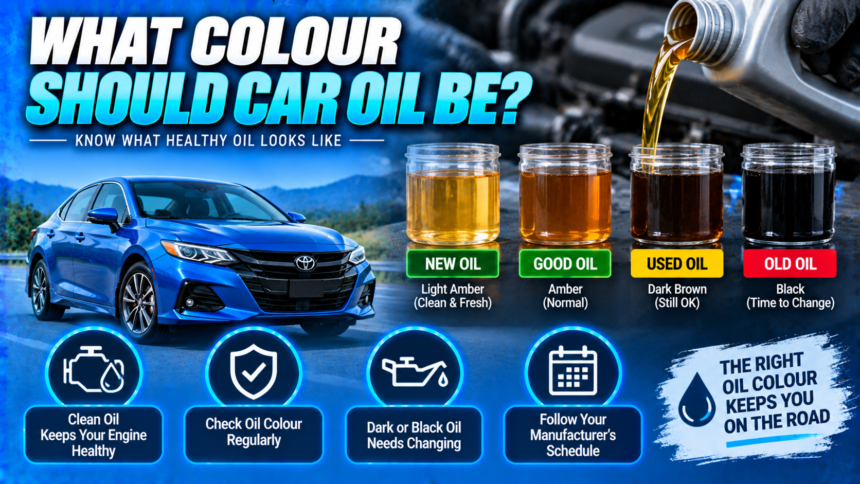
Fresh engine oil is a clear amber, roughly the colour of honey. Once it has been in the engine it turns light brown, then dark brown, and eventually close to black. All of that is normal.
- Why oil goes dark, and why that is good news?
- A colour guide to what you are looking at
- The colours that genuinely mean trouble
- Why texture tells you more than colour?
- How to check your oil properly?
- How fast should oil darken?
- So when should you actually change it?
- Conclusion
- Frequently asked questions
- Related Articles
If you have just checked your dipstick and found dark oil, that on its own is not a problem. Dark oil is usually oil doing exactly what it was designed to do. The appearance that should concern you is not a dark one at all, and it is worth knowing which.
Why oil goes dark, and why that is good news?
Engine oil is not just a lubricant. It is a carefully built chemical package, and two of its ingredients explain almost everything about the colour.
Detergents scrub carbon deposits and sludge off hot internal surfaces such as pistons and rings, keeping them from baking on. Dispersants then take all that loosened material and hold it in suspension, spread evenly through the oil, so it cannot clump together into sludge or block a narrow oil passage.
Combustion is the other half of it. Burning fuel produces fine soot, and a small amount gets past the piston rings into the crankcase. Those particles are sub-micron, far too small to be caught by the filter and far too small to scratch anything, but they are intensely black and they colour the oil quickly.
Dark oil is not oil full of dirt. It is oil that has picked the dirt up off your engine and is carrying it safely, which is precisely the job.
Heat contributes as well. Oil runs at around 195 to 220 degrees Fahrenheit in normal use, heating and cooling with every trip, and that repeated cycling slowly oxidises it and shifts the colour. Much like cooking oil in a pan, it darkens with use even when nothing is wrong.
So the colour change tells you the additive package is active. Oil that stayed golden for ten thousand miles would be more worrying, not less, because it would suggest the detergents were not picking anything up.
A colour guide to what you are looking at
Here is what each appearance on the dipstick actually means.
| What you see | What it means | What to do |
| Amber or honey | Fresh oil, recently changed | Nothing. Check the level and carry on |
| Light to mid brown | Normal, in service | Nothing. This is where oil spends most of its life |
| Dark brown or black, still flows | Normal. Detergents holding soot in suspension | Change at the scheduled interval, not because of the colour |
| Black, thick, tacky or gritty | Additives exhausted, sludge forming | Change it now and shorten the interval |
| Milky, beige, like coffee with milk | Coolant or water in the oil | Stop driving and get it diagnosed |
| Foamy or bubbly | Overfilled, or gases getting into the oil | Check the level first, then investigate |
| Reddish tinge | Possibly transmission fluid mixing in | Have it looked at |
Notice that the top three rows all resolve to the same advice. There is a wide band of perfectly normal appearance, and most drivers looking at their dipstick and worrying are somewhere inside it.
The colours that genuinely mean trouble
Two appearances are worth acting on, and neither of them is simply dark.
Milky or beige oil, with the look of coffee that has had milk stirred into it, means coolant or water has got into the oil. If it is coolant, the usual causes are a failed head gasket, a cracked head, or a warped block, and continuing to drive can turn an expensive repair into a replacement engine. Water and oil do not lubricate, so bearings suffer quickly. Check the coolant level and look for white smoke from the exhaust or a mayonnaise-like deposit under the oil filler cap.
There is a milder version of this worth knowing, because it saves a lot of unnecessary panic. A pale creamy smear on the underside of the filler cap alone, with clean oil on the dipstick, is often just condensation. Water is a natural product of combustion, and on a car used for short trips the engine never gets hot enough for long enough to boil it off. A decent long drive usually clears it. If the dipstick itself is milky, that is a different matter and needs attention.
The second warning sign is black oil that has stopped behaving like a liquid. Oil that is tacky, gritty between the fingers, unusually thick, or reluctant to run off the dipstick has exhausted its additives and is heading towards sludge. Here the colour matters only in combination with the texture.
Why texture tells you more than colour?
This is the part most colour guides skip. Colour is a crude indicator, and by itself it cannot tell you whether the oil still protects your engine. The only precise answer comes from laboratory oil analysis, which most drivers will never bother with. What you can do at the roadside is use your fingers and your nose.
- Feel it. Rub a drop between finger and thumb. Healthy oil is slippery and smooth. Grittiness means particles the filter is not catching. Tackiness means it is thickening.
- Smell it. A strong burnt smell points to overheating. A petrol smell suggests fuel is diluting the oil, which thins it and reduces protection.
- Watch how it flows. Oil should run off the dipstick readily when warm. Oil that clings and creeps is a concern regardless of shade.
- Check the level. This matters more than any of the above. An engine low on oil is in real danger, whatever colour the remaining oil happens to be.
Put simply, black oil that flows freely is dirty but working. Black oil that is thick and pasty is not. Firestone’s guide to engine oil colour makes the same point, noting that colour alone is not a reason to delay a scheduled change or to rush one forward.
How to check your oil properly?
A colour check is only as good as the method behind it.
- Park on level ground. A slope gives a false reading in either direction.
- Let the engine sit. Either check it cold before starting, or wait ten to fifteen minutes after switching off so the oil drains back into the sump.
- Pull the dipstick and wipe it clean on a lint-free cloth.
- Push it fully back in, then withdraw it again. The first pull is smeared by oil splashing around the tube and tells you very little.
- Read the level against the two marks, and look at the colour and clarity while you are there.
- Hold it against something white. A sheet of paper or a white cloth shows the true shade far better than a dark engine bay.
On many newer cars there is no dipstick at all, and the level is read through the dashboard menu. In that case you will only see the oil at a change, so pay attention to what comes out.
One more thing the dipstick can tell you that colour cannot. Look at where the oil sits between the two marks and note it each time you check. A level that falls steadily between services matters far more than any shade: an engine using oil is either burning it or leaking it, and both are worth understanding before the level gets low enough to cause damage.
How fast should oil darken?
Faster than most people expect, and the rate depends far more on your engine and your driving than on the quality of the oil.
Diesel engines produce much more soot, and their oil often goes dark within a thousand miles. Modern direct-injection petrol engines behave similarly for the same reason. Turbocharged engines and stop-start city driving both accelerate it.
There is also a specific case that alarms people: oil that goes dark within days of a change. That usually means the fresh oil is cleaning out deposits left behind by a previous long interval. It is the detergents working through a backlog, not evidence that the shop skipped the job or used poor oil.
Long steady motorway miles keep oil lighter for longer, because the engine runs hot and steady and produces less soot per mile. Short cold trips are the hardest on it.
Oil type makes less difference to colour than people expect. Synthetic oil resists oxidation better and holds its viscosity longer, but it carries the same detergent and dispersant chemistry, so it darkens for the same reasons. A synthetic that has gone black has not failed early, and paying more for oil does not buy you a lighter dipstick.
So when should you actually change it?
Follow the interval in your handbook, based on mileage or time, whichever comes first. That figure comes from testing the specific oil in the specific engine, and it is a far better guide than anything you can judge by eye.
Time matters as much as distance. Oil degrades in the sump even when the car sits, so a low-mileage car still needs its annual change. Many handbooks also list a severe-service schedule with shorter intervals for short journeys, towing, dusty conditions, or a lot of idling, and most everyday driving is closer to severe service than owners assume.
Change it early if the texture is wrong, if it smells burnt, if the level has dropped noticeably, or if the car has been running hot. Do not change it early purely because it looks black on the stick.
Conclusion
Amber when fresh, brown to black in service, and both are fine. Darkening means the detergents and dispersants are lifting soot and deposits off your engine and holding them safely in suspension, which is what you are paying for. Judge the oil by how it feels, how it smells, and where the level sits rather than by shade, change it on the schedule in your handbook, and treat milky oil as the one appearance that means stop and get it checked.
Frequently asked questions
Is black engine oil bad?
Not by itself. Black oil that still flows freely is doing its job, holding soot in suspension. It only signals a problem when it is also thick, tacky, or gritty, which suggests the additives are spent.
Why did my oil turn dark just days after an oil change?
The fresh oil is cleaning deposits left by the previous fill. Detergents lift that material and dispersants hold it in the oil, so it darkens quickly. Diesel and direct-injection engines do this fastest.
What does milky engine oil mean?
Coolant or water has mixed with the oil, often from a failed head gasket. A creamy smear on the filler cap alone can be harmless condensation, but milky oil on the dipstick needs diagnosis before you drive further.
Can I tell when to change my oil by its colour?
No. Colour tracks how much soot the oil has picked up, not how much protection it has left. Use the interval in your handbook, and check texture, smell, and level alongside it.
Should engine oil be checked hot or cold?
Either works if you are consistent. Check it cold before starting, or wait ten to fifteen minutes after switching off so oil drains back to the sump. Always park on level ground first.
Related Articles
What Happens If a Car Belt Breaks? Serpentine vs Timing
What Is a Touchless Car Wash? How It Works and When to Use