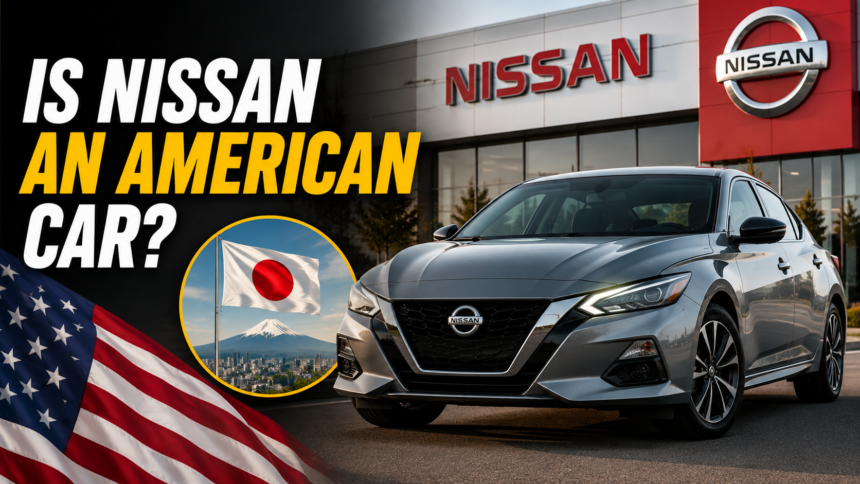
Car buyers often ask “is Nissan an American car?” because they see Nissan trucks and SUVs rolling out of U.S. plants every day. It feels natural to assume a brand manufacturing locally must also be a local company. But ownership, manufacturing location, and brand identity are three separate things, and a car can be built in America without being an American brand.
- The Origins of Nissan
- Founding History
- Original Name: Jidosha-Seizo Co., Ltd.
- Evolution into Nissan Motor Co.
- Headquarters Location
- Nissan’s Ownership Structure
- Who Owns Nissan Today
- The Renault-Nissan-Mitsubishi Alliance
- Japanese Corporate Stakeholders
- Publicly Traded Status
- Nissan’s Manufacturing Presence in the U.S.
- Smyrna, Tennessee Plant
- Canton, Mississippi Plant
- American Jobs Created
- Models Built in the U.S.
- Export vs. Domestic Sales
- What Makes a Car “American”?
- Legal Definitions
- Headquarters vs. Manufacturing Location
- Parts Sourcing and Domestic Content
- Assembled in USA vs. American-Owned
- Comparing Nissan to Truly American Brands
- Nissan’s Economic Impact on the U.S.
- Job Creation and Local Economies
- Investment in American Infrastructure
- Tax Contributions and Community Involvement
- Common Misconceptions
- “Made in USA” Does Not Mean American Company
- Why People Assume Nissan Is American
- Similar Misconceptions About Other Brands
- Nissan’s Global Identity
- Presence in Other Countries
- Balancing Global and Local Identity
- Retained Japanese Engineering Philosophy
- Quick Comparison Table
- Conclusion
- FAQs
- Is any Nissan model 100% American-made?
- Is Nissan more American or Japanese in its operations?
- Which Nissan models are imported versus domestically built?
- Related Articles
This guide walks through Nissan’s history, who actually owns the company today, where its cars are built, and how experts legally define an “American car” in the first place. By the end, you will have a complete and clear answer, along with an honest comparison to Nissan’s biggest rivals in the same space.
The Origins of Nissan
Nissan’s story does not start in Detroit or Tennessee; it starts in Japan almost a century ago. Understanding this origin is the first step toward answering whether Nissan counts as an American company.
Founding History
Nissan traces its roots back to 1933, when it began as a small automobile manufacturing venture in Japan. The company grew quickly during the following decades, expanding its lineup and its factories across the country. From the very beginning, its leadership, engineering teams, and capital were entirely Japanese.
Original Name: Jidosha-Seizo Co., Ltd.
Before it became “Nissan,” the company operated under the name Jidosha-Seizo Co., Ltd. This name reflected its early focus on general automobile production in Japan. The Nissan name was officially adopted a short time later as the brand expanded its identity.
Evolution into Nissan Motor Co.
Over time, the company restructured and rebranded into what we now know as Nissan Motor Co., Ltd. This transformation cemented its identity as a major Japanese automaker and set the stage for its eventual global expansion, including its move into the American market decades later.
Headquarters Location
Even today, Nissan’s global headquarters remains in Yokohama, Japan. This is where major corporate decisions, engineering direction, and financial reporting are centered, which is one of the clearest indicators that Nissan is not, and has never been, an American company.
Nissan’s Ownership Structure
Ownership is often the strongest evidence of a company’s true nationality, and Nissan’s ownership structure leaves little room for doubt.
Who Owns Nissan Today
Nissan is a publicly traded Japanese corporation. Its shares are owned by a mix of institutional investors, alliance partners, and the general public through the stock market, but no American entity controls the company. This ownership model is standard for major Japanese corporations operating worldwide.
The Renault-Nissan-Mitsubishi Alliance
Nissan is part of a long-standing global partnership with Renault, a French automaker, and Mitsubishi, another Japanese company.
This alliance allows the three companies to share technology, platforms, and resources, but each brand retains its own separate identity and headquarters. Renault’s involvement actually reinforces that Nissan’s roots are French-Japanese, not American.
Japanese Corporate Stakeholders
A significant portion of Nissan’s shares are held by Japanese financial institutions and corporate partners. This keeps major strategic decisions closely tied to Japan, reinforcing the company’s national identity even as it operates factories around the world.
Publicly Traded Status
Nissan is listed primarily on the Tokyo Stock Exchange, not any American exchange as its primary listing. This detail matters because a company’s primary stock listing usually reflects where its financial and legal home base truly is.
Nissan’s Manufacturing Presence in the U.S.
This is where most of the confusion comes from, so it deserves a close and honest look.
Smyrna, Tennessee Plant
Nissan operates one of its largest global manufacturing plants in Smyrna, Tennessee. This facility produces several popular models sold across North America, employing thousands of local workers and contributing heavily to the regional economy.
Canton, Mississippi Plant
Alongside Tennessee, Nissan also runs a major plant in Canton, Mississippi. Together, these two facilities represent a massive manufacturing footprint inside the United States, rivaling or exceeding the output of some domestic automakers.
American Jobs Created
Between both plants, Nissan employs tens of thousands of American workers directly, along with many more through its supplier network. This economic contribution is real and significant, even though it does not change the company’s country of origin.
Models Built in the U.S.
Many well-known Nissan vehicles, including popular sedans, trucks, and SUVs, are assembled at these American facilities rather than imported from Japan. Buyers often see “Made in USA” on the window sticker, which fuels the belief that Nissan itself is American.
Export vs. Domestic Sales
Interestingly, not all vehicles built at Nissan’s U.S. plants stay in America. Some models manufactured domestically are exported to other countries, showing that these factories serve a global supply chain rather than existing solely for the American market.
What Makes a Car “American”?
To properly answer “is Nissan an American car,” it helps to understand how the term is actually defined.
Legal Definitions
The American Automobile Labeling Act requires manufacturers to disclose the percentage of U.S. and Canadian parts content, along with the final assembly location, on every new vehicle. This law exists precisely because assembly location alone does not determine a car’s true origin.
Headquarters vs. Manufacturing Location
A company’s headquarters, where its executive decisions and profits are legally based, is generally considered the strongest indicator of nationality. Manufacturing location, on the other hand, is often driven by cost, logistics, and trade policy rather than national identity.
Parts Sourcing and Domestic Content
Even vehicles assembled in the U.S. often rely on parts imported from Japan, Mexico, or other countries. The domestic content percentage varies by model, meaning some “American-built” Nissans contain fewer U.S.-made parts than buyers might expect.
Assembled in USA vs. American-Owned
There is a clear difference between a car being assembled in the USA and a company being American-owned. Nissan fits the first category, while brands like Ford or General Motors fit both, which is the core reason Nissan is not classified as a true American car.
Comparing Nissan to Truly American Brands
Placing Nissan next to genuinely American automakers makes the distinction even clearer.
Ford, GM, and Stellantis
Ford and General Motors are headquartered in the United States, founded by American entrepreneurs, and remain American-owned corporations to this day. Stellantis, formed from Chrysler’s lineage, has a more complex international structure, but Chrysler’s American roots still separate it from Nissan’s Japanese origins.
How Nissan Differs
Despite heavy U.S. manufacturing, Nissan’s leadership, headquarters, and majority financial structure all remain based in Japan. This is the key differentiator that keeps Nissan classified as a Japanese brand rather than an American one, regardless of how many trucks roll off its Tennessee assembly line.
Other Foreign Brands with U.S. Plants
Nissan is far from alone in this situation. Toyota, Honda, BMW, and several other foreign automakers all operate large manufacturing plants inside the United States while remaining headquartered abroad. This shared pattern shows that Nissan’s setup is a common global business strategy, not an exception.
Nissan’s Economic Impact on the U.S.
Even though Nissan is not American-owned, its footprint inside the country is substantial and worth acknowledging fairly.
Job Creation and Local Economies
Nissan’s Tennessee and Mississippi plants support entire local economies, from direct factory jobs to nearby suppliers, restaurants, and service businesses that depend on that employment base.
Investment in American Infrastructure
Over the years, Nissan has invested billions of dollars into expanding and upgrading its American facilities, including newer investments tied to electric vehicle production, showing long-term commitment to its U.S. operations.
Tax Contributions and Community Involvement
Beyond wages, Nissan’s American plants generate meaningful state and local tax revenue, and the company regularly participates in community programs near its manufacturing hubs, further blurring the emotional line between “foreign” and “local” in the eyes of nearby residents.
Common Misconceptions
A few recurring myths keep this question alive, so clearing them up directly is useful.
“Made in USA” Does Not Mean American Company
Seeing “Assembled in USA” on a window sticker does not mean the company behind the badge is American. It simply means final assembly happened domestically, while ownership and profits may still flow back to Japan.
Why People Assume Nissan Is American
Familiarity plays a big role here. Because Nissan has operated in the U.S. for decades and its factories are so visible, many buyers naturally assume the brand itself must be homegrown, even though that assumption is incorrect.
Similar Misconceptions About Other Brands
This same confusion applies to Toyota, Honda, and other foreign automakers with large U.S. footprints. Buyers frequently misjudge all of these brands the same way, making Nissan’s case part of a much broader pattern rather than a unique situation.
Nissan’s Global Identity
Nissan’s business model reflects a truly international approach rather than a single-country identity.
Presence in Other Countries
Beyond Japan and the United States, Nissan manufactures and sells vehicles across Europe, Asia, and other regions, reinforcing its status as a global company rather than one tied to a single national market.
Balancing Global and Local Identity
Nissan adapts certain models and features to match regional preferences, including in the American market, while still maintaining centralized engineering and design leadership based in Japan.
Retained Japanese Engineering Philosophy
Despite this global spread, Nissan’s core engineering philosophy, quality standards, and design language remain distinctly Japanese, tracing directly back to the company’s original roots.
Quick Comparison Table
| Factor | Nissan | Ford (Example: American Brand) |
| Headquarters | Yokohama, Japan | Dearborn, Michigan, USA |
| Founded | 1933, Japan | 1903, USA |
| Primary Stock Exchange | Tokyo Stock Exchange | New York Stock Exchange |
| U.S. Manufacturing Plants | Yes (Tennessee, Mississippi) | Yes (Multiple States) |
| Company Ownership | Japanese-based | American-based |
| Alliance Partners | Renault, Mitsubishi | Independent |
Conclusion
So, is Nissan an American car? The honest answer is no. Nissan remains a Japanese automaker at its core, with headquarters in Yokohama and ownership rooted firmly in Japan and its international alliance partners.
What Nissan does have is a massive American manufacturing presence, built through decades of investment in Tennessee and Mississippi, which understandably confuses many buyers.
Assembly location and company ownership are simply two different things, and once that distinction is clear, the answer to this common question becomes much easier to understand.
FAQs
Is any Nissan model 100% American-made?
No single Nissan model is entirely American-made, since most vehicles still rely on some imported parts even when final assembly happens in the U.S.
Is Nissan more American or Japanese in its operations?
Nissan’s operations are heavily global, but its ownership, headquarters, and core leadership remain Japanese, making it a Japanese company overall.
Which Nissan models are imported versus domestically built?
Some Nissan models are built entirely in Japan and imported, while others, especially popular trucks and SUVs, are assembled at the Tennessee or Mississippi plants for the North American market.
Related Articles
What to Put Under Tires When Storing a Car?
What Is Neutral For in a Car? Complete Guide for Every Driver
Does My Car Smell of Petrol? Causes, Risks & Fixes Explained