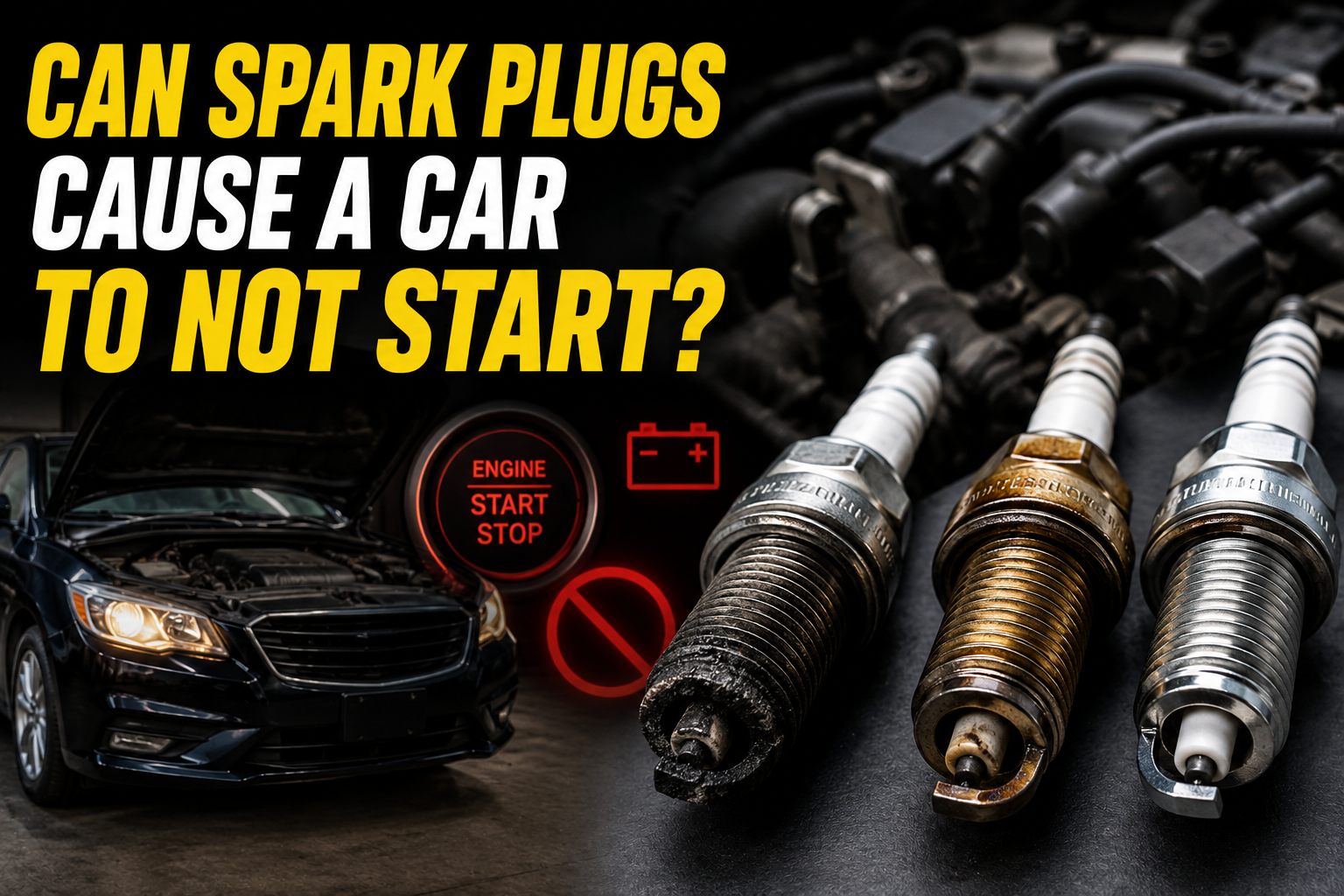
Yes, but only in specific circumstances. One worn plug in a six-cylinder engine will make it run rough, not refuse to start. All four plugs fouled in a four-cylinder engine will absolutely stop it starting.
- What has to be true for an engine to start
- How many plugs it takes
- The failure modes that actually stop an engine
- Reading the plugs tells you a lot
- What to check before blaming the plugs
- Plugs or coils?
- How to clear a flooded engine
- When replacing plugs is the right call
- Conclusion
- Frequently asked questions
- Can one bad spark plug stop a car from starting?
- How do I know if my no-start is spark plugs or the battery?
- Why are my spark plugs wet with fuel?
- How long do spark plugs last?
- Should I replace all spark plugs or just the bad one?
- Related Articles
The distinction matters because plugs are among the least likely causes of a no-start, and people replace them when the real fault is elsewhere. Here is when plugs genuinely are the problem, how to tell, and what is more likely.
What has to be true for an engine to start
An engine needs four things at once: fuel, air, compression, and a properly timed spark. Take away any one and it will crank without ever catching.
Spark plugs sit at the end of the ignition chain. The coil generates high voltage, the plug carries it into the cylinder, and the gap between its electrodes is where the arc happens. That arc ignites the compressed fuel and air.
So plugs can absolutely stop an engine starting. They are the last link in the spark chain. But they are one of several parts in that chain, and the chain is one of four requirements. That is why plugs get blamed more often than they deserve.
An engine that cranks but does not fire has a fuel, spark, compression, or timing problem, and plugs are a candidate. An engine that will not crank at all has a battery or starter problem, and plugs are irrelevant.
How many plugs it takes
This is the part that resolves most of the confusion, and it comes down to cylinder count.
Each cylinder fires in turn. When one cylinder fires successfully, it drives the crankshaft round far enough for the next cylinder to reach its firing position. Starting is a chain reaction, and it needs enough working cylinders to keep that chain going.
One dead cylinder in a V6 or V8 leaves five or seven others doing the work. The engine starts, runs unevenly, and triggers a misfire code. Annoying, not disabling. The more cylinders an engine has, the easier it is to start with one plug out of action.
One dead cylinder in a three or four-cylinder engine is a bigger proportion of the total. The gaps between power strokes get long, and on a cold morning with thick oil and a marginal battery, the engine may not build enough momentum to catch. It usually still starts, but it is closer to the edge.
Two or more dead cylinders in a four-cylinder engine will very often prevent starting altogether. Half the engine is doing nothing.
Which raises the obvious question: what makes several plugs fail simultaneously? Normal wear does not, because wear is gradual and roughly even. Something else is usually going on.
The failure modes that actually stop an engine
Not all plug problems are equal, and the ones that cause no-starts are specific.
Fuel fouling is the most common. Repeated failed start attempts dump raw fuel into the cylinders, and the plugs get wet. A wet plug conducts electricity down its own surface instead of arcing across the gap, so no spark reaches the mixture. The engine is now flooded, and each further attempt makes it worse. This is the single most common way plugs stop a car starting, and it is usually a symptom of another fault rather than the fault itself.
Oil fouling coats the electrodes in black oily deposits. It points to oil getting past worn rings or valve seals, which is an engine condition problem, not a plug problem.
Carbon fouling leaves dry black soot. It comes from an over-rich mixture, lots of short trips, or a failing sensor, and it builds on all plugs at once, which is why it can affect several cylinders together.
Cracked insulators let voltage leak to the cylinder head instead of jumping the gap. Often caused by dropping a plug during installation.
Severely worn gaps make the arc harder to strike. Electrodes erode with use, the gap widens, and eventually the coil cannot bridge it. This is what neglected plugs at very high mileage do.
Notice a pattern. Most of these have an underlying cause. Replace the plugs without fixing the cause and you are back where you started in a few thousand miles.
Reading the plugs tells you a lot
If you pull a plug, its appearance is a diagnostic in itself.
| What the plug looks like | What it means |
| Light tan or grey deposits | Normal, working correctly |
| Wet with fuel, smells of petrol | Flooded engine, or a fuel delivery fault |
| Dry black soot | Running rich, or too many short trips |
| Black and oily | Oil entering the combustion chamber |
| White, blistered, or melted | Running too hot or too lean |
| Rounded, eroded centre electrode | Simply worn out |
There is one more thing this tells you. If one plug looks different from the others, the problem lives in that cylinder. If all of them look the same, whatever is happening affects the whole engine.
What to check before blaming the plugs
Work through these first, because they are more likely and mostly cheaper.
- Is it cranking properly? A slow, laboured crank points at the battery, not the ignition. A healthy battery reads about 12.6 volts at rest and should not drop below roughly 9.6 volts while cranking.
- Is fuel reaching the engine? Turn the key to the on position without starting and listen for a two-second hum from the fuel pump. Silence points at the pump, its relay, or its fuse.
- Does it smell strongly of fuel? Then fuel is arriving and something is stopping it burning, or the engine is flooded.
- Are there stored codes? A cheap OBD-II reader will show misfire codes. A single-cylinder code such as P0301 points at that cylinder. A random misfire code such as P0300 across all cylinders suggests something systemic like fuel pressure or a crank sensor.
- When were the plugs last changed? Copper plugs last roughly 30,000 to 50,000 miles. Platinum and iridium plugs typically run 60,000 to 100,000, some further. Plugs changed 20,000 miles ago are almost certainly not your problem.
That last question resolves most cases on its own. Plugs are a wear item on a long schedule, and a no-start from wear alone means they are badly overdue.
Plugs or coils?
These two get conflated constantly, and the difference is worth understanding because the parts cost very differently.
Most modern engines use coil-on-plug ignition, meaning each cylinder has its own small coil sitting directly on top of its plug. The coil generates the high voltage; the plug delivers it. A failure in either produces the same symptom, a dead cylinder.
The practical test is swapping. If one cylinder is misfiring, move its coil to a neighbouring cylinder and clear the codes. If the misfire follows the coil to the new cylinder, the coil is at fault. If the misfire stays put, the problem is the plug, the injector, or the cylinder itself. This takes a few minutes and no special tools on most engines.
Coils tend to fail suddenly and individually, so a single hard failure that appeared overnight points more at a coil than at plugs, which degrade gradually across the whole set.
How to clear a flooded engine
If the plugs are wet with fuel, you can often fix it without parts.
- Stop cranking. Every attempt adds more fuel and drains the battery.
- Wait ten to fifteen minutes with the bonnet open. Some of the fuel will evaporate.
- Try the clear-flood procedure. On most cars, holding the accelerator flat to the floor while cranking tells the computer to cut fuel injection. Crank for five to ten seconds, then release.
- If that fails, remove the plugs and dry them. Wipe them clean, crank the engine briefly with the plugs out to clear vapour from the cylinders, then refit and try again.
If it starts and then floods again, the flooding has a cause. Leaking injectors, a failing coolant temperature sensor, or a fuel pressure regulator fault will all keep dumping excess fuel.
When replacing plugs is the right call
There are cases where plugs genuinely are the answer.
- The car is at or past its plug interval and has been running progressively worse. Hard starting, rough idling, and weaker acceleration developing over months is the classic worn-plug picture.
- You pulled a plug and it is visibly eroded, cracked, or fouled.
- The engine has misfire codes across several cylinders and the plugs are original at high mileage.
Replace all of them at once rather than one, since they wear together and the labour is nearly the same. Match the type your engine specifies. Fitting copper plugs where iridium is specified means a much shorter service life. Check the gap against the figure on the underhood emissions sticker, and start each plug by hand to avoid cross-threading the cylinder head.
Conclusion
Spark plugs can stop a car starting, but usually only when several are fouled at once, most often with fuel after repeated failed attempts. A single worn plug causes rough running, not a no-start, particularly on engines with six or more cylinders. Before buying plugs, confirm the engine is cranking properly, that fuel is reaching it, and when the plugs were last replaced. If they are nowhere near their service interval, the fault is almost certainly somewhere else.
Frequently asked questions
Can one bad spark plug stop a car from starting?
Rarely on its own. A single dead cylinder in a V6 or V8 causes rough running and a misfire code, not a no-start. On a three or four-cylinder engine it makes starting harder, especially when cold, but the engine usually still fires.
How do I know if my no-start is spark plugs or the battery?
Listen to the crank. If the engine turns over strongly but never catches, the fault is fuel, spark, or compression, and plugs are a candidate. If it cranks slowly, clicks, or does nothing, the battery or starter is the problem.
Why are my spark plugs wet with fuel?
The engine is flooded, usually from repeated failed start attempts, though leaking injectors or a faulty temperature sensor can cause it too. Wet plugs cannot spark properly. Dry them, or use the clear-flood procedure, and fix the underlying cause.
How long do spark plugs last?
Copper plugs typically last 30,000 to 50,000 miles, while platinum and iridium plugs run 60,000 to 100,000 or more. Check your owner’s manual, since the interval varies by engine and plug type.
Should I replace all spark plugs or just the bad one?
Replace them all. They wear at a similar rate, so the others are close behind, and most of the cost is the labour of reaching them. Doing one at a time means paying for that access repeatedly.
Related Articles
Does a Dirty Air Filter Cause Your Car to Jerk?
What to Put Under Tires When Storing a Car?