To Dispose of a Car Battery Take it to any auto parts store. AutoZone, O’Reilly, Advance Auto Parts, NAPA, and Batteries Plus all accept used car batteries for free, you do not have to buy anything, and it does not matter where the battery came from. Most stores hand you a $10 gift card for it as well.
- The auto parts store is the easy answer
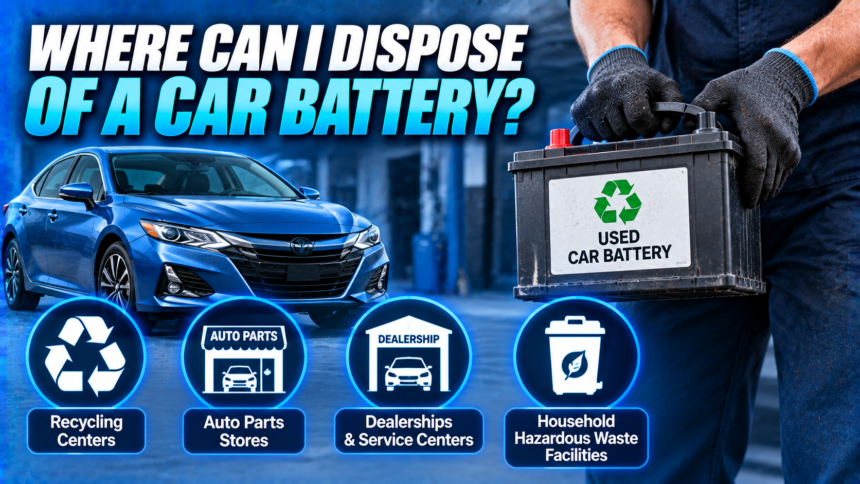
- Every place that will take a used car battery
- Get your core charge back while you are there
- If it is still bolted in the car
- Scrap yards pay cash, with two catches
- How to carry it there without hurting yourself
- Why the trash and the recycling bin are both wrong
- What happens to the battery after you hand it over
- Hybrid and electric car batteries are a different job
- The situations that trip people up
- Conclusion
- Frequently asked questions
- Can I get money for an old car battery?
- Do I have to buy a new battery to drop off the old one?
- Can I put a car battery in my recycling bin?
- How long can I keep a dead battery in my garage?
- Does Walmart take old car batteries?
- Related Articles
That is the fastest route for most people. Scrap metal yards pay cash instead, municipal hazardous waste sites take them free, and any shop that replaces your battery keeps the old one automatically. The one place a car battery must never go is the trash or your curbside recycling bin.
The auto parts store is the easy answer
Every major chain runs a free take-back program, and none of them require a purchase. Carry the battery to the counter, tell them you are recycling it, and you are done in two minutes. The brand does not matter, so an O’Reilly battery is fine at AutoZone and the other way round.
AutoZone and O’Reilly both give a $10 gift card for each battery you bring in for recycling, as long as it is not a core you already paid a deposit on. It is store credit rather than cash, and stores usually cap it at around five batteries a day so people cannot dump commercial loads. If you are curious about the fine print before you drive over, AutoZone’s battery disposal page lays out its version of the program.
Parts stores also take motorcycle, marine, lawn mower, and golf cart batteries, which is handy if the garage has collected a few over the years.
Every place that will take a used car battery
| Where | Cost or payout | Worth knowing |
| Auto parts store | Free, often $10 store credit | Longest hours, no purchase needed, brand does not matter |
| The shop that replaced it | Free | They keep the old one by default, so there is nothing for you to do |
| Scrap metal yard | Pays cash by weight | Weekday hours, and the payout moves with lead prices |
| Household hazardous waste site | Free | Often limited drop-off days, so call before you load the car |
| Battery specialist store | Free, sometimes credit | Good for odd sizes, marine and equipment batteries |
| Car dealership | Free | The route for hybrid and electric high-voltage packs |
Get your core charge back while you are there
When you buy a new battery, the price includes a core charge, which is a deposit designed to bring the old battery back through the door. It usually runs between about $5 and $25 depending on the state and the size of the battery. Hand over the old one and the deposit comes straight back to you.
Two things make that go smoothly. Bring the receipt, since the refund is tied to the purchase, and check the return window, because some stores want the core back within 30 days. If you already collected the core refund on this battery, you cannot claim it twice, but a second old battery sitting in the garage still qualifies for the recycling credit.
Some states add their own version. In New York, a retailer charges a $5 return incentive payment if you do not hand over an old battery when you buy a new one, and refunds it when you bring one back within 30 days.
If it is still bolted in the car
Switch the engine off and take the key out. Loosen the negative terminal first, the one marked with a minus sign, and tuck that cable to the side where it cannot spring back onto the post. Then do the positive. That order matters, because with the negative disconnected a wrench that brushes the bodywork cannot complete a circuit and throw sparks at you.
Next comes the hold-down clamp at the base of the battery, which is the part people forget and then wonder why the battery will not lift. Undo it, lift with both hands and with your knees rather than your back, and do not trust the fabric carry strap on an old battery. They tear.
Scrap yards pay cash, with two catches
A scrap metal yard buys used batteries by weight, which makes it the better choice if you have a stack of them rather than one. Call for the day’s rate first, because the payout tracks the lead market and moves around. The other catch is paperwork. Most states regulate scrap metal sales to discourage theft, so expect to show photo ID, and expect payment by check or card rather than notes at some yards. Opening hours are usually weekdays, and many close in the early afternoon.
How to carry it there without hurting yourself
A car battery weighs somewhere between 30 and 50 pounds and is full of sulfuric acid, which burns skin and eats holes in clothing and carpet. A dead battery still holds enough charge to spark. None of that is a reason to be nervous, but it is a reason to take five minutes over it.
- Wear gloves and something over your eyes, and take rings and watches off first
- Keep the battery upright the entire time, including while you carry it
- Put it in a plastic tub, a milk crate, or a sturdy box rather than straight onto upholstery
- Set it on the trunk floor or a footwell, wedged so it cannot tip on a corner
- Tape over the terminals if the plastic covers are missing, so nothing metal can bridge them
- Keep tools, jack handles, and anything else metal away from the top of it
- Wash your hands afterwards, even if nothing looked wet
If the case is cracked, bulging, or damp around the top, phone ahead before you drive anywhere. A leaking battery is handled differently, and a hazardous waste facility is often the better destination for it.
Why the trash and the recycling bin are both wrong
A car battery is roughly 20 pounds of lead sitting in acid. Buried in a landfill, both can work their way into groundwater. Burned in an incinerator, the lead goes into the air. So the disposal route is regulated rather than optional.
Landfilling lead-acid batteries is banned outright in a long list of states, and many states also require any retailer selling batteries to accept used ones back free of charge and to post a sign saying so. Penalties exist for individuals too. New York, for one, makes it illegal to put a lead-acid battery in the trash and attaches a civil penalty of up to $50 per violation.
The curbside recycling bin is not a workaround. Batteries in the general recycling stream get crushed inside collection trucks and sorting lines, which is a common cause of fires at recycling facilities. Kerbside crews are not equipped for them, and the load can be rejected.
What happens to the battery after you hand it over
It gets taken apart and rebuilt into another battery, usually within weeks. The old one is broken up in a hammermill, and the pieces separate by weight: lead falls to the bottom, plastic floats, and the acid is drained off to be neutralized or converted into sodium sulfate for use in detergent and glass.
All three of those components are fully recyclable, and lead can be recycled over and over without losing quality. That is why about 99 percent of lead batteries in the United States get recycled, making them the most recycled consumer product in the country, ahead of aluminum cans. A typical new battery is built from more than 80 percent recycled material.
The system runs on convenience rather than good intentions. More than 300,000 retail and collection sites accept these batteries, which keeps around 160 million of them out of landfills every year. The EPA’s case study on lead-acid battery collection is worth a look if you want to see how that collection network is put together.
Hybrid and electric car batteries are a different job
The large high-voltage pack in a hybrid or electric car is not something to unbolt yourself or carry into a parts store. Those packs hold enough energy to be lethal, and they go back through a dealership or a specialist recycler who is set up for them. If yours needs replacing, the shop doing the work handles the old pack as part of the job.
There is a catch worth knowing. Almost every hybrid and electric car also carries an ordinary 12-volt lead-acid battery for the lights, computers, and door locks. That one is exactly like any other car battery, and it goes to the parts store like any other car battery.
The situations that trip people up
A few cases come up often enough to be worth planning for:
- You cannot lift it. Ask at the counter, since staff will usually come out to the car for it. If a shop is fitting the new battery, the problem solves itself.
- You have four or five from a garage clear-out. Most stores cap recycling credit at a few per day, so either split the trip or take them to a scrap yard.
- There is no parts store nearby. Municipal hazardous waste days accept them free, and most towns run several a year.
- The battery is not from a car. Motorcycle, boat, mower, and mobility scooter batteries go to the same places.
- It has been sitting in the shed for two years. Still fine to recycle, and still worth the same credit.
Conclusion
Any auto parts store will take your old car battery free, no purchase required, and most give you $10 in store credit for it. If you would rather have cash, a scrap yard pays by weight, and a household hazardous waste site is the fallback if neither is close. Carry it upright in a box, wear gloves, and keep it out of the trash and the recycling bin. Ten minutes of effort and the thing gets rebuilt into another battery.
Frequently asked questions
Can I get money for an old car battery?
Yes. Auto parts stores usually give $10 in store credit per battery, and scrap metal yards pay cash by weight. If you are returning the battery you just replaced, ask for your core charge back instead, which is typically $5 to $25.
Do I have to buy a new battery to drop off the old one?
No. The take-back programs at AutoZone, O’Reilly, Advance Auto Parts, and NAPA are open to anyone, whether or not you buy anything. Where the old battery came from does not matter either.
Can I put a car battery in my recycling bin?
No. Batteries get crushed inside collection trucks and sorting equipment, which starts fires, and household recycling is not set up to handle lead or acid. Take it to a store, a scrap yard, or a hazardous waste site.
How long can I keep a dead battery in my garage?
There is no deadline, but store it upright, off bare concrete, somewhere cool and dry, with nothing metal on top. Check it now and then for cracks or damp patches, since an old case can eventually seep.
Does Walmart take old car batteries?
Walmart locations with an auto care center generally accept them and refund a core charge on a battery bought there. Coverage varies by store, so call first, or use a parts store, which is more reliably set up for it.
Related Articles
Are Automatic Car Washes Bad for Your Car?
Which One Is the Brake in the Car? Pedal Guide