


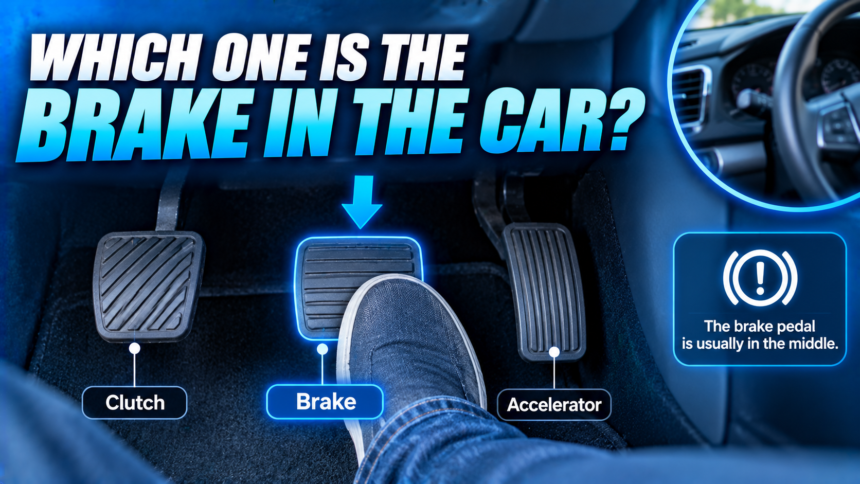
The brake Pedal is the pedal to the left of the accelerator. In an automatic car with two pedals, the brake is the left one. In a manual car with three pedals, it is the middle one. Either way, the rule that never changes is this: the brake is always the second pedal counting from the right.
- The layout in both types of car
- How to tell them apart without looking
- What a healthy brake pedal should feel like
- Which foot to use
- Pedal confusion is a real crash cause
- Five habits that prevent pedal errors
- What about electric cars?
- Quick reference
- Conclusion
- Frequently asked questions
- Is the brake on the left or the right?
- Do the pedals swap in right-hand drive cars?
- Can I use my left foot to brake in an automatic?
- Why is the brake pedal bigger than the accelerator?
- What should I do if the car accelerates when I press the brake?
- Related Articles
That single rule works in every car, in every country, whether the steering wheel is on the left or the right. Learn it that way and you will never have to work it out again.
The layout in both types of car
Count from the right side of the footwell and the order is always the same.
| Car type | Pedals | Left | Middle | Right |
| Automatic | 2 | Brake | (none) | Accelerator |
| Manual | 3 | Clutch | Brake | Accelerator |
A useful memory aid runs right to left: A-B-C, for Accelerator, Brake, Clutch. The accelerator is always furthest right, the brake sits next to it, and the clutch (if there is one) is furthest left.
Right-hand drive cars do not reverse this. A car in the UK, Australia, India, or Japan has the same pedal order as one in the US or Europe. The driver’s seat moves; the pedals do not swap.
How to tell them apart without looking
You should not need to look down at your feet while driving, so it helps to know what each pedal feels like.
The brake is wider. Manufacturers make it broad and flat so your foot can find it quickly and press it squarely. The accelerator is narrower, often a slim rectangle or a hinged pad.
The brake sits higher. It is usually mounted slightly above the accelerator, so moving between them means lifting your foot rather than sliding it flat across.
They feel completely different underfoot. The accelerator is light and springy, and moves easily with gentle pressure. The brake is firm and resists you, needing deliberate force. If a pedal feels soft and easy, your foot is on the accelerator.
The clutch is furthest left and travels a long way. In a manual, it has the longest travel of the three and a distinct heaviness. There is a wide gap between it and the brake, which is deliberate.
Before you drive an unfamiliar car, sit still with the engine off and press each pedal a few times with your right foot. Ten seconds of this tells your body where they are, which is worth more than any diagram.
What a healthy brake pedal should feel like
Once you know which pedal is which, the next useful thing is knowing what normal feels like, because a change in pedal feel is often the first sign of a brake problem.
A healthy brake pedal is firm and stops well before the floor. Press it with the engine running and you should meet steady resistance a couple of inches down, with the car slowing smoothly in proportion to how hard you push.
Three changes are worth acting on:
- A soft or spongy pedal that sinks further than usual often points to air in the brake lines or a fluid problem, and needs checking promptly.
- A pedal that slowly sinks toward the floor while you hold steady pressure at a red light suggests a failing master cylinder. This is not a wait-and-see fault.
- A pedal that pulses or judders under normal braking usually means warped discs. Note that a rapid pulsing during hard emergency braking is normal, and is just the anti-lock system working as designed.
One quirk catches new drivers out. With the engine off, the brake pedal goes hard and feels almost immovable. That is the brake booster, which relies on the running engine and is behaving exactly as it should. Start the engine and the pedal softens to its normal travel.
Which foot to use
In an automatic, use your right foot for both pedals. Move it between the brake and the accelerator, pivoting on your heel where you can. Your left foot rests on the footrest to the left, doing nothing.
That is the standard advice from driving instructors, and the reason is simple. If your left foot hovers over the brake, it is easy to rest weight on it without noticing, dragging the brakes and confusing drivers behind you. Worse, in a moment of panic people tend to press both feet down at once, applying brake and accelerator together.
In a manual, your left foot operates only the clutch and your right foot handles the brake and accelerator. This is one reason manual drivers rarely develop left-foot braking habits.
Left-foot braking does exist in motorsport, where drivers switch between pedals faster than a single foot allows. It is a specialist technique on a closed circuit, not something to adopt on the road.
Pedal confusion is a real crash cause
This is the part worth taking seriously, because it is where a simple question stops being trivial.
Pressing the accelerator when you meant the brake has a name in crash research: pedal error, or pedal misapplication. NHTSA estimates approximately 16,000 preventable crashes a year in the United States from it, roughly 44 a day.
The pattern in the data is consistent. NHTSA’s research on pedal application errors found that 77 percent of the crashes identified through media reports happened in parking lots or driveways rather than on the open road. In the North Carolina crash database it examined, 57 percent occurred in car parks or driveways, with parking and low-speed manoeuvres heavily represented.
Age matters too. Drivers under 20 accounted for just over 3 percent of all crashes but nearly 18 percent of pedal error crashes, a more than fivefold overrepresentation. Drivers over 80 showed a similar spike. The researchers link this to the brain regions handling complex tasks, which are not fully developed until around 25 and decline again in later life.
The mechanics of what goes wrong fall into three types:
- Pressing the accelerator while intending to press the brake
- A foot sliding off the edge of the brake onto the accelerator
- Pressing both pedals at once, so the throttle overrides the partial braking
What makes these incidents dangerous is how fast they escalate. The throttle opens fully, the car surges, and the driver has a few seconds in a confined space while startled to work out what has happened. Many drivers realise the error and still cannot correct it in time.
None of this should make a new driver nervous about a machine they will use safely thousands of times. It is simply the reason the habits below are worth building early.
Five habits that prevent pedal errors
NHTSA’s advisory on pedal error recommends the following.
- Get familiar. Adjust your seat, mirrors, steering wheel, and pedals before you start the engine. In an unfamiliar car, find the pedals with your foot before you move.
- Aim for the middle of the brake. Make a habit of hitting the centre of the pedal rather than its edge. This builds muscle memory and stops your foot slipping off the side onto the accelerator.
- Avoid distractions. Stay focused on driving until the car is stopped, in park, and switched off. Most pedal errors happen during the low-speed moments people treat as the easy part.
- Slow down in car parks. Take it gently pulling into and backing out of spaces. This is where most of these crashes happen.
- Wear the right shoes. Flip-flops, heavy boots, and high heels all interfere with pedal feel and control. Flat, lightweight, thin-soled shoes let you feel the difference between the two pedals through your foot.
That last point gets dismissed as fussy, but it is the easiest one to act on. A thick boot sole removes the feedback that tells you which pedal you are on, and a flip-flop can catch under a pedal entirely.
What about electric cars?
EVs and hybrids have two pedals in the same positions: brake on the left, accelerator on the right. Nothing about the layout changes.
What can change is how often you use the brake. Many EVs offer one-pedal driving, where lifting off the accelerator engages regenerative braking strongly enough to slow the car and, in some models, bring it to a complete stop. The motor acts as a generator, feeding energy back into the battery.
Two things are worth understanding about this if you drive an EV.
The brake pedal is still there and still does the important work. Regenerative braking is not designed for emergencies. In a genuine panic stop you press the brake pedal firmly, exactly as in any other car, and the friction brakes take over.
One-pedal driving can also mean you go long stretches without touching the brake at all. Some instructors suggest using the brake pedal periodically anyway, both to keep the habit fresh and because friction brakes benefit from occasional use.
Quick reference
| Question | Answer |
| Which pedal is the brake in an automatic? | The left one, of two |
| Which pedal is the brake in a manual? | The middle one, of three |
| Does right-hand drive change this? | No, the order is identical |
| Which foot presses the brake? | The right foot |
| How do I identify it by feel? | Wider, higher, and much firmer than the accelerator |
Conclusion
The brake is the second pedal from the right in every car: the left pedal in a two-pedal automatic, the middle pedal in a three-pedal manual, unchanged by right-hand drive. Use your right foot for it, learn the feel of a wide firm pedal against a narrow springy one, and take ten seconds to find both pedals whenever you get into an unfamiliar car. A good result is being able to brake without ever looking down or thinking about it, which is exactly the point at which pedal confusion stops being a risk.
Frequently asked questions
Is the brake on the left or the right?
It is on the left in an automatic and in the middle in a manual, so the reliable way to remember it is that the brake is always the second pedal from the right. The accelerator is always the furthest right.
Do the pedals swap in right-hand drive cars?
No. A right-hand drive car in the UK, Japan, or Australia has the same pedal order as a left-hand drive car. Only the position of the driver’s seat changes.
Can I use my left foot to brake in an automatic?
It is not recommended for everyday driving. A left foot resting near the brake can drag it unintentionally, and under stress people tend to press both pedals at once. Use the right foot for both.
Why is the brake pedal bigger than the accelerator?
So you can find it quickly and press it squarely, including in an emergency. The brake is also usually mounted slightly higher and feels much firmer underfoot.
What should I do if the car accelerates when I press the brake?
Check your foot position first, since this is usually pedal error rather than a fault. Shift to neutral, brake firmly, and steer to a safe stop. Investigations have consistently traced these incidents to the wrong pedal being pressed.
Related Articles
How Do the Fins Help in Radiator Cooling? A Complete Guide for Drivers
Why Is My Car Smoking From the Hood? What It Means
How Many Lumens Is a Car Headlight? The Complete Brightness Guide