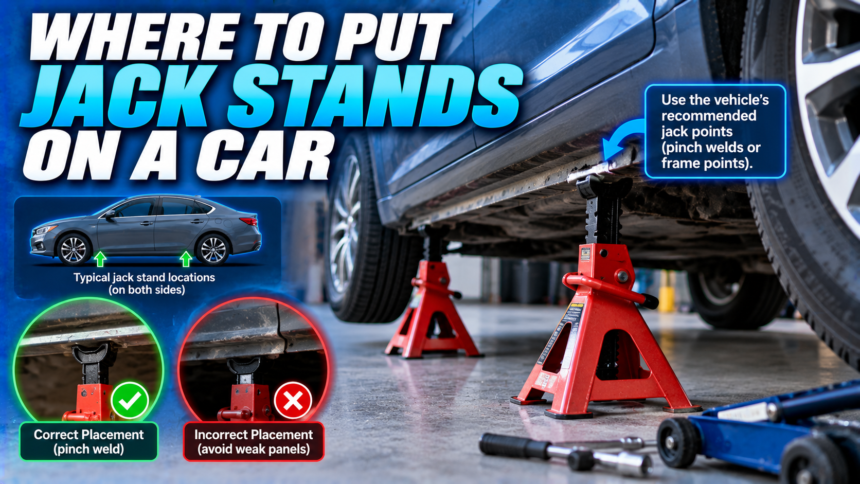
Jack stands go under a reinforced structural point on the car’s underside. On most modern cars that means the pinch weld seam just behind each front wheel and just ahead of each rear wheel. On body-on-frame trucks and SUVs it means the frame rails or the rear axle tubes. On many unibody cars you can also use the front subframe or the rear axle, if the manual says so.
- The four places jack stands belong
- Where to put jack stands for the front of the car
- Where to put jack stands for the rear
- Lifting the whole car on four stands
- Where jack stands must never go
- How to find your car’s exact points
- Getting the stand in when the jack is already there
- The shake test
- Conclusion
- Frequently asked questions
- Can I put jack stands on the pinch welds?
- Where do I put the jack if the stands are on the jack points?
- How many jack stands do I need?
- Can I put jack stands on the differential?
- How high should the car be?
- Related Articles
The short version: put the stand somewhere the car is designed to carry its own weight. Everything else on the underside is sheet metal, plastic, or a part that will bend.
Here is how to find those points on your car, and how to get a stand in place when the jack is already sitting on the spot you wanted.
The four places jack stands belong
Nearly every safe support point on a car falls into one of four types.
| Point type | Where you’ll find it | Best for |
| Pinch weld | The seam under the rocker panel, behind the front wheel and ahead of the rear wheel | Most unibody cars, all four corners |
| Frame rail | Long boxed steel beams running front to back | Trucks, SUVs, older body-on-frame cars |
| Subframe or crossmember | The steel cradle under the engine and under the rear suspension | Unibody cars, front and rear ends |
| Solid axle or axle tube | The rear axle housing on trucks and rear-drive cars | Lifting a whole rear end at once |
The pinch weld is the one most owners meet first, because it is what the emergency scissor jack in the boot is designed for. It is a double or triple layer of steel where the floor pan and rocker panel are welded together, and on most cars it is reinforced at four specific spots with a notch, a dimple, or an arrow in the plastic trim to mark them.
That reinforcement is the whole point. Two inches either side of the marked spot, the same seam will fold over like a beer can.
Where to put jack stands for the front of the car
For the front, you have two good options.
Under the pinch welds behind each front wheel. Find the marked notch, slot the stand’s saddle over the seam, and let the seam sit in the groove rather than on a flat pad. If your stands have a flat or V-notch saddle, add a slotted rubber pad or a hockey puck with a slot cut in it. A bare steel V-notch on a bare pinch weld will crush the seam and strip the paint, and a stripped seam in a wet climate turns into rust.
Under the front subframe. This is the steel cradle the engine and lower control arms bolt into. It is thick, it already carries the engine, and it gives a flat contact patch that is far more forgiving than a seam. Place the stand under the solid rails of the cradle, not under a thin bridging plate or a bolt-on cover.
A useful rule for both: the stand should be as close as practical to the wheel it is supporting. The further inboard you go, the more leverage the car has to twist off the stand.
Where to put jack stands for the rear
Rear placement depends on what kind of rear suspension you have.
If the car has a solid rear axle, which covers most pickups, older rear-drive cars, and some SUVs, put the stands under the axle tubes just inside each spring perch. The axle already carries the full rear weight of the car every time you drive it, so it is a natural support. Avoid the differential cover in the centre, which is often thin stamped steel and will dent.
If the car has independent rear suspension, use the rear pinch weld points ahead of the rear wheels, or the rear subframe if the manual shows it as a support point. Many small cars only publish pinch weld points at the rear, so that is what you use.
Never put a stand under a trailing arm, a control arm bush, or the fuel tank shield. They look solid and they are not.
Lifting the whole car on four stands
Do it in two halves, and do the heavy end first.
- Chock both rear wheels, front and back of each tyre.
- Lift the front from the central jack point (usually the front subframe or crossmember) and set stands under both front points.
- Lower onto the stands and check they are seated flat.
- Move to the rear, lift from the rear central point or the axle, and set the rear stands.
- Lower and check again.
Raise the front higher than you think you need. When the rear goes up afterwards, the car levels out and the front drops a little, so a front end that was only just clear can end up resting on the ground again.
Set every stand to the same height on the same axle, and make sure the locking pin or ratchet pawl is fully engaged, not resting half a tooth off.
Where jack stands must never go
This list matters more than the placement list, because these are the mistakes that hurt people.
- The oil pan or gearbox sump. Thin aluminium. It will crack, and you will be under it.
- The exhaust, heat shields, or plastic undertrays. Not structural at all.
- The differential cover. Stamped steel on most vehicles, unlike the cast housing next to it.
- Suspension arms with no spring seat. If a coil spring loads into the arm, it carries weight and may be usable. If it does not, it will not.
- Any unreinforced part of the pinch weld or floor pan. The seam is only strong at the marked spots.
- Bricks, blocks, wood stacks, or wheels. None of these are rated, and none fail gracefully.
Also worth saying plainly: a floor jack is a lifting tool, not a support. Hydraulic seals leak down under load, and a release valve can creep. NHTSA looked at a year of emergency room data on jack failures and estimated around 4,822 people were treated nationwide in that period, with roughly three-quarters of those injuries caused by the vehicle or jack slipping and falling rather than the jack itself giving out. Slipping is a placement problem. That is what the stand is there to fix.
How to find your car’s exact points
The owner’s manual is the first stop. Look for a diagram in the tyre-changing section, usually a side view of the car with four arrows on it.
On the car itself, look for these physical markers along the rocker panel: a triangular notch cut into the seam, a raised dimple, a pair of arrows moulded into the plastic sill trim, or a plastic cover you can flip open. Run your hand along the seam. The reinforced section is noticeably thicker.
If the manual is missing, the factory service manual for your model is worth finding, and enthusiast forums for a specific model often have photographs of exactly where owners place stands on that car. Treat forum advice as a starting point to verify, not gospel.
Getting the stand in when the jack is already there
This is the problem nobody warns you about. The manual gives you four pinch weld points, you put the jack on one of them, and now the only approved spot is occupied by the jack.
You have three ways out.
Use different point types for the jack and the stand. Lift from the front subframe or crossmember in the centre, then place stands at both pinch welds. This is the cleanest solution and it does both wheels in one lift. Reverse it if you prefer: lift at the pinch weld, support at the subframe.
Lift from the end of the seam. Some cars have enough reinforced length that you can lift at one end of the marked section and slide the stand in beside it. Only do this if the seam is clearly thick along that whole run.
Lift one corner and support the adjacent point. Slower, but it works when a car has no usable central lift point.
Whatever you choose, use a slotted pinch weld adapter on both the jack and the stand. It is a cheap part that turns a seam-crushing contact into a safe one.
Buy stands rated properly, too. Since ASME PASE took effect, stands are rated as a pair rather than individually, so a “3-ton” pair holds about 1.5 tons per stand. Take your car’s kerb weight, halve it for one end, and buy a pair rated comfortably above that.
The shake test
Before any part of you goes under the car, grab a corner and push and pull it hard. Rock it. You want the car to feel like a single solid object with the floor.
If a stand rocks, shifts, or makes a noise, or if you see the pinch weld starting to fold, lift the car again and reposition. This is the moment to find out that your garage floor is not as level as it looks, or that the stand is not fully seated on its safety catch. NHTSA’s data on the same jack failure study found the injuries clustered among people repairing vehicles, not people changing tyres, which fits: repairs are when you get underneath and stay there.
Leave the floor jack in place with light pressure on the car as a backup, and if you have removed wheels, slide one flat under the sill. Neither is a substitute for the stands. Both give you something in the way if the worst happens.
Conclusion
Jack stands belong under structure: the reinforced pinch welds at all four corners, the subframe at either end, the frame rails on a truck, or the rear axle tubes. Check your manual for the marked points, use a slotted pad so the seam does not crush, lift from a different point than the one you are supporting, and shake the car hard before you go under it. If it does not move, you are good to work.
Frequently asked questions
Can I put jack stands on the pinch welds?
Yes, at the reinforced points marked on the seam, and only there. Use a slotted saddle or pinch weld adapter so the seam sits in a groove rather than being squashed flat by a bare steel V-notch.
Where do I put the jack if the stands are on the jack points?
Lift from a different point type. On most unibody cars that means the central front crossmember or subframe, or the rear axle. Lift centrally once, then place both stands at the corner points.
How many jack stands do I need?
Two for one end of the car, four if you are lifting the whole thing. Never support a raised car on a single stand, and never leave a car resting on the jack alone while you work.
Can I put jack stands on the differential?
Only on a cast axle housing where the manufacturer allows it. Never on the stamped steel differential cover. The axle tubes just inside the spring perches are the safer choice on a solid axle.
How high should the car be?
Only as high as the job needs. A lower car is a more stable car. Raise the front end slightly higher than you think you need if you plan to lift the rear afterwards, because levelling the car will drop the front.
Related Articles
Which Nissan Cars Are Discontinued in 2026?
How Many Engine Mounts Does a Car Have?