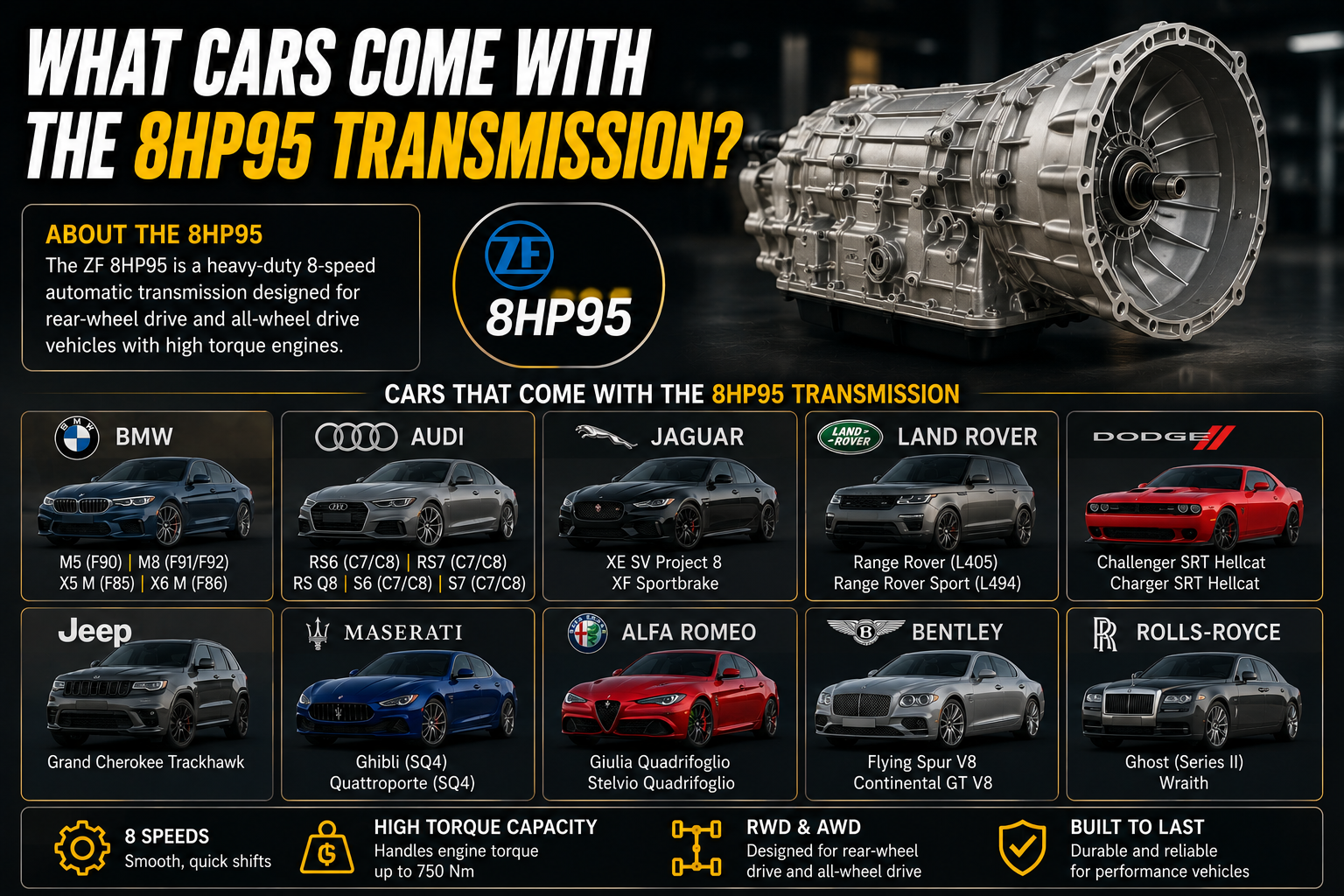
The ZF 8HP95 is the high-torque member of ZF’s eight-speed automatic family, rated for 900 Nm (664 lb-ft) on petrol engines and up to 1,000 Nm (738 lb-ft) on diesel. It appears almost exclusively in vehicles making serious power: supercharged Hellcat-family Stellantis products, Aston Martin’s V12 flagship, Rolls-Royce Black Badge models, Bentley SUVs, and Audi’s RS and S performance line.
- The core applications
- Where the 8HP95 sits in the range
- The generation detail people get wrong
- What ZF says about the family
- Hybrid and drivetrain variants
- Same designation, different transmissions
- Why so much torque capacity matters
- Identifying what you actually have
- Servicing considerations
- Conclusion
- Frequently asked questions
- What is the torque rating of the 8HP95?
- Is the 8HP95 the same as the 8HP90?
- Does the Jeep Trackhawk use a ZF 8HP95?
- Can I swap an 8HP95 between different cars?
- What fluid does the 8HP95 take?
- Related Articles
If you are here because you are sourcing a transmission, cross-referencing a swap, or trying to work out what is under your own car, the short version is below. The longer version matters, because “8HP95” is not one part number and units from different manufacturers are not casually interchangeable.
The core applications
These are the vehicles most consistently identified as running an 8HP95 or its Stellantis-built equivalent.
| Manufacturer | Models |
| Jeep | Grand Cherokee SRT Trackhawk (6.2L supercharged V8) |
| Dodge | Durango SRT Hellcat, Challenger and Charger SRT Hellcat variants |
| Ram | 1500 TRX (6.2L supercharged V8) |
| Aston Martin | DBS Superleggera (5.2L twin-turbo V12) |
| Rolls-Royce | Ghost Black Badge, Wraith Black Badge, Dawn Black Badge |
| Bentley | Bentayga, Flying Spur |
| Audi | RS 6, RS 7, S8, SQ7, Q8 variants |
| BMW | M760i / M760Li (V12) |
The common thread is torque rather than brand prestige. A supercharged 6.2L Hellcat V8 and a twin-turbo V12 are very different engines, but both produce enough twist to need the largest-case unit in the 8HP range.
Aston Martin’s DBS Superleggera is a clean illustration. Its 5.2L twin-turbo V12 makes exactly 900 Nm, sitting right at the 8HP95’s petrol rating, and Aston paired it with a shorter 2.93:1 final drive than the DB11’s 2.70:1.
Where the 8HP95 sits in the range
ZF’s naming is straightforward once you know the pattern. The 8 is the gear count, HP stands for the German for hydraulic planetary, and the number that follows indicates the torque class.
Physically, the 8HP family splits into two case sizes: a smaller case covering roughly 8HP45 through 8HP50, and a larger case for 8HP55 through 8HP95. The 8HP95 is a large-case unit, which matters if you are measuring for a swap.
| Variant | Max torque | Typical use |
| 8HP45 | 450 Nm | Four-cylinder sedans and compact SUVs |
| 8HP50 | 500 Nm | Mid-range sedans, Alfa Giulia and Stelvio |
| 8HP70 | 700 Nm | V8 and diesel applications, Ram 1500, Charger V8 |
| 8HP75 | 740 Nm | Performance sedans, M5 (F90), Giulia Quadrifoglio |
| 8HP90 | 900 Nm | First-generation high-torque unit |
| 8HP95 | 900 Nm petrol / 1,000 Nm diesel | Supercharged and V12 flagships |
| 8HP100 | 1,000 Nm | Fourth-generation, BMW XM and M5 (G90) |
The generation detail people get wrong
This is where a lot of online lists go astray, so it is worth stating plainly.
The 8HP95 is a second-generation unit, introduced in 2014. It is not part of the original 2010 first-generation lineup, and it is not the fourth-generation flagship.
The confusion arises because the first generation included an 8HP90, also rated at 900 Nm, which fitted vehicles like the Audi A8 (D4), Audi RS6 (C7), Bentley Mulsanne, BMW 760i (F01/F02), the Hellcat Challenger and Charger, and the Porsche Cayenne of that era. The 8HP90 and 8HP95 are different units from different generations that share a headline torque number.
Second-generation changes are meaningful. The gear ratio spread widened to 7.81 from the first generation’s 7.07, first gear went from 4.714 to 5.000, and eighth from 0.667 to 0.640. ZF also reduced drag from the shift elements and lowered required pump pressure, claiming roughly 3% better fuel economy than the first generation.
If you see a page listing the 8HP95 alongside 8HP45 and 8HP70 as first-generation siblings, treat the rest of its detail with caution.
What ZF says about the family
It helps to understand what the 8HP was designed to do, because the 8HP95 inherits all of it.
ZF’s own material on the 8-speed automatic transmission describes a family covering roughly 220 to 1,000 Newton metres, intended for every rear-wheel and all-wheel-drive application from lower mid-size cars up to the sporty luxury segment. The design uses four planetary gear sets with only five shift elements, and because just two shift elements are open in any given gear, internal drag losses are unusually low.
ZF also notes that despite adding two gears over the previous six-speed 6HP, the external dimensions stayed the same while weight dropped by around 3%. A mid-size 8HP70 weighs 87 kg including oil.
That combination of compact packaging and modularity explains the 8HP’s spread across more than 20 brands. The same basic architecture scales from a four-cylinder sedan to a supercharged V8 SUV, which is why the 8HP95 shares so much design DNA with units a third of its torque rating.
Hybrid and drivetrain variants
Worth knowing if you are matching a unit to a specific car, because the designation alone does not capture it.
The 8HP family exists in rear-wheel-drive and all-wheel-drive forms, and Volkswagen Group applications historically used a version with a Torsen centre differential. All-wheel-drive versions interface with a transfer case, which is why a Trackhawk transmission is typically sold alongside its transfer case rather than as a standalone unit.
From the third generation onward, ZF also offered mild-hybrid and plug-in-hybrid variants of the 8HP with an electric motor integrated into the bellhousing area. These change the physical package substantially. A hybrid 8HP is not interchangeable with a conventional one even within the same torque class.
For the 8HP95 specifically, most applications are conventional non-hybrid units, but confirming the drivetrain configuration matters as much as confirming the torque rating.
Same designation, different transmissions
Here is the practical complication for anyone buying or swapping.
Stellantis holds a license to build ZF’s eight-speed and manufactures it at Kokomo, Indiana under the TorqueFlite name. A Trackhawk’s transmission is functionally an 8HP95 but is a Stellantis-built unit with Stellantis part numbers, its own valve body calibration, and software integrated into that vehicle’s powertrain management.
Consequences worth knowing:
- Part numbers do not cross between manufacturers. A Rolls-Royce 8HP95 and a Trackhawk 8HP95 are not shelf-interchangeable despite the shared designation.
- Calibration is vehicle-specific. These units are programmed intimately into the host car’s powertrain software. Physical fitment is only half the problem.
- Service details vary. The Trackhawk, for instance, uses a serviceable filter and metal pan arrangement rather than the integrated plastic pan with incorporated filter found on lesser Grand Cherokee models.
The lesson: identify by part number and vehicle application, not by the ZF designation alone.
If you are cross-shopping used units, note that the Trackhawk, Durango Hellcat, and Ram TRX share the same Stellantis 8HP95 family, which makes them the most accessible source of these transmissions in the US market. Rolls-Royce and Aston Martin units exist but are far harder to find and considerably more expensive.
Why so much torque capacity matters
A transmission’s torque rating is not marketing. Exceed it consistently and clutch packs slip, then glaze, then fail.
The 8HP95’s headroom is why it turns up in tuning circles. A stock Trackhawk makes around 645 hp, and the transmission handles it comfortably. That margin is also why heavily modified Hellcat-platform cars often keep the factory unit longer than you might expect, though builders do reinforce clutch packs and revise valve bodies for sustained high-power use.
For diesel applications the 1,000 Nm rating reflects a different demand: diesels produce high torque at low rpm, which loads a transmission differently from a petrol engine making similar peak numbers higher in the range.
Identifying what you actually have
If you need to confirm the variant in a specific car, work through these in order.
- Check the vehicle’s build sheet or VIN decode. Most manufacturers provide dealer-accessible records showing the original transmission code.
- Look for the ZF or manufacturer tag on the case. ZF units carry an identification label; Stellantis units carry Mopar part numbers.
- Note the case size. Larger case indicates 8HP55 and above, which narrows things considerably.
- Cross-reference the engine. Torque output usually determines the variant, so a supercharged 6.2L or a twin-turbo V12 points strongly toward the 8HP95.
- Ask a transmission specialist. For a rebuild or swap, correct identification is worth a phone call rather than an assumption.
Do not rely on the manufacturer’s marketing name. BMW calls its units things like GA8HP, Jaguar uses its own codes, and Stellantis uses TorqueFlite designations, all describing ZF hardware underneath.
Servicing considerations
Two points come up repeatedly with these transmissions.
Fluid specification matters. ZF’s Lifeguard 8 is the approved fluid for the 8HP family, and using the wrong specification causes problems that mimic incorrect fluid level. Each manufacturer has its own filling procedure, but all target the correct level at a specified fluid temperature.
Temperature affects level checking. The fluid in these units expands noticeably as it warms, so a level check at the wrong temperature gives a misleading reading. Follow the procedure for your specific vehicle rather than checking cold and assuming.
Despite the “sealed for life” framing some manufacturers used, most independent specialists recommend periodic fluid service, particularly on high-output applications where the transmission runs hotter.
Conclusion
The 8HP95 is ZF’s second-generation high-torque eight-speed, rated at 900 Nm petrol and 1,000 Nm diesel, and it appears in the Jeep Grand Cherokee Trackhawk, Dodge Durango Hellcat, Ram 1500 TRX, Aston Martin DBS Superleggera, Rolls-Royce Black Badge models, Bentley Bentayga and Flying Spur, and Audi’s RS and S range. It is not the same as the first-generation 8HP90 despite the similar torque rating. If you are sourcing one, identify by part number and vehicle rather than by the ZF designation, because Stellantis-built units and ZF-built units are not interchangeable even where the name matches.
Frequently asked questions
What is the torque rating of the 8HP95?
900 Nm (664 lb-ft) for petrol applications and up to 1,000 Nm (738 lb-ft) for diesel. That places it at the top of ZF’s second-generation eight-speed range.
Is the 8HP95 the same as the 8HP90?
No. The 8HP90 is a first-generation unit from 2010 and the 8HP95 is second-generation from 2014. They share a 900 Nm petrol rating but have different gear ratios, a wider ratio spread, and different internals.
Does the Jeep Trackhawk use a ZF 8HP95?
It uses the Stellantis-built equivalent, produced under license at Kokomo and branded TorqueFlite. Functionally the same design, but with Mopar part numbers and vehicle-specific calibration.
Can I swap an 8HP95 between different cars?
Not straightforwardly. Bellhousing patterns, transfer case interfaces, output shafts, and especially software calibration are vehicle-specific. Physical similarity does not mean interchangeability.
What fluid does the 8HP95 take?
ZF Lifeguard 8 is the approved specification for the 8HP family. Follow your manufacturer’s filling procedure, since correct level depends on fluid temperature rather than a simple dipstick reading.
Related Articles
Can You Lease a Car With Bad Credit? What It Costs
Why Does My Car Smell Like Burning Oil?
Can You Put Gas in a Running Car?