A burning oil smell almost always means oil has escaped somewhere it should not be and is cooking on a hot surface, usually the exhaust manifold. The most common source by a wide margin is a leaking valve cover gasket, which sits at the top of the engine and lets oil run down onto the exhaust below.
- When you notice it narrows the cause
- The common causes, in order
- Is it actually oil?
- Finding the source yourself
- If it started right after work was done
- What it costs to fix
- How urgent is it?
- Preventing the next one
- Conclusion
- Frequently asked questions
- Is it safe to drive with a burning oil smell?
- Why does my car smell like burning oil but there’s no leak?
- Why is the smell stronger after I park?
- How much does a valve cover gasket cost to fix?
- Can burning oil smell get into the cabin?
- Related Articles
Before the causes, one thing worth knowing straight away: if you can see smoke coming from under the hood, stop driving. An exhaust manifold runs hot enough to ignite oil without any spark involved, and that is the one version of this problem that becomes a fire rather than a repair bill.
Most cases are not that. Most cases are a gasket that has hardened with age, and catching it early is the difference between a modest repair and an expensive one.
When you notice it narrows the cause
This is the fastest way to shorten the list, and it takes no tools.
Strongest after you park. Classic upper-engine leak. While driving, airflow carries the smell away; once you stop, heat soaks and the smell rises through the hood gap. Points at a valve cover gasket or something else high on the engine.
Only when the engine is hot. Small seeps often only open up once metal has expanded and oil has thinned. This is normal for an early-stage gasket leak.
Inside the cabin, especially with the heater on. The heater draws air from the cowl at the base of the windshield. If the smell strengthens with the fan running, the source is likely near the back of the engine bay.
Right after an oil change. Usually spilled oil burning off the exhaust, and it should fade within a few drives. If it persists beyond that, check the drain plug and filter for a genuine leak.
With blue smoke from the tailpipe. Different problem entirely. That means oil is burning inside the combustion chamber rather than outside on hot metal, which points at worn piston rings or valve guide seals.
The common causes, in order
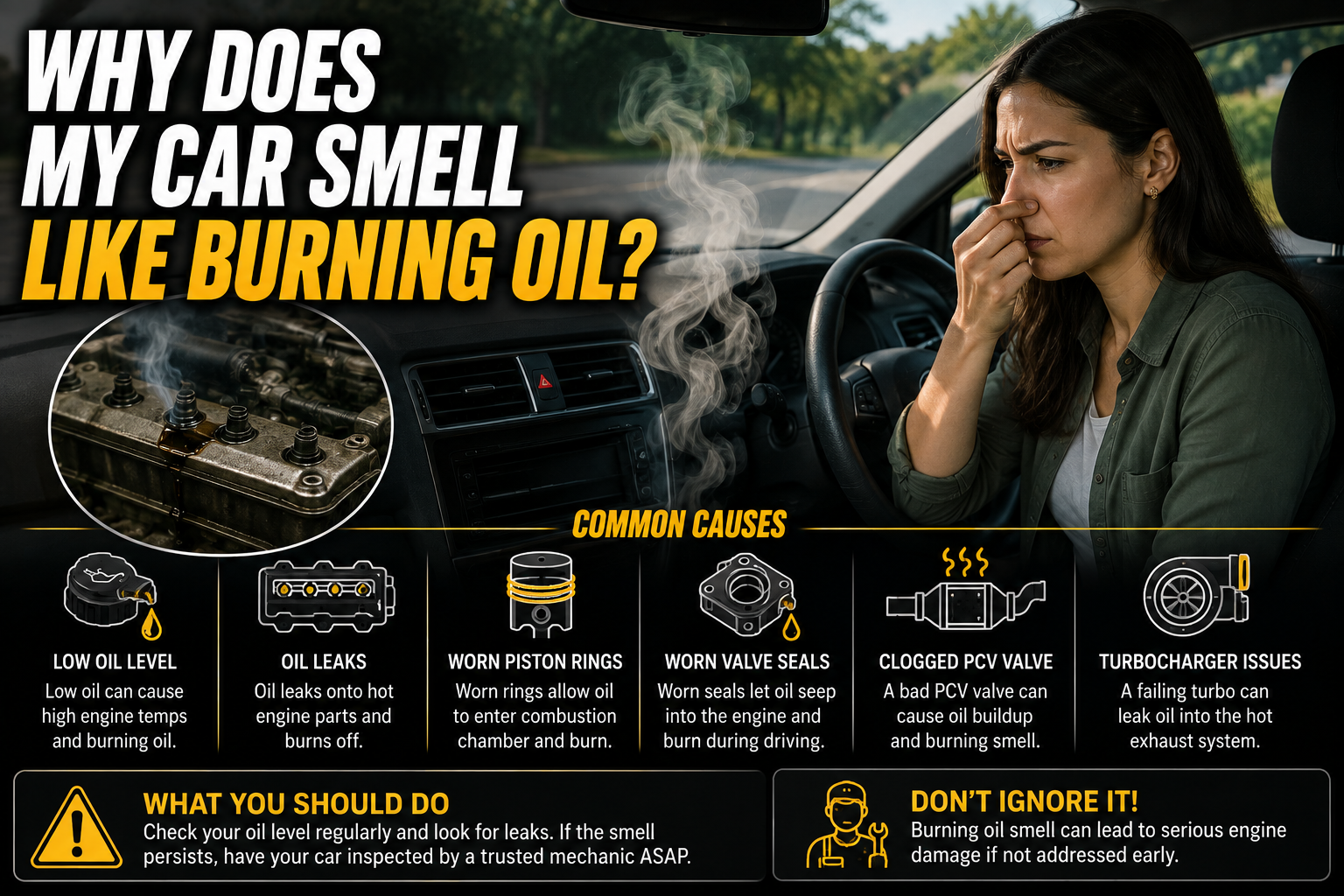
Valve cover gasket. The single most likely source. This gasket seals the top of the cylinder head, and it hardens and shrinks with heat cycling over years. Oil then seeps out of the seam and runs down the side of the engine onto the exhaust manifold. Look for wet, shiny oil along the edge where the valve cover meets the head, particularly at the rear corners where it is easy to miss.
Oil pan gasket or drain plug. Lower down, so this one more often leaves drips on your driveway than smell. It still produces odor if oil reaches the exhaust pipe underneath.
Front or rear main seal. Crankshaft seals harden with age. A rear main seal typically shows oil around the bellhousing area between engine and transmission, and it tends to fling oil around rather than drip neatly.
Oil filter or filter housing. A filter that was not seated properly, double-gasketed, or overtightened will weep. So will a cracked filter housing, which is a known weak point on some engines.
Overfilled oil. Adding too much creates crankcase pressure that pushes oil out through the breather system. This one catches people who topped up generously after seeing a low reading.
Turbocharger seals. On turbo engines, failing seals let oil into the exhaust side, which produces both smell and blue smoke.
Worn piston rings or valve guide seals. Internal wear letting oil into the combustion chamber. Distinguished by blue exhaust smoke and rising oil consumption without any external leak.
AutoZone’s guide on why a car smells like burning oil also flags engine overheating as a contributor, since excessive heat breaks oil down faster and produces its own burnt odor. If your temperature gauge is climbing, treat that as the primary problem.
Is it actually oil?
Several smells get reported as burning oil and are not. Getting this right matters, because two of them are more urgent.
| Smell | Likely source | Urgency |
| Acrid, thick, like a hot frying pan | Engine oil on hot exhaust | Investigate soon |
| Sweet, syrupy | Coolant leak | High, overheating risk |
| Sharp, like burning plastic or fish | Electrical fault, melting insulation | Stop driving |
| Burning rubber | Slipping belt, or hose touching hot metal | Investigate soon |
| Hot, metallic, worst after braking | Dragging brake or stuck caliper | High, check wheel temp |
| Burnt toast, faintly sweet | Overheating transmission fluid | Investigate soon |
The electrical one deserves emphasis. A sharp, chemical, plastic-like smell is not oil and can precede a wiring fire. If that is what you are smelling, stop and switch off.
Coolant is the other to catch early. Ethylene glycol smells distinctly sweet, and coolant loss means overheating, which causes far more damage far faster than a slow oil seep.
Finding the source yourself
Twenty minutes with a flashlight resolves most of these.
- Let the engine cool completely. An exhaust manifold can exceed 500°F. This is not a step to rush.
- Check the oil level first. A dipstick reading below minimum suggests a leak significant enough to be losing measurable oil. A reading well above maximum suggests overfill is your answer.
- Look along the valve cover seam. Follow the joint where the cover meets the cylinder head all the way around, including the back edge nearest the firewall. Fresh oil looks wet and shiny; older leaks look like dark, dirty grime.
- Trace downward. Oil runs with gravity, so the highest wet point is usually nearest the source. Oil from a valve cover can travel down the block and mimic a leak from much lower.
- Check the exhaust manifold and heat shields for baked-on residue or discoloration, which confirms oil has been reaching hot metal.
- Look underneath for drips on the ground, and note their position relative to the engine.
The trick that saves guesswork: clean the engine bay with degreaser, drive for a few days, then look again. Fresh oil against clean metal shows you exactly where it is coming from. Trying to read a decade of accumulated grime tells you almost nothing.
If that does not resolve it, a shop can add UV dye to the oil and find the leak under ultraviolet light. It is cheap, and far better than replacing gaskets speculatively.
If it started right after work was done
A burning oil smell that appears immediately after a garage visit is a different situation from one that developed gradually, and it is worth separating.
After an oil change. The most common version, and usually harmless. Oil spilled on the exhaust during the drain or filter change burns off over the next few heat cycles. Expect it to fade within two or three drives. If it does not, go back and ask them to check the drain plug torque and the filter seal.
The double-gasket problem. When an oil filter is changed, the old rubber gasket occasionally stays stuck to the housing. Fitting the new filter on top of it creates a seal that looks fine and then leaks under pressure, sometimes badly. If your smell started after a filter change and the oil level is dropping, this is worth checking immediately.
After valve cover or gasket work. A fresh gasket that leaks usually means something else was wrong: a warped cover, over-tightened bolts, a missed sealant point at a corner, or a clogged PCV system creating crankcase pressure the gasket cannot hold. Replacing the gasket again without addressing the cause repeats the failure.
After engine bay cleaning. Degreaser residue and dampness burning off can smell odd for a drive or two. Harmless, and it settles.
The general rule: a smell that appears within a day of service and fades over several drives is almost certainly residue. One that appears and persists, or comes with a dropping oil level, means something was disturbed and should go back.
What it costs to fix
Rough ranges, since the variable is access rather than parts. The spread on gaskets is almost entirely labor: a four-cylinder with a valve cover you can reach in ten minutes sits at the bottom, while a V6 where the intake manifold has to come off to reach the rear bank sits at the top. Rear main seals are expensive for the same reason, since the transmission usually has to come out.
| Repair | Typical cost |
| Oil filter reseat or drain plug | Under $50 |
| Correcting an overfill | Cost of an oil change |
| Valve cover gasket | $150 to $600 |
| Oil pan gasket | $300 to $900 |
| Front main seal | $400 to $900 |
| Rear main seal | $800 to $2,000 |
| Piston rings or internal engine work | $2,500 and up |
How urgent is it?
Not every burning oil smell needs a tow, but some do.
Stop driving now if: you see smoke from under the hood, the oil pressure light comes on, the temperature gauge is climbing, or the smell is strong enough inside the cabin to be affecting you.
Book it in this week if: the oil level is dropping between checks, you can see fresh oil on the exhaust manifold, the smell is getting stronger, or you find oil in the spark plug wells.
Monitor if: the smell is faint, the oil level is holding steady, there is no visible smoke, and you have a service due soon anyway.
Two specific escalations are worth knowing. Oil in the spark plug wells can foul plugs and damage ignition coils, turning a gasket job into a gasket plus coils job. And a valve cover leak on a turbo engine can create a vacuum leak through the PCV system, which causes running problems on top of the oil loss.
Preventing the next one
Gaskets fail with age and heat, so you cannot prevent this indefinitely. You can slow it down.
- Change oil on schedule. Degraded oil runs hotter and is harder on seals.
- Do not overfill. Check the dipstick after topping up rather than trusting the bottle.
- Keep the engine bay reasonably clean. Old baked-on oil both hides new leaks and produces smell of its own.
- Address small seeps early. A weep that costs a gasket now can cost a gasket plus coils plus a cleanup later.
- Watch the oil level between services. A quarter of a quart lost over a month is information worth having.
Conclusion
A burning oil smell means oil is reaching something hot, and the valve cover gasket is the most likely culprit. Check the oil level, look along the valve cover seam and down onto the exhaust manifold with the engine cold, and clean the engine bay so a fresh leak shows itself. Confirm it is actually oil rather than coolant or an electrical smell, since those two are more urgent. A good result is a dry seam, a stable oil level, and no smell after a full drive cycle. If you see smoke under the hood at any point, stop and get it recovered rather than driving on.
Frequently asked questions
Is it safe to drive with a burning oil smell?
Briefly, if the leak is small and the oil level is holding. Stop immediately if you see smoke, the oil pressure light comes on, or the temperature gauge rises, since oil on a hot exhaust is a genuine fire risk.
Why does my car smell like burning oil but there’s no leak?
Often a small seep that only opens up when the engine is hot, or residue burning off after a recent oil change. It can also be internal oil consumption, which shows as blue exhaust smoke rather than an external leak.
Why is the smell stronger after I park?
Airflow carries it away while you drive. Once stopped, heat soaks through the engine bay and the smell rises through the hood gap. This pattern usually indicates an upper-engine leak.
How much does a valve cover gasket cost to fix?
Commonly $150 to $600, with labor being the main variable. Engines where the intake manifold must come off to reach the rear cylinder bank sit at the higher end.
Can burning oil smell get into the cabin?
Yes. The heater intake sits at the base of the windshield, so a leak near the back of the engine bay draws odor straight into the ventilation system, particularly with the fan running.
Related Articles
Can You Put Gas in a Running Car?
Can You Lease a Used Car? How CPO Leasing Works