


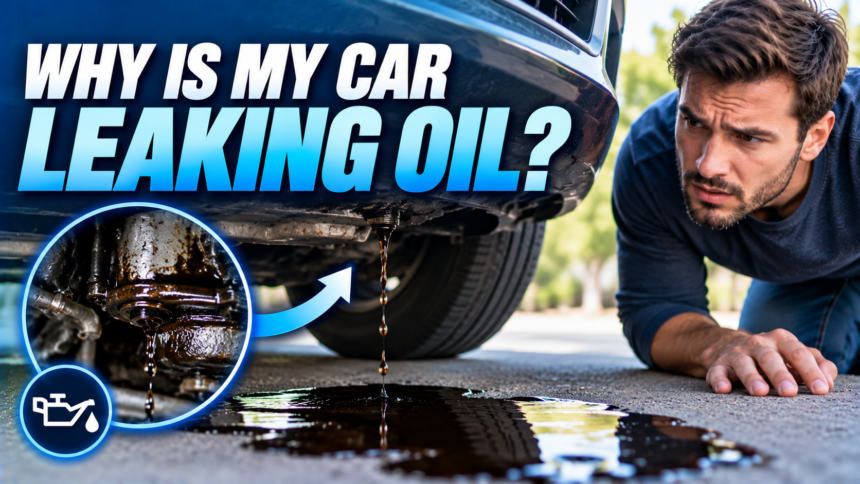
Most oil leaks come from a worn gasket or seal that has hardened or cracked over time. The usual suspects are the valve cover gasket, the oil pan gasket, and the crankshaft seals. Less often, the cause is a loose oil filter or drain plug, a damaged oil pan, or an overfilled engine. The good news is that many leaks are minor and cheap to fix, as long as you catch them early.
Before you worry, it helps to confirm the fluid is actually oil, then narrow down where it is coming from. This guide walks through both, then explains how serious different leaks are and what they cost to fix.
First, make sure it is actually oil
Cars have several fluids, and they leak in different colors. A quick check tells you whether you are dealing with an oil leak or something else entirely.
Put a clean sheet of light-colored cardboard or paper under the car overnight, then look at the color of the drip in the morning:
| Fluid color | Likely fluid | What it points to |
| Amber to dark brown | Engine oil | A gasket or seal leak. The focus of this guide. |
| Green, orange, or pink | Coolant | A cooling system leak, not oil. Different fix. |
| Red or reddish-brown | Transmission or power steering fluid | A leak from those systems, not the engine oil. |
| Clear and watery | Usually just water | Condensation from the AC. Normal, no action needed. |
Fresh engine oil is amber, while older oil is dark brown or nearly black. If the drip is one of the other colors, the fix is different and this guide may not be the right one. A clear, watery puddle is usually just condensation dripping from the air conditioning, which is completely normal and nothing to fix.
The most common causes of an oil leak
Your engine has a collection of gaskets and seals, each filling the gap between two metal surfaces. Most are made of rubber or cork, and heat and age make them brittle until they finally let oil past. These are the leaks you will run into most:
- Valve cover gasket. This seals the top of the engine. It is one of the most common leaks, and because it sits up high, leaking oil can run down the side of the engine or drip onto the hot exhaust and cause a burning smell.
- Oil pan gasket. This seals the pan at the bottom of the engine that holds the oil. When it wears out, or the pan is dented by road debris or a curb, oil drips straight down and pools under the car.
- Crankshaft seals (front and rear). These seal the spinning crankshaft where it exits the engine. The rear one, called the rear main seal, is the most serious of the common leaks because it is expensive to reach.
- Loose or worn oil filter or drain plug. After an oil change, a filter that is not tight or a drain plug with a worn washer can seep oil. This is one of the easiest problems to fix.
- Bad oil filler cap. A cracked or loose oil cap can let oil escape from the top of the engine while it runs. Cheap and quick to sort.
- Overfilled engine or a clogged PCV valve. Too much oil, or a blocked crankcase vent, raises pressure inside the engine and pushes oil past seals that were otherwise fine.
A leak higher up the engine can trickle down and drip from a lower point, making it look like the oil pan or rear main seal is the culprit when it is not. That is why finding the true source matters before you pay for a repair.
How to find where the leak is coming from
Pinpointing the source saves you from paying to fix the wrong thing. You can narrow it down yourself with a simple approach:
- Clean the engine first. Old oil spreads everywhere and hides the source. Degrease the area so you are looking for fresh oil, not old residue.
- Run the engine and look. With the car safely raised and supported, or over a service pit, watch for where fresh oil appears. Some leaks, like the valve cover, only show while the engine is running and the valves are moving oil around.
- Follow the trail upward. Oil runs down with gravity, so the highest wet point is usually nearer the source than the lowest drip. A small telescoping mirror helps you see the top and back of the engine.
- Use a tracer if it is hidden. Adding a UV dye to the oil and shining a UV light, or dusting a suspect area with white foot powder, makes a stubborn leak path easy to spot.
If that sounds like more than you want to take on, a shop can do a dye test quickly. For a step-by-step on the most common of these, Mobil has a good walkthrough on tracing and replacing a valve cover gasket.
How serious is it? Is it safe to drive?
It depends on how fast the oil is leaving. A slow seep that leaves a small spot is usually not an emergency, though it should still be fixed before it grows. A steady drip or a fast leak is a different matter, because running low on oil starves the engine of lubrication and can cause permanent, expensive damage.
Stop driving and get help if you see a rapidly growing puddle, if your oil warning light comes on, or if you smell burning oil or see smoke from under the hood. Oil dripping onto a hot exhaust is a genuine fire risk.
The safest habit while you sort out a leak is to check your oil level often, using the dipstick, and top it up so the engine is never low. A rear main seal deserves extra caution: because the crankshaft spins right against it, a small tear can turn into a fast leak that drains the oil quickly, so do not let that one slide.
The bottom line is that a minor leak is a fix-it-soon job, not a park-it-forever one, but only if you keep the oil topped up and watch that it is not getting worse.
What it costs to fix
Cost depends far more on where the leak is than on the part itself, because labor is the real expense. A gasket might cost very little, but reaching it can take hours.
A loose drain plug, filter, or oil cap is often a quick, cheap fix. A valve cover or oil pan gasket is a moderate job, since the part is inexpensive but there is some labor to get to it. The rear main seal is the costly one, because reaching it usually means removing the transmission, and totals often land in the range of about $600 to $1,200 or more depending on the vehicle.
Whatever the source, fixing a leak sooner is almost always cheaper than the alternative. A small gasket replacement now beats a damaged engine later, and it keeps you from constantly buying oil to make up the loss.
Conclusion
An oil leak almost always means a worn gasket or seal, most often the valve cover gasket, oil pan gasket, or a crankshaft seal. Start by confirming the drip is amber or brown oil, then clean the engine and trace the leak to its highest wet point. A slow seep is a fix-it-soon job as long as you keep the oil topped up, but a fast leak, a warning light, or a burning smell means stop and get help. Catching it early keeps the repair small.
Frequently asked questions
Is it safe to drive with an oil leak? A slow seep is usually fine short term if you keep the oil topped up and watch it closely. A fast leak, an oil warning light, or a burning smell means stop driving and get it checked.
How do I know if it is oil or coolant leaking? Check the color of the drip. Engine oil is amber or dark brown. Coolant is green, orange, or pink. Transmission fluid is reddish. A clear, watery puddle is usually just AC condensation.
What is the most common cause of an oil leak? A worn valve cover gasket or oil pan gasket. Both are rubber or cork seals that harden and crack with heat and age, letting oil escape.
Why does my car leak oil only when parked but not while driving? Some leaks pool while the car sits and the oil settles. Others, like a valve cover gasket, show mainly while running. Where the oil collects helps identify the source.
Can I just use an oil-stop-leak additive? These can slow a minor seep by softening old seals, but they are a temporary patch, not a repair. For anything more than a small leak, fixing the gasket or seal is the real solution.
Related Articles
Why Is My Car Leaking Water? (When It’s Normal)
How Much Oil to Put in Your Car: Quarts by Engine?