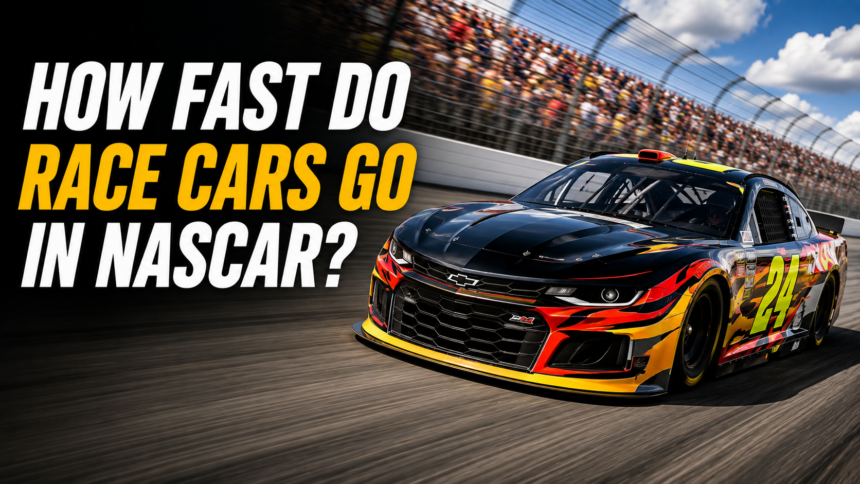
Few questions get a motorsports conversation going faster than this one: how fast do race cars go in NASCAR? It’s the first thing casual fans want to know, and even longtime followers of the sport are often surprised by just how much the answer changes depending on the track, the car, and the era being discussed.
In simple terms, NASCAR Cup Series cars typically race between 130 and 200 mph, with the fastest tracks pushing cars close to 200 mph in a straight line and short tracks slowing things down to closer to 90-130 mph through tight, technical corners. But that single range doesn’t tell the whole story. Speed in NASCAR is shaped by engineering, track design, safety rules, and decades of trial and error that have turned stock car racing into one of the most carefully balanced motorsports in the world.
This guide breaks the topic down piece by piece, from all-time speed records to the everyday physics that keep a 3,400-pound stock car glued to the pavement at nearly 200 mph. Whether you’re prepping for your first race weekend or just settling a debate with a friend, you’ll walk away with a full picture of how fast do race cars go in NASCAR and why.
Top Speed Records
The all-time fastest lap in NASCAR Cup Series history still belongs to Bill Elliott, who turned a qualifying lap at Talladega Superspeedway in the spring of 1987 at an average speed a hair above 212 mph. It’s a number that has stood for decades and, given how the sport has changed since, is unlikely to ever be matched in competition.
That era of racing looked very different from today. Cars ran without the restrictor plates and tapered spacers that NASCAR later introduced specifically to slow superspeedway racing down after safety concerns mounted in the late 1980s. In fact, later that same year, a separate incident at Talladega involving a car going airborne into the catch fence pushed NASCAR to act almost immediately, and speed restrictions followed within months.
It’s worth noting there’s a difference between an official record and a car’s outright top-end capability. In the mid-2000s, one driver famously removed a restrictor plate during a private practice session at Talladega and hit a top speed north of 216 mph — but because it happened outside of an official qualifying run, it never counted as a record. This distinction matters: NASCAR’s record books track sanctioned, timed laps, not the theoretical ceiling of what these machines can do unrestricted.
Modern qualifying speeds look much tamer by comparison. Current Cup Series cars, tuned for pack racing and drafting rather than solo speed, typically top out in the 180-190 mph range during qualifying at Daytona and Talladega — still blisteringly fast, just not record-chasing fast.
Speed by Track Type
Perhaps the biggest factor in answering how fast do race cars go in NASCAR is simply asking: on what kind of track? NASCAR’s schedule includes several distinct track categories, and speeds swing wildly between them.
| Track Type | Example Tracks | Typical Speed Range |
|---|---|---|
| Superspeedways | Daytona, Talladega | 180-200+ mph |
| Intermediate tracks | Charlotte, Texas, Las Vegas | 160-190 mph |
| Short tracks | Bristol, Martinsville | 90-130 mph |
| Road courses | Watkins Glen, COTA, the Charlotte Roval | 60-120 mph (variable) |
Superspeedways are the crown jewels of NASCAR speed. Their steep banking and long straightaways let cars run wide open for extended stretches, and drafting in a tightly packed field can carry the whole line along faster than any single car could manage alone. Intermediate, or “mile-and-a-half,” tracks offer a blend of high speed and real cornering demands, which is why they’re often considered the truest test of a well-rounded race car.
Short tracks flip the script entirely. With tight corners and little room to build momentum, average speeds drop dramatically even though the racing is often considered more physical and aggressive. Road courses add left-and-right turns, elevation changes, and hard braking zones into the mix, which keeps average speeds lower still, even though cars can hit high numbers on the rare long straightaway.
Factors That Affect Speed
A NASCAR Cup Series car isn’t fast by accident. A long list of engineering and regulatory factors work together — sometimes pulling in opposite directions — to determine exactly how fast these cars can go on a given day.
- Engine specifications and horsepower: Cup Series engines are purpose-built V8s producing roughly 670 horsepower on most tracks, dropping to around 510 horsepower on superspeedways where NASCAR intentionally limits output for safety.
- Aerodynamics and downforce: Body shape, spoilers, and underbody airflow all affect how much a car is pushed down onto the track versus how much drag it creates at speed.
- Tapered spacers (the modern successor to restrictor plates): These devices limit airflow into the engine on superspeedways, capping horsepower and, by extension, top speed, specifically to keep pack racing safer.
- Track banking and corner geometry: Steeper banking, like Talladega’s famous 33-degree turns, lets cars carry far more speed through corners than a flat track ever could.
- Weather conditions: Cooler, denser air generally helps engines produce more power, while track temperature affects tire grip and, in turn, how fast drivers can push.
- Draft and pack racing effects: Cars running nose-to-tail punch a smaller combined hole through the air, letting the whole pack run faster than any one car could in isolation.
Each of these elements is a lever NASCAR and race teams can pull, and the sport’s rulebook has evolved specifically to keep speeds from climbing back toward the dangerous highs of the late 1980s.
NASCAR Car Classes and Their Speeds
Not all NASCAR competition happens in the flagship Cup Series. The sport runs a tiered system of national series, each with cars tuned to slightly different speed and power levels.
- Cup Series — The top tier and the fastest cars in NASCAR, with the horsepower and aerodynamic packages capable of approaching 200 mph on superspeedways.
- Xfinity Series — Often described as NASCAR’s minor-league proving ground, these cars run slightly less horsepower and typically qualify a few miles per hour slower than their Cup Series counterparts on the same tracks.
- Truck Series — Built on pickup-truck bodies, these vehicles carry different aerodynamic profiles and generally post the lowest top speeds of the three national series, though they remain plenty fast by everyday standards.
The gaps between series aren’t enormous, but they’re consistent enough that fans watching a doubleheader weekend can usually feel the difference in raw speed and sound between a Cup car and a Truck Series entry on the same layout.
How NASCAR Speeds Compare to Other Motorsports?
It’s natural to wonder how NASCAR stacks up against other forms of racing, especially since each series optimizes for a different kind of speed.
- Formula 1: F1 cars are dramatically quicker through corners thanks to extreme downforce and lighter weight, and they post higher lap-average speeds on road-course-style circuits, though their outright top speed on a straight is often similar to or only slightly higher than a NASCAR superspeedway car.
- IndyCar: Indy cars are lighter and more aerodynamically efficient than NASCAR stock cars, which lets them post higher qualifying speeds at ovals like Indianapolis, generally in the 220-230+ mph range.
- Everyday road cars: Even a quick sports car rarely exceeds 180 mph, meaning a stock NASCAR racer at full pace on a superspeedway is comfortably faster than nearly anything else on public roads.
- Drag racers: Top Fuel dragsters operate in an entirely different discipline, reaching over 300 mph — but only in a straight line over a quarter mile, with no cornering involved at all.
The comparison makes clear that NASCAR occupies its own niche: heavier and less aerodynamically extreme than F1 or IndyCar, but built for sustained, close-quarters, pack-style racing that those other series rarely attempt.
Safety at High Speeds
Speed and safety have always pulled against each other in NASCAR, and the sport’s history is full of moments where a leap in speed was quickly followed by a safety response. The most consequential turning point came in 1988, when NASCAR introduced restrictor plates at Daytona and Talladega, directly reducing horsepower and top speed after a string of high-speed incidents raised alarm across the garage.
The 2001 death of Dale Earnhardt at Daytona triggered another wave of safety innovation. In the years that followed, NASCAR mandated the HANS device (Head and Neck Support) for all drivers, accelerated the rollout of SAFER barriers around track walls, and eventually introduced a redesigned “Car of Tomorrow” with a stronger chassis and improved driver cocoon.
Modern Cup Series cars are engineering marvels when it comes to protecting drivers at speed. Full roll cages, energy-absorbing foam, six-point safety harnesses, and cockpit-mounted seats molded to each driver all work together to help drivers walk away from crashes that would have been catastrophic in earlier decades. Drivers also routinely experience significant G-forces in sustained high-speed corners, particularly at high-banked tracks like Talladega and Daytona, which is part of why physical conditioning has become such a major focus for today’s competitors.
Acceleration and Lap Times
Top speed only tells part of the story — how quickly a car gets there matters just as much on a track full of restarts, cautions, and pit exits. A Cup Series car can generally accelerate from 0 to 60 mph in roughly 3 to 4 seconds, a figure that rivals many high-performance street cars despite the NASCAR racer’s considerable weight.
Lap times vary enormously by track. A lap around Daytona’s 2.5-mile superspeedway typically takes somewhere around 45 seconds during green-flag pack racing, while a lap around a tight half-mile track like Martinsville can take closer to 19-20 seconds despite covering far less distance, simply because of how much time is spent braking and cornering.
One number that surprises a lot of new fans: pit road speed limits. Rather than being an afterthought, pit lane speed is tightly enforced, usually somewhere in the 30-55 mph range depending on the track, specifically to protect crew members working in a tight, high-traffic space. It’s a jarring contrast for drivers who are running well over 150 mph moments before peeling off into pit lane.
Fun Facts and Records
- Bill Elliott’s 212.809 mph qualifying lap at Talladega in 1987 remains the fastest official lap in NASCAR Cup Series history.
- The first NASCAR race car to officially break 200 mph in competition did so at Talladega in the early 1970s, years before the track’s speeds peaked in the mid-1980s.
- Restrictor plates, later replaced by tapered spacers, were introduced specifically because cars were becoming too fast for the safety technology of the time to reliably protect drivers.
- Modern superspeedway qualifying speeds tend to sit 20-30 mph below Elliott’s 1987 mark, a gap that reflects deliberate rule changes rather than any lack of raw engineering capability.
- Despite superspeedway top speeds grabbing headlines, most NASCAR races are actually won and lost on intermediate and short tracks, where consistency and handling matter more than outright velocity.
Conclusion
So, how fast do race cars go in NASCAR? The honest answer is: it depends entirely on where they’re racing. On a superspeedway like Daytona or Talladega, cars can approach 200 mph in a tightly bunched pack. On a short track like Bristol or Martinsville, that same car might spend most of its lap under 130 mph, wrestling with tight corners instead of wide-open straights. Averaged across a full race distance, most Cup Series speeds land somewhere in the 130-190 mph range, shaped by track layout, cautions, and pit strategy.
What makes NASCAR’s relationship with speed so compelling is the balance behind it. Every mile per hour on the board today exists within a framework of horsepower limits, aerodynamic rules, and safety technology built from decades of hard-earned lessons. The result is a sport that still delivers spectacular, edge-of-your-seat speed — just with far more protection for the drivers chasing it than existed in the record-setting days of the late 1980s.
Related Articles
Do LMP2 Cars Have Traction Control? The Complete Guide
What to Put Under Tires When Storing a Car?
Is Nissan an American Car? The Real Answer Explained
What Is Neutral For in a Car? Complete Guide for Every Driver