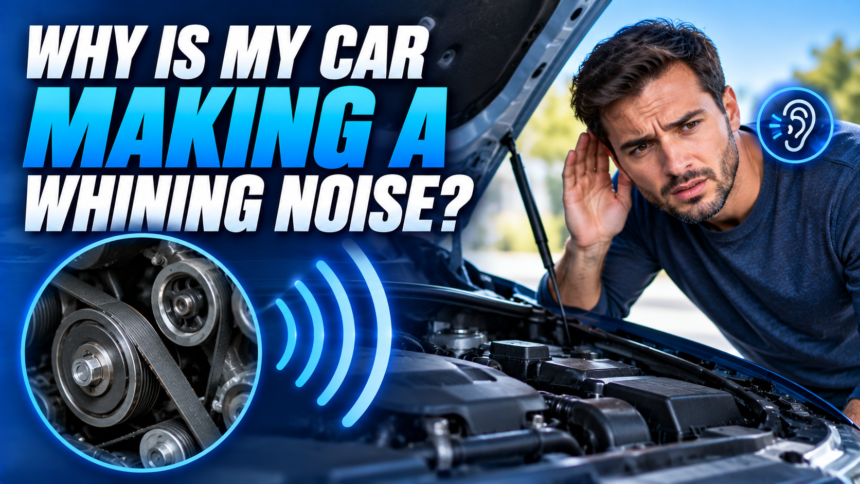
A whining noise almost always comes from something spinning: a belt, a pump, a bearing, or a set of gears. The fastest way to narrow it down is to notice what the whine follows. If the pitch rises and falls with engine revs, the cause is under the bonnet. If it rises with road speed regardless of revs, the cause is at the wheels or in the drivetrain. If it appears only when you turn the wheel, it is the power steering.
- Start with the three-question test
- If the whine follows engine revs
- If the whine follows road speed
- If the whine happens when steering
- If the whine relates to gear changes
- What cold and warm tell you
- What to do next
- What to tell the mechanic
- Conclusion
- Frequently asked questions
- Is it safe to drive with a whining noise?
- Why does my car whine when I accelerate but not at idle?
- Why does my car whine when I turn the steering wheel?
- Can low fluid cause a whining noise?
- Is a whining noise expensive to fix?
- Related Articles
That one distinction separates a belt you can replace for under $100 from a differential that costs well over $1,000. Most guides list a dozen possible causes without telling you how to tell them apart, which is why people end up paying to replace the wrong part.
Start with the three-question test
You can do this on a normal drive, with the radio off and a window slightly open.
Question 1: Does the whine change when you rev the engine in neutral?
Sit stationary, in park or neutral, and raise the revs gently. If the whine rises and falls with the engine, the source is engine-driven: a belt, alternator, power steering pump, or water pump.
Question 2: Does it change with road speed instead?
If the noise is steady at idle but builds as you drive faster, and holding a steady speed keeps it constant, the source turns with the wheels. Think wheel bearings, tyres, or differential.
Question 3: Does it change when you turn the steering wheel?
Turn the wheel slowly while stationary or crawling in a car park. A whine that appears or worsens as you turn points at the power steering system.
The most useful single test: at a steady 40 mph on a quiet road, shift down a gear so the revs rise but your speed stays the same. If the whine changes, it follows engine speed. If it stays put, it follows road speed. That one manoeuvre eliminates half the possible causes.
If the whine follows engine revs
These are the causes that live under the bonnet, and they include the cheapest fixes on the list.
Serpentine belt or tensioner. A worn, glazed, or loose belt whines or squeals, often loudest on a cold start and easing as things warm up. The belt drives the alternator, water pump, power steering pump, and AC compressor, so a single failing belt can sound like several problems at once. Belts are consumable parts and replacing one is among the cheaper jobs a shop does.
Alternator bearing. A high-pitched whine that rises with revs and gets louder when you switch on headlights, heated rear window, or air conditioning suggests the alternator. Extra electrical load makes it work harder. Dim or flickering lights, or a battery warning light, strengthen the case considerably.
Water pump bearing. Usually a whine or light growl from the front of the engine that tracks revs. Worth taking seriously because a water pump that seizes can shred the belt and, on some engines, cause overheating quickly.
Idler or tensioner pulley. These simply guide the belt, and when their bearings wear they whine. With the engine off and the belt removed, a failing pulley often spins roughly or has noticeable play.
If the whine follows road speed
These matter more, because two of them affect how the car handles.
Wheel bearing. Typically a hum, drone, or growl that grows with speed, often most noticeable between 30 and 60 mph. The distinguishing test is steering: on a safe, empty road, gently weave left and right. A wheel bearing usually gets louder when you turn toward its side and quieter when you turn away, because cornering loads and unloads it.
Tyres. Uneven or feathered wear produces a hum that also builds with speed, which is why tyre noise gets mistaken for a bearing constantly. Tyre noise usually changes with road surface, and often improves after a rotation. A bearing does neither.
Differential. On rear-wheel-drive, all-wheel-drive, and four-wheel-drive vehicles, worn gears or bearings in the diff produce a whine that tracks road speed and typically changes with load. A whine under acceleration that quietens when you lift off, or the reverse, points here. Low or contaminated gear oil is a common contributor.
If the whine happens when steering
Power steering whine is the most recognisable of the group and often the cheapest to investigate.
The system is hydraulic, and a pump under strain complains. Low fluid lets the pump draw in air, and those bubbles collapsing inside it produce the classic whine, a process called cavitation. AutoZone’s guide to what causes power steering whine lists the usual suspects as low fluid, a worn pump, a slipping belt, and air in the system.
Checking the fluid takes two minutes. Find the reservoir, which is usually a small tank with a cap marked with a steering wheel symbol, and check the level against the marks on the side or the dipstick under the cap.
One important caveat: if the level is low, the fluid went somewhere. These are sealed systems, so a low level means a leak, and topping it up is a diagnostic step rather than a repair. Check around hose connections, the pump, and the ends of the steering rack for wetness.
Also note that many newer cars have electric power steering with no fluid at all. If you cannot find a reservoir, that is likely why, and a whine when turning would then point at the steering motor rather than a pump.
If the whine relates to gear changes
A whine that changes with gear selection, or appears in some gears and not others, points at the transmission.
In an automatic, low or degraded fluid is the first thing to check, and a whine that changes when the torque converter locks up is a recognised pattern. In a manual, worn bearings on the input or output shaft typically whine in specific gears and go quiet in others, and a noise that changes when you press the clutch pedal implicates the release or pilot bearing.
Transmission work is expensive, which cuts both ways. It is worth having diagnosed properly rather than guessed at, and it is also worth ruling out the cheaper road-speed causes first, since a wheel bearing and a transmission whine can sound alike from the driver’s seat.
What cold and warm tell you
When the whine appears is a clue in its own right, and it is one most people notice without realising it matters.
Loudest on a cold start, then fades. This usually points at a belt or a pulley bearing. Rubber stiffens when cold and grips less well, and cold grease has not yet thinned enough to lubricate a worn bearing properly. A belt whine that disappears after five minutes is a belt telling you it is near the end of its life, not a problem that fixed itself.
Absent when cold, arrives once warm. More often a fluid issue. Warm fluid is thinner, so a marginal power steering pump or a transmission low on fluid can behave acceptably cold and complain once everything is up to temperature.
Present all the time, unchanged. Bearings tend to behave this way. A wheel bearing does not care about engine temperature, because its noise depends on wheel rotation and load.
Only in wet weather or after washing the car. Water on a belt makes it slip, producing a temporary squeal or whine that clears within a minute or two. On its own this is normal. If it happens every time it rains, the belt is glazed and worth replacing.
What to do next
Not every whine needs the same urgency.
| Symptom alongside the whine | What to do |
| Steering feels heavy, or whine only when turning | Check power steering fluid, then book in |
| Battery light, dim or flickering lights | Have the charging system tested soon |
| Temperature gauge rising, or coolant loss | Stop driving, risk of overheating |
| Noise changes when you weave left and right | Wheel bearing, get it inspected promptly |
| Vibration through the steering wheel or floor | Do not delay, book in now |
| Whine plus slipping gears or harsh shifts | Transmission diagnosis before driving further |
| Quiet whine, no other symptoms, not worsening | Monitor, mention it at your next service |
Two of these deserve emphasis. A suspected wheel bearing is not something to run for weeks while you decide. Bearings fail progressively, and in advanced stages can seize or allow enough play to affect steering and braking. Manufacturers and workshops treat it as a safety-critical component for that reason. Drive gently, avoid long trips, and get it looked at.
Overheating is the other. If a whine arrives alongside a rising temperature gauge, treat it as a stop-driving situation rather than a noise problem.
What to tell the mechanic
The single most useful thing you can bring to a workshop is a precise description, because it saves diagnostic time that you are paying for.
Note down:
- When it started, and whether it is getting worse
- Whether it tracks engine revs or road speed
- Whether it changes when turning, braking, or changing gear
- Whether it is worse cold, worse warm, or unchanged
- Roughly what speed or rev range it is loudest at
- Any other symptom: warning lights, steering feel, vibration, smells
Better still, offer to go on the road test with the technician so you can point out the noise when it happens. A whine that will not reproduce on the ramp is a genuinely common frustration, and being able to say “there, that one” is worth more than any description.
Conclusion
Whining noises come from rotating parts, so identify what the sound follows before you spend anything. Rev the engine in neutral, listen for whether the pitch tracks revs or road speed, and check whether steering input changes it. Engine-speed whines are usually belts, pulleys, or the alternator, and are often inexpensive. Road-speed whines mean wheel bearings, tyres, or the differential, and the bearing is the one to act on quickly. Power steering whine starts with a two-minute fluid check. A good result is arriving at the workshop able to describe exactly when the noise happens, which usually cuts the diagnosis to a fraction of the time.
Frequently asked questions
Is it safe to drive with a whining noise?
It depends on the source. A belt whine with no other symptoms is usually not urgent, while a suspected wheel bearing, overheating, or any whine with vibration or handling changes should be inspected before you drive further.
Why does my car whine when I accelerate but not at idle?
That usually means the noise tracks either engine load or road speed. Downshift at a steady speed to see which. Transmission, differential, and belt problems all commonly show up under acceleration.
Why does my car whine when I turn the steering wheel?
Almost always the power steering system, typically low fluid or air in it causing the pump to cavitate. Check the reservoir level first, and look for a leak if it is low, since these systems do not consume fluid.
Can low fluid cause a whining noise?
Yes. Low power steering fluid, transmission fluid, and differential gear oil can all cause whining, because each leaves a pump or gear set running without enough lubrication.
Is a whining noise expensive to fix?
It varies enormously. A belt or pulley is one of the cheaper repairs, while a differential or transmission rebuild runs into four figures. That gap is exactly why identifying the source before authorising work matters.
Related Articles
How Many Miles Can a Honda Odyssey Last? Full Lifespan Guide
How Do the Fins Help in Radiator Cooling? A Complete Guide for Drivers
How to Shut Off a Radiator: Full Guide
How Old to Rent a Car in Texas? Complete Age Requirements Guide