


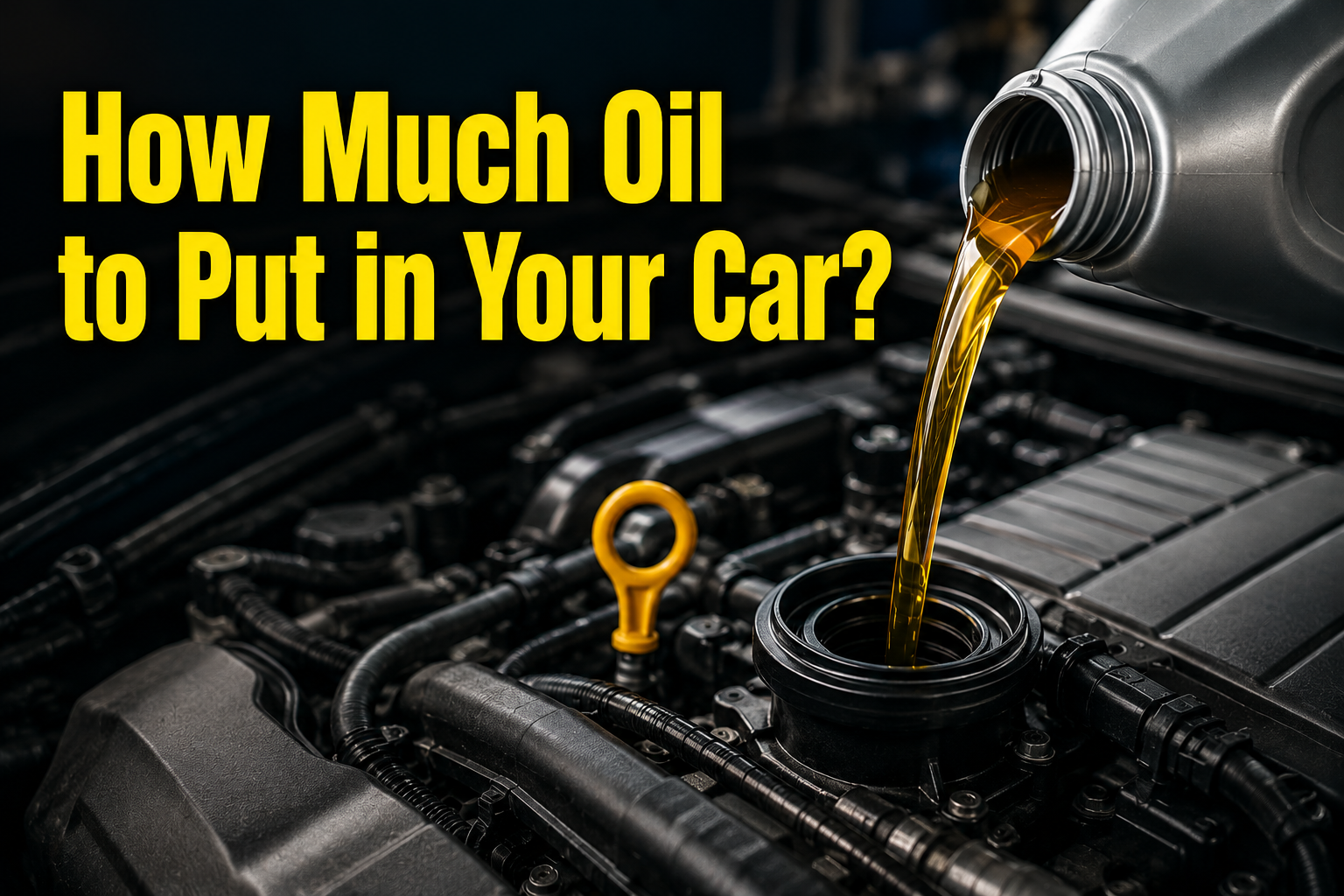
For a full oil change, most cars take 5 to 6 quarts. A four-cylinder usually needs 4 to 5, a V6 around 5 to 6, and a V8 or larger truck engine 6 to 8. If you are just topping up a low level, add half a quart at a time and check the dipstick between pours.
- Two different questions
- How much oil for a full oil change
- How much to buy
- How to pour it without overfilling
- Topping up between changes
- Why overfilling is a real problem
- How to remove excess oil
- Conclusion
- Frequently asked questions
- How many quarts of oil does my car take?
- How much oil should I add if the dipstick is at the low mark?
- What happens if I put too much oil in my car?
- Should I fill to the max mark or the middle?
- Do I need more oil if I change the filter?
- Related Articles
Those are averages, though, and your engine has an exact figure. Here is how to find it, how to pour it without overfilling, and what to do if you have already put in too much.
Two different questions
“How much oil” means two different things depending on why you are asking, and the answers are not the same.
If you are doing a full oil change, you drained everything out and need to refill the whole system. That is the 4 to 8 quart figure, and it comes from your manual.
If you are topping up, there is already oil in the engine and you are only replacing what it has lost. That is usually half a quart to a quart, and it comes from the dipstick, not the manual. Pouring a manual’s full capacity into an engine that already has oil in it is one of the most common ways people overfill.
Work out which one you are doing before you open a bottle.
How much oil for a full oil change
Engine size is the main driver, because a bigger engine needs a bigger reservoir.
| Engine | Typical capacity |
| 4-cylinder | 4 to 5 quarts (about 3.8 to 4.7 litres) |
| V6 | 5 to 6 quarts (about 4.7 to 5.7 litres) |
| V8 | 6 to 8 quarts (about 5.7 to 7.6 litres) |
| Large diesel or heavy-duty truck | 7 quarts or more |
Treat that table as a rough guide for buying, not as your fill figure. Two cars of the same model can differ if one has a turbo or a larger engine option, and capacities rarely land on round numbers. Plenty of engines take something like 4.4 or 5.7 quarts.
Three places give you the exact number:
- Your owner’s manual, under a section usually called Capacities or Technical Data. This is the authoritative source.
- An oil finder tool from an oil brand or parts retailer. Enter your VIN or your year, make, model, and engine, and it returns the exact volume and the viscosity grade.
- The oil filler cap or a sticker under the hood. Many cars print the required grade there, though not always the capacity.
One detail catches people out. Published capacity normally includes the oil that fills the filter. If you change the filter, you need that full figure. If you are only draining the pan and reusing the filter, you will need slightly less. Your manual usually specifies which scenario the number covers.
How much to buy
Buy one quart more than your capacity, and buy the right grade while you are at it.
Motor oil is sold in 1-quart bottles and 5-quart jugs, and the jug is almost always cheaper per quart. If your car takes 5.7 quarts, a 5-quart jug plus a single bottle covers the change with a little left over. That spare is genuinely useful, because it lives in the boot for top-ups until the next change, and it means you are not stuck part way through a job.
The grade matters as much as the volume. Your engine calls for a specific viscosity, printed on the oil filler cap and in the manual, commonly 0W-20, 5W-20, or 5W-30 on modern cars. Using a thicker oil than specified slows flow on cold starts, which is exactly when most engine wear happens. Do not substitute something close because it was on offer.
How to pour it without overfilling
The safest method is to deliberately under-pour, then creep up on the target. Mechanics call it a short fill.
- Start with less than the full amount. If your spec is 5.2 quarts, pour 5 and stop.
- Wait a minute. Oil takes time to drain down into the pan, so an immediate dipstick reading will show low.
- Check the dipstick. Pull it, wipe it, reinsert fully, pull again and read.
- Run the engine briefly if you fitted a new filter. Thirty seconds is enough to fill it. Shut off and wait another minute, because the filter has now taken some of what you poured.
- Add the rest in small increments. Quarter of a quart at a time, checking between each, until the level sits at or just below the full mark.
This takes a few extra minutes and it is far easier than removing oil you should not have added.
Topping up between changes
If your oil is low rather than absent, you need a much smaller amount, and the dipstick tells you how much.
Nearly every dipstick has two marks: a minimum and a maximum, sometimes shown as holes, notches, or a crosshatched zone. On most passenger cars the gap between them represents about one quart. That is your measuring scale.
- At the minimum mark, you need roughly one quart.
- Halfway between the marks, about half a quart.
- Just below the maximum, a small splash is enough.
Add half a quart, wait a minute, and recheck rather than pouring a full bottle in one go. The exact gap volume varies between engines, so treating one quart as universal can push you over.
Check on level ground with the engine off. If you have just been driving, wait a few minutes so the oil drains back into the pan. Do not pour into the dipstick tube, use the filler cap on top of the engine with a funnel.
Reading the dipstick correctly matters more than people assume, because a bad reading is what causes most wrong fills. Park on flat ground, since even a mild slope shifts the level enough to mislead you. Wait at least five minutes after switching off, and longer if the car has been working hard. Pull the dipstick, wipe it completely clean, push it all the way back in, then pull it out again and read it. The first pull is never accurate, because oil splashes up the stick while the engine runs.
Some newer cars have no dipstick at all. These use an electronic level sensor and report the level through the dashboard menu instead. If yours works this way, follow the procedure in the manual, which usually requires the engine warm and the car level, and add oil in small amounts while rechecking the display.
Worth noting: engines are not supposed to consume much oil. If you are adding a quart every month or two, something is leaking or burning and the topping up is treating a symptom.
Why overfilling is a real problem
Adding a bit extra for insurance is not harmless. It causes a specific mechanical failure.
The crankshaft spins just above the oil in the pan. Fill the pan too high and the crankshaft starts hitting the oil surface, whipping it into foam. Foamy oil is full of air bubbles, and the oil pump cannot build proper pressure with it, so bearings and camshafts lose their protective film. The result looks a lot like running the engine low on oil.
Excess oil also raises crankcase pressure, which strains seals and gaskets and can force oil past them. That shows up as new leaks, blue smoke from burning oil, or a fouled catalytic converter.
How much is too much? Roughly:
- Up to about half a quart over the max mark: most engines tolerate this. Correct it soon, but do not panic.
- Half a quart to a quart over: drain the excess before driving much further.
- More than a quart over: get it corrected before driving at all.
Turbocharged engines are less forgiving than most, because the turbo depends on a steady supply of non-aerated oil.
How to remove excess oil
Two ways, and one is much easier than the other.
An oil extractor pump is a hand pump that draws oil out through the dipstick tube. It costs little, needs no jacking or crawling, and lets you remove a measured amount and recheck. This is the practical option for a modest overfill.
Loosening the drain plug is the alternative if you have no extractor. Get the car safely supported, warm the engine slightly so the oil flows, crack the plug open, catch a small amount, and tighten it again. The difficulty is control, since a quart escapes faster than you expect.
Either way, recheck the dipstick after removing oil, and take the used oil to a parts store or recycling centre rather than disposing of it at home.
Conclusion
Most cars take 5 to 6 quarts for a full change, but buy based on the average and fill based on your manual’s exact figure. Pour slightly less than the spec, then top up in small increments while checking the dipstick. If you are only correcting a low level, the gap between the dipstick marks is roughly one quart, so half a quart at a time is the right pace. Filling a little under is safe; filling over is not.
Frequently asked questions
How many quarts of oil does my car take?
Most passenger cars take 5 to 6 quarts, four-cylinders 4 to 5, and V8s 6 to 8. Check your owner’s manual under Capacities for the exact figure, since it varies by engine even within one model.
How much oil should I add if the dipstick is at the low mark?
About one quart on most cars, since that is roughly the gap between the minimum and maximum marks. Add half a quart, wait a minute, recheck, then add more if needed.
What happens if I put too much oil in my car?
The crankshaft can whip the excess into foam, which cannot maintain oil pressure, and higher crankcase pressure can push oil past seals. Up to about half a quart over is usually tolerated; more than that should be drained.
Should I fill to the max mark or the middle?
At or just below the max mark is ideal. Anywhere within the safe zone is fine to drive on, but the upper half gives you more margin before the level drops to the minimum.
Do I need more oil if I change the filter?
Yes. A new filter holds some oil, so a change with a filter takes slightly more than a drain and refill alone. Published capacities usually include the filter, but confirm in your manual.
Related Articles
How Much Oil to Put in Your Car: Quarts by Engine?
How Many Engine Mounts Does a Car Have?
How Long Can a Car Sit Before the Battery Dies?