


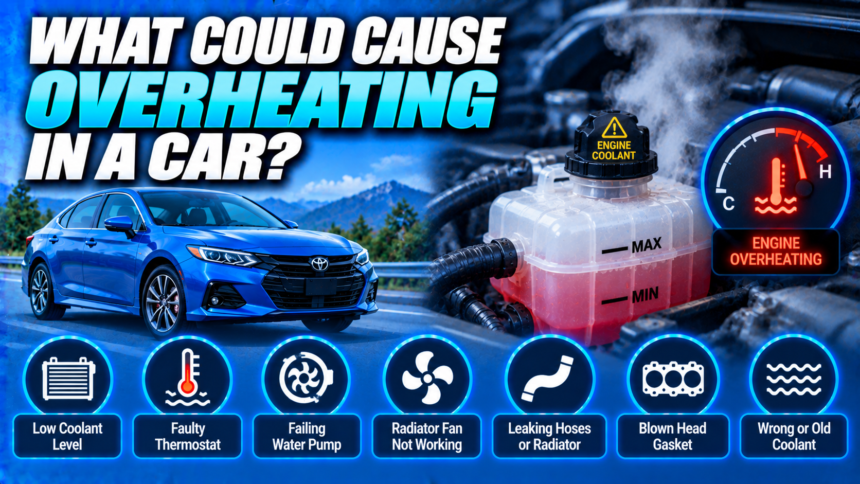
Nearly every overheating car comes down to one of five things: low coolant, a thermostat stuck shut, a cooling fan that is not running, a water pump no longer circulating properly, or a radiator that can no longer shed heat.
- If it is overheating right now
- When it overheats tells you why?
- Low coolant and leaks
- A stuck thermostat
- The cooling fan
- A failing water pump
- A blocked or tired radiator
- The causes people forget
- What overheating actually damages?
- How to stop it happening again?
- Conclusion
- Frequently asked questions
- Related Articles
The useful part is that you do not have to guess between them. When your car overheats narrows it down quickly, and that is where this article starts once the immediate safety is covered.
If it is overheating right now
If the gauge is in the red or you can see steam, deal with that before reading any further.
- Turn the air conditioning off and the heater on full, with the blower at maximum. It is unpleasant, but the heater matrix is a second small radiator and it genuinely pulls heat out of the engine.
- Pull over somewhere safe and switch the engine off. Do not sit and idle, because an idling engine keeps making heat with very little airflow.
- Wait. Give it at least twenty to thirty minutes before you open anything.
- Check the coolant reservoir once cool, not the radiator. The translucent plastic tank has minimum and maximum marks on the side, so you can often read the level without opening a thing.
- Top up with coolant if it is low, or clean water in an emergency, and get the cause looked at rather than assuming it is fixed.
Never open the radiator cap on a hot engine. The system is pressurised, and releasing that pressure lets superheated coolant flash to steam and erupt out of the opening. These are serious burns, and they are entirely avoidable by waiting.
If the temperature keeps rising after topping up, or it climbs again within minutes, stop driving and call for recovery. A tow is far cheaper than a cylinder head.
When it overheats tells you why?
This is the shortcut that most cause lists leave out. The cooling system has two jobs: circulate coolant through the engine, and blow air through the radiator to dump the heat. Different faults break different halves, and they show up at different times.
At road speed, air is forced through the radiator by the car’s own motion, so airflow is plentiful and the fan barely matters. At a standstill, that airflow disappears entirely and the fan is the only thing left.
| When it overheats | Where to look first |
| In traffic or at idle, fine once moving | Cooling fan or fan clutch. Airflow is the only thing missing at a standstill |
| At speed or uphill, fine at idle | Blocked radiator, weak water pump, or a thermostat not opening fully |
| Only with the air conditioning on | Fan circuit, or a radiator blocked by debris behind the grille |
| All the time, and quickly | Low coolant, a stuck thermostat, or no circulation at all |
| Gradually over weeks, coolant dropping | A leak somewhere, external or internal |
So a car that boils in traffic but runs cool on the motorway almost always has a fan problem. A car that is fine at the lights but climbs on a long hill has a flow or capacity problem instead. Noticing which one you have saves a great deal of time and money.
Low coolant and leaks
This is the most common cause by a wide margin, and it is never really the cause on its own. A sealed cooling system does not consume coolant, so if the level has dropped, something is letting it out.
External leaks are the easier kind. Look for crusty white or coloured deposits around hose joints, a damp patch on the radiator, drips under the front of the car, or a sweet smell after a drive. Hoses perish and split, the radiator corrodes at its seams, and the water pump usually seeps from a small weep hole when its seal goes.
Internal leaks are worse. A failed head gasket lets coolant into the combustion chambers or the oil, and the level drops with nothing ever appearing on the driveway. Signs include white sweet-smelling smoke from the exhaust, a creamy deposit on the oil filler cap, bubbles in the expansion tank, or coolant that keeps vanishing with no puddle anywhere.
Air in the system does something similar. A pocket of air after a coolant change or a repair stops proper circulation and creates hot spots, which is why cooling systems have to be bled properly rather than just topped up.
A stuck thermostat
The thermostat is a temperature-controlled valve between the engine and the radiator. It stays shut when the engine is cold so it warms up quickly, then opens once it reaches operating temperature to let coolant through to the radiator.
Stuck closed, the coolant never reaches the radiator at all. Temperature then climbs fast and consistently, often within a few miles of a cold start, and the top radiator hose stays cool while the engine gets hot. That contrast is a good clue.
Stuck open causes the opposite problem: the engine never properly warms up, the heater is weak, and fuel economy suffers. That will not overheat you, but it is worth fixing.
Thermostats are among the cheapest parts in the cooling system, which makes this the best possible outcome when a car overheats.
The cooling fan
Most modern cars use an electric fan that switches on when the coolant reaches a set temperature or when the air conditioning is running. Older cars often use a mechanical fan driven by the engine through a viscous clutch.
When the fan fails, the car cools perfectly well at speed and overheats the moment you stop. That pattern is close to diagnostic on its own.
The fan itself is not always at fault. The fan relay, its fuse, the coolant temperature sensor, or the wiring can all break the circuit while the motor is perfectly healthy. It is worth checking those before replacing the fan, since they cost a fraction as much.
You can test it easily enough. Let the engine warm up while parked, watch the gauge, and listen for the fan cutting in as the temperature rises. Switching the air conditioning on should also start it almost immediately on most cars. Goodyear’s guide to engine overheating causes covers the roadside side of this if you want a second reference.
A failing water pump
The water pump circulates coolant through the engine and radiator. It is usually belt driven, so it spins faster as engine speed rises.
That is why a worn pump often overheats a car under load rather than at idle: at higher revs it may just about cope, but a corroded or eroded impeller cannot move enough coolant when demand is highest. Some worn pumps do the reverse and struggle at low revs. Either way the pattern is inconsistent, which is itself a clue.
Listen for a low whine or grinding from the front of the engine, which suggests the bearing is going, and look for coolant seeping from the weep hole beneath it. On many engines the pump is driven by the timing belt, in which case it is normally replaced at the same time as the belt because most of the labour is shared.
A blocked or tired radiator
Radiators fail in two ways, and they behave differently.
Blocked on the outside means the fins are packed with leaves, insects, road dirt, or plastic bags, so air cannot pass through. This is easy to check by shining a torch through the grille, and often easy to fix with a gentle rinse. Air conditioning condensers sit in front of the radiator and collect the same debris.
Blocked on the inside means corrosion, scale, and old degraded coolant have silted up the narrow passages. Coolant then cannot flow through fast enough, which shows up most under load. This is what old coolant does when it is left in far beyond its service life, and it is a strong argument for changing it on schedule.
A weak radiator cap belongs in this section too. The cap holds the system at pressure, and pressure raises the boiling point of the coolant. A cap that no longer seals lets the system boil at a lower temperature than it should. It is one of the cheapest parts on the car and a genuinely common cause.
The causes people forget
- The wrong coolant, or the wrong mix. Coolant is roughly a fifty-fifty blend with water for a reason. Neat water boils too easily and corrodes; neat antifreeze transfers heat poorly. Mixing incompatible types can also cause them to gel.
- Low engine oil. Oil carries away a meaningful share of engine heat as well as lubricating. An engine low on oil runs hotter before it runs into anything worse.
- A slipping or broken belt. On a belt-driven pump, a glazed or snapped belt stops circulation instantly. If the belt drives the alternator too, the battery light will usually come on at the same moment.
- A collapsed hose. Old bottom hoses can collapse under suction at higher revs, blocking flow exactly when it is needed most, then look perfectly normal once the engine stops.
- Genuine hard work. Towing, a heavy load, a long climb, or crawling traffic on a hot day all push a marginal cooling system past its limit. In that case nothing is broken exactly, but something is no longer up to the job.
What overheating actually damages?
This matters because it explains why the advice is always to stop rather than press on.
Aluminium cylinder heads expand and warp when they get too hot, and once a head is warped its gasket can no longer seal. That is the classic blown head gasket, and it lets coolant and combustion gases mix. Beyond that, pistons can seize in bores, and in the worst cases the block itself cracks.
The costs escalate steeply. A thermostat is trivial, a fan relay is cheap, a water pump is moderate, a head gasket is expensive, and a cracked block usually means a different engine. The gap between those outcomes is often just a few miles of driving with the gauge in the red.
How to stop it happening again?
Check the coolant level every month or so, when the engine is cold, using the marks on the reservoir. It takes seconds and catches a slow leak long before it strands you.
Change the coolant at the interval in your handbook rather than topping it up forever. Coolant contains corrosion inhibitors that deplete over time, and once they are gone the system starts rusting itself from the inside.
Squeeze the hoses occasionally when cold. They should feel firm but pliable, not rock hard, spongy, or crunchy. Replace any that feel wrong, since a burst hose empties a cooling system in under a minute.
Keep the front of the radiator clear, and take a rising gauge seriously the first time. Cars usually give some warning before they overheat properly, and the drivers who avoid big bills are the ones who act on it.
Conclusion
Start with when it happens. Overheating at a standstill that clears once you move points at the fan and airflow. Overheating under load that clears at idle points at coolant flow, meaning the radiator, pump, or thermostat. Overheating all the time usually means low coolant or a thermostat stuck shut. Check the level when cold, never open a hot radiator cap, and stop driving rather than pressing on, because the difference between a cheap fix and a new engine is often just a few more miles.
Frequently asked questions
Why does my car overheat at idle but not while driving?
At speed, motion forces air through the radiator. At a standstill only the fan does that, so a failed fan, relay, or temperature sensor shows up in traffic and disappears once you are moving again.
Can I drive a short distance with an overheating car?
It is a gamble. Warping a cylinder head or blowing a head gasket takes only a few miles in the red. If you must move, run the heater on full, keep moving rather than idling, and stop at the first safe place.
Is it safe to add water instead of coolant?
As an emergency measure, yes, on a cool engine. Water lacks the corrosion inhibitors and the raised boiling point of proper coolant, so have the system drained and refilled properly soon afterwards.
Why does my car only overheat with the air conditioning on?
The air conditioning adds heat load and its condenser sits in front of the radiator. If the fan is weak or the condenser is packed with debris, that extra load is enough to push the temperature up.
My coolant keeps disappearing but there is no puddle. Why?
That suggests an internal leak, commonly a head gasket letting coolant into the combustion chambers. Look for sweet white exhaust smoke, a creamy deposit under the oil filler cap, or bubbles in the expansion tank.
Related Articles
What Does a Car Belt Do? The Two Belts Explained
Which Nissan Cars Are Discontinued in 2026?