


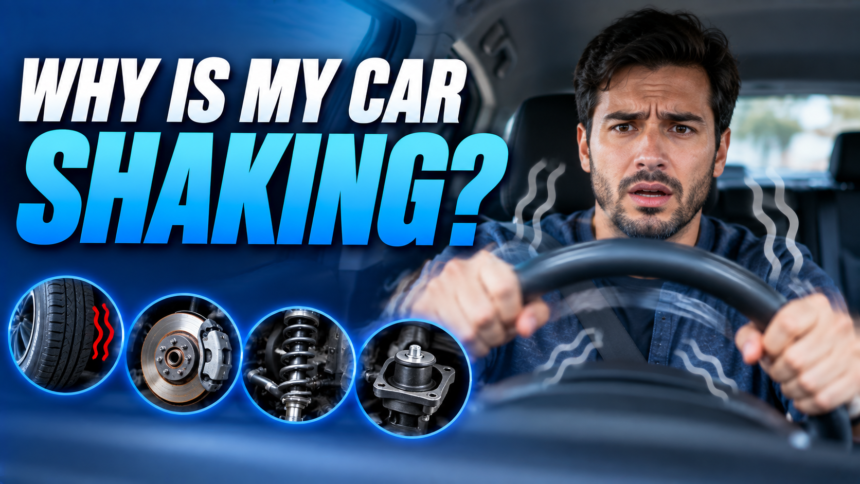
A shaking car is almost always a tire, brake, suspension, or engine problem. The fastest way to narrow it down is to notice when the shaking happens. A car that only shakes when you brake has a different problem from one that shakes at 70 mph or one that buzzes while sitting at a red light.
- Shaking when braking
- Shaking at highway speed
- Shaking when accelerating
- Shaking at idle or when stopped
- Is it safe to keep driving?
- How to narrow it down yourself
- Conclusion
- Frequently asked questions
- Why does my car shake only when I brake?
- Why does my steering wheel shake at high speed?
- Is it safe to drive a car that is shaking?
- Why does my car shake when stopped but not when driving?
- Can bad tires cause my whole car to shake?
- Related Articles
Vibration is never normal, but it is rarely a mystery. Use the moment the shaking shows up as your main clue, and you can usually work out the likely cause and how urgent it is before you ever reach a mechanic. Here is what each type of shake tends to mean.
Quick guide to what your shake is telling you:
| If the shaking is… | It often points to… | How soon to act |
| Only when braking | Warped rotors or worn pads | Soon, days not weeks |
| At highway speed, steering wheel | Unbalanced or bent wheels | Soon, and it is a safety issue |
| When accelerating | A CV joint or engine mount | Soon, before it worsens |
| Only at idle or when stopped | A misfire, mounts, or vacuum leak | Fairly soon, watch for lights |
| Sudden and violent, plus a warning light | A serious mechanical fault | Stop driving, get it towed |
Now for the detail on each one, starting with the most common.
Shaking when braking
If the shaking only shows up when you press the brake pedal, the problem is almost certainly in your brakes. The usual cause is warped rotors, the metal discs your brake pads squeeze to slow the car. Rotors can warp from heat and hard use, and once they are no longer perfectly flat, you feel a pulsing or shuddering through the pedal and often the steering wheel as you stop.
Worn brake pads cause the same thing. When pads get too thin, they press unevenly and can make the car shudder or pull to one side when you brake. A screeching or grinding noise alongside the shake is a strong hint the pads are worn out. A sticking brake caliper is another possibility: it can drag on one wheel, causing a vibration that gets worse the faster you go, sometimes with a burning smell when you stop.
There is a quick way to tell brake shake apart from other kinds. Brake-related shaking appears when you press the pedal and eases when you let off, and it usually gets stronger the harder you brake or the faster you were going. If the vibration is there whether or not you are braking, the brakes are probably not the cause and you should look at the tires or engine instead.
If the shake lines up with the brake pedal every time, treat it as a brake job and get it looked at within days. Brakes are not the place to wait and see.
Shaking at highway speed
If the car is smooth around town but the steering wheel starts to shimmy once you pass 50 to 60 mph, the cause is usually your tires or wheels. Out-of-balance tires are the most common reason. A tire that carries slightly more weight on one side spins unevenly, and that wobble turns into a steady shake that often shows up around 50 to 55 mph, peaks near 60, and can smooth out again at higher speeds.
Uneven tire wear does the same thing. Flat spots, cupping, or a worn edge on the tread all transfer vibration straight to the steering wheel, usually at mid-range speeds. A bent wheel, often from hitting a bad pothole, throws off the balance too. In most of these cases the fix is simple: a tire balance, a rotation, or in some cases a new tire or wheel. Suspension wear can amplify the effect, since worn parts let the wheels move more than they should at speed.
Shaking when accelerating
A shake that appears or gets worse as you speed up, especially from a stop, points to a few likely culprits. A common one is a worn CV joint. The CV joints sit at the ends of your axles and let the wheels turn while still receiving power. If a joint’s protective boot tears, dirt gets in and the joint wears out, causing a vibration that grows with acceleration, often with a clicking noise on turns.
Worn engine mounts are another cause. The mounts hold the engine to the frame and soak up its movement. When they crack or wear, the engine’s normal shaking transfers into the cabin, and you feel a rough shudder that is strongest when the engine is working hard, such as pulling away from a light. An engine misfire can also show up under acceleration, since a cylinder that is not firing properly leaves the engine straining to deliver smooth power.
Less often, a shudder as you speed up can come from the transmission, especially a slipping or hesitating shift where the revs climb but the car does not pull smoothly. If the shaking pairs with delayed or jerky gear changes, that is a sign to have the transmission checked rather than assuming it is an axle or mount. Getting the right area diagnosed early matters here, because a small transmission issue is far cheaper to address than a neglected one.
Shaking at idle or when stopped
If your car shakes while parked or sitting at a light but smooths out once you are moving, the problem is usually under the hood. At idle the engine runs at its lowest, most delicate speed, so anything upsetting its balance shows up clearly. Higher speeds then mask it, which is why a rough idle can disappear the moment you accelerate.
The most common causes are worn spark plugs and a vacuum leak. Worn or fouled spark plugs cause misfires, which make the engine run unevenly and shake. Spark plugs generally need replacing somewhere between 30,000 and 100,000 miles depending on the car. A vacuum leak, from a cracked or loose hose, throws off the air and fuel mix and leads to rough, uneven idling. Other suspects include dirty fuel injectors, a clogged air filter, a failing idle air control valve, and worn engine mounts.
There is one quick self-test worth knowing. If the shaking eases when you shift into neutral or park but returns in drive while stopped, that often points to the engine or transmission mounts rather than the engine itself. For a fuller rundown of idle-specific causes, the Mechanic Base guide to idle vibration breaks them down clearly.
Is it safe to keep driving?
It depends on how bad the shaking is and what is causing it. Mild vibration from something routine, like a tire that needs balancing or a slightly worn spark plug, is not an immediate danger, though it still deserves attention soon. You have a little time, not unlimited time.
Some signs mean you should stop and get help rather than drive on. Treat these as red flags:
- A burning smell, which can mean an overheating brake or a slipping belt.
- New clunks, grinding, or squealing alongside the shake.
- A warning light appearing on the dashboard at the same time.
- Shaking that is sudden, violent, or getting rapidly worse, or comes with a loss of power.
Any of those, and the safe move is to pull over when you can and have the car towed rather than risk a tire, brake, or steering failure at speed. When in doubt, err toward caution. Shaking is your car flagging a problem early, and catching it now is almost always cheaper and safer than waiting for the part to fail outright.
How to narrow it down yourself
You do not need tools to gather useful clues before a shop visit. Pay attention to a few things and you can often walk in with a strong hunch, which makes diagnosis faster and cheaper:
- Note exactly when it happens. Only when braking, only at a certain speed, only at idle, or all the time. This single detail rules out most causes.
- Note where you feel it. The steering wheel points to the front tires, brakes, or steering. The seat or the whole car points more toward the rear or the engine.
- Listen for noises. Clicking on turns suggests a CV joint. Grinding when braking suggests pads. A steady hum that rises with speed suggests a tire.
- Check the obvious. Look for an underinflated or visibly worn tire, and think back to any recent pothole or curb strike.
In winter, one cause is harmless: packed snow and ice inside the wheels can throw off their balance and make the car shake until it clears. If the shaking started right after a cold, slushy drive, running the car through a wash to clear the wheels can rule this out before you spend anything.
For anything beyond that, a proper diagnosis is worth it. A shake can have overlapping causes, and a technician can pin down the exact part quickly rather than replacing things on a guess.
Conclusion
When your car shakes, let the timing guide you. Braking points to rotors or pads, a highway-speed shimmy points to tire balance, a shake under acceleration points to CV joints or engine mounts, and a rough idle points to spark plugs or a vacuum leak. Note when and where you feel it, watch for burning smells, new noises, or warning lights, and treat those as a signal to stop and get help. A good result is catching the worn part now, on your schedule, instead of after it fails.
Frequently asked questions
Why does my car shake only when I brake?
Almost always warped brake rotors or worn brake pads. When the discs are no longer flat or the pads are too thin, you feel a pulsing through the pedal and wheel as you stop. Get the brakes inspected within a few days.
Why does my steering wheel shake at high speed?
Usually unbalanced tires or a bent wheel. The shimmy typically starts around 50 to 60 mph. A tire balance, rotation, or occasionally a new tire fixes it. Worn suspension parts can make it more noticeable.
Is it safe to drive a car that is shaking?
Mild vibration from a balance or spark plug issue is usually fine to drive on briefly. Stop and get help if the shaking is severe or comes with a burning smell, new noises, warning lights, or power loss.
Why does my car shake when stopped but not when driving?
That points to the engine at idle: often worn spark plugs, a vacuum leak, or worn engine mounts. Higher speeds mask the roughness. If the shake eases in neutral but returns in drive, suspect the mounts.
Can bad tires cause my whole car to shake?
Yes. Unbalanced, worn, or flat-spotted tires are one of the most common causes of shaking, usually felt most at highway speed. Checking tire condition and balance is a cheap and sensible first step.
Related Articles
How to Turn Off Tesla Location Sharing: Complete Step-by-Step Guide
How Many Quarts of Oil Does a Honda CR-V Take?
What SUV Has LY7 Engine? Complete Guide, Specs & Buying Tips
How Long Do Honda Pilots Last? Full Lifespan & Reliability Guide