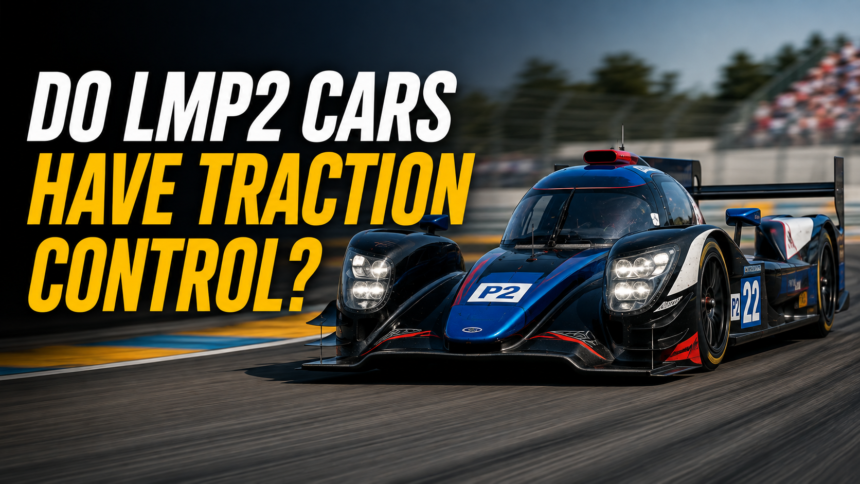
If you’ve ever watched an LMP2 prototype scream out of a corner at the 24 Hours of Le Mans, sliding just slightly under full power, you may have wondered: do LMP2 cars have traction control? It’s a fair question. After all, plenty of high-performance road cars and even some race categories rely on this technology to keep the rear wheels from spinning uselessly under hard acceleration.
- What Is LMP2 Racing?
- What Is Traction Control? (A Quick Primer)
- The Official Rule: No Traction Control in LMP2
- Why LMP2 Bans Traction Control?
- What Driver Aids ARE Allowed in LMP2?
- How Drivers Manage Power Without Traction Control?
- LMP2 vs LMP1/Hypercar vs GT3 — Traction Control Comparison
- The Spec Engine and ECU System
- What Happens If a Team Is Caught Cheating?
- Common Myths and Misconceptions
- Conclusion
- Related Articles
The short answer is no — LMP2 cars are not allowed to run traction control. But that simple answer only scratches the surface. To really understand why, you need to look at how the category is built, what the rulebook actually says, and what teams are allowed to use instead. This article walks through all of it in plain, easy-to-follow language, so by the end you’ll know exactly what’s under the skin of one of endurance racing’s most competitive classes.
What Is LMP2 Racing?
LMP2, short for Le Mans Prototype 2, is a class of closed-cockpit sports prototype that sits below the top-tier Hypercar/LMP1 category and above GT machinery in the endurance racing hierarchy. It’s a “spec” category, meaning cars are built to a tightly controlled set of rules rather than being fully custom designs from each manufacturer.
The class is overseen jointly by the Automobile Club de l’Ouest (ACO) and the FIA, with IMSA running a closely related version of the rules in North America. You’ll find LMP2 cars competing in some of the sport’s biggest series, including:
| Series | Region |
|---|---|
| FIA World Endurance Championship (WEC) | Global |
| 24 Hours of Le Mans | France |
| European Le Mans Series (ELMS) | Europe |
| Asian Le Mans Series | Asia |
| IMSA WeatherTech SportsCar Championship | North America |
Because LMP2 is meant to be an affordable stepping stone for teams, drivers, and manufacturers, the rulebook deliberately limits technology that would push costs up or reduce the role of driver skill — and that’s exactly where traction control comes in.
What Is Traction Control? (A Quick Primer)
Before diving deeper, it helps to understand what traction control actually does. In simple terms, traction control is an electronic system that monitors wheel speed and automatically reduces engine power or braking force to the wheel when it detects wheelspin. Instead of the driver having to feather the throttle by hand, the computer does it for them, smoothing out power delivery and helping the car put power down more consistently.
In everyday road cars, this improves safety, especially in wet or icy conditions. In racing, it can shave lap times by allowing drivers to get on the throttle earlier out of corners without risking a spin. That’s precisely why some categories, like Formula 1 in earlier eras, embraced it — and why others, like LMP2, have banned it outright.
The Official Rule: No Traction Control in LMP2
So, do LMP2 cars have traction control? According to the official ACO and FIA technical regulations, the answer is a firm no. The rules state that closed-loop electronic systems — meaning any system that automatically adjusts a car’s behavior based on sensor feedback, such as wheel-speed data — are prohibited unless specifically authorized. Traction control tied to wheel-slip detection falls squarely into that banned category.
This restriction isn’t a vague guideline; it’s written into the technical regulations that every constructor and team must follow to be homologated for competition. Scrutineers actively check for compliance, and the spec electronic control unit (ECU) used across the field is configured so that genuine slip-based traction control cannot be activated. Any traction-control-related parameters within that ECU dataset must remain unchanged from the officially issued base file, closing the door on teams quietly tuning their own version of the system.
Why LMP2 Bans Traction Control?
There are a few clear reasons the category has stuck to this rule for years:
- Cost control – Traction control systems, especially sophisticated ones, add development expense. LMP2 exists specifically to keep budgets manageable for privateer and semi-professional teams.
- Driver skill emphasis – Removing electronic aids puts more of the lap time in the driver’s hands (literally), rewarding throttle control and car feel rather than software.
- Spec-series philosophy – LMP2 uses a single homologated chassis manufacturer pool, a single engine supplier, and standardized electronics. The whole point is a level playing field, and allowing custom traction control would undermine that balance.
- Category identity – LMP2 sits below Hypercar/LMP1, which does permit more sophisticated electronics. Keeping LMP2 simpler helps preserve a clear technical ladder between classes.
What Driver Aids ARE Allowed in LMP2?
While full slip-based traction control is off the table, LMP2 cars aren’t stripped completely bare of electronic assistance. Here’s what teams can actually use:
| Driver Aid | Allowed in LMP2? | Notes |
|---|---|---|
| Traction control (wheel-slip based) | ❌ No | Banned as a closed-loop electronic system |
| Anti-lock braking (ABS) | ✅ Yes | Permitted to aid braking stability |
| Engine mapping / throttle maps | ✅ Yes (limited) | Preset maps within homologated ECU |
| Pit lane speed limiter | ✅ Yes | Standard safety requirement |
| Power steering | ✅ Yes | Common across the field |
| Fully custom driver-tunable traction control | ❌ No | Would violate spec ECU rules |
This mix means drivers get help with braking stability and safety systems, but the actual job of managing wheelspin under acceleration is left entirely to their right foot.
How Drivers Manage Power Without Traction Control?
Without a computer smoothing things out, LMP2 drivers rely on a blend of skill, setup, and mechanical feel to get power down cleanly. A few of the key techniques and factors involved include:
- Progressive throttle application – Easing into the throttle rather than stabbing it, especially in the early phase of corner exit.
- Reading the tires – Understanding how much grip is available in real time, adjusted for tire wear, track temperature, and fuel load.
- Setup tuning – Engineers adjust differential settings, suspension geometry, and aerodynamic balance to make the car more forgiving under power.
- Muscle memory and experience – Because there’s no safety net, top LMP2 drivers develop an intuitive sense for the exact throttle position their car can handle at any given moment.
This is part of why LMP2 is respected as such a serious proving ground. Drivers who excel here are demonstrating raw car control, not just an ability to exploit electronics.
LMP2 vs LMP1/Hypercar vs GT3 — Traction Control Comparison
It helps to see how LMP2’s rules compare with its neighboring categories:
| Category | Traction Control Allowed? | General Reasoning |
|---|---|---|
| LMP2 | No | Cost control, spec-series parity, driver-skill focus |
| Hypercar/LMP1 | Limited/varies by era and regulation cycle | Higher technical ceiling, factory-level development |
| GT3 | No (heavily restricted electronics) | Similar cost-control and parity goals to LMP2 |
| Road-legal performance cars | Yes | Focused on safety and everyday usability, not spec racing |
The takeaway is that LMP2 isn’t uniquely strict — it shares its no-traction-control stance with GT3, another cost-conscious, driver-focused category. The comparison also shows that the presence or absence of traction control is less about a car’s outright speed and more about the philosophy behind each racing class.
The Spec Engine and ECU System
A big part of how the traction control ban is actually enforced comes down to standardized hardware. LMP2 currently uses a single-supplier Gibson engine across the entire field, paired with a homologated electronic control unit loaded with a fixed base software dataset. Because every car runs the same engine and the same locked-down ECU configuration, there’s no room for a team to secretly develop or install their own slip-detection traction control software.
This spec approach does double duty: it keeps costs predictable for teams (since nobody is out-developing a rival’s engine or electronics package), and it makes policing the rules far more straightforward for officials, since deviations from the standard ECU file are easy to flag.
Looking ahead, the category isn’t standing still — a new generation of LMP2 regulations is planned to introduce a turbocharged V6 Gibson power unit alongside continued strict cost controls, while keeping the same core philosophy of a tightly regulated, electronics-limited spec class.
What Happens If a Team Is Caught Cheating?
Because the rules are so clearly defined, any attempt to run illegal traction control would be treated as a serious breach of the technical regulations. Consequences in endurance racing for this kind of infringement typically include:
- Post-race technical disqualification
- Loss of championship points
- Fines or suspension of team personnel
- Reputational damage that can affect sponsorship and future entries
Scrutineers use both physical inspection and data analysis of the spec ECU to check for irregularities, and because the entire field runs the same base software, unauthorized modifications tend to stand out quickly during post-session audits.
Common Myths and Misconceptions
A few misunderstandings keep this topic murky for newer motorsport fans:
- “All prototypes have traction control.” Not true — this varies significantly by category and era. LMP2 specifically bans it.
- “If a sim racing game shows a TC setting for LMP2 cars, that must reflect reality.” Video games often include simplified or optional driver-aid settings for accessibility, which doesn’t necessarily reflect the real-world regulations.
- “Traction control and stability control are the same thing.” They’re related but distinct systems; LMP2’s ban focuses specifically on wheel-slip-based traction control tied to engine power reduction.
- “Modern hypercars must also lack traction control since they’re related to LMP2.” Hypercar and LMP1 rules are separate from LMP2’s, and their electronic aid allowances have differed across regulation cycles.
Conclusion
So, to bring it all back to the original question — do LMP2 cars have traction control? No, they don’t. The category’s technical regulations explicitly prohibit slip-based traction control systems, reinforced by a spec engine and locked-down ECU that make cheating difficult to hide. This isn’t an oversight; it’s a deliberate design choice meant to control costs, preserve competitive balance, and put the emphasis back on driver skill.
Related Articles
Can You Lease a Used Car? How CPO Leasing Works
Can You Put Gas in a Running Car?