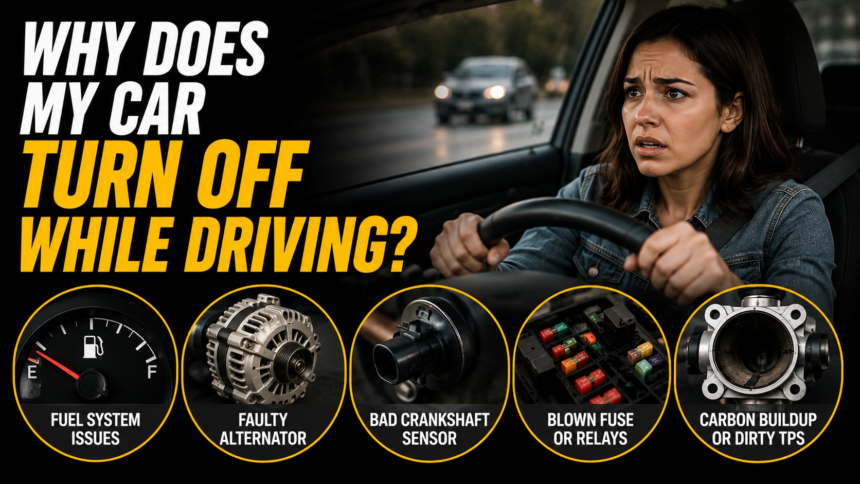
Few things are as unsettling as being on the road, cruising along normally, and suddenly feeling your car lose power for no obvious reason. If you’ve typed “why does my car turn off while driving” into a search bar after this happened to you, you’re not alone. This is one of the most common — and most alarming — problems drivers report, and it can happen at any speed, on any road, and in any type of vehicle.
- How Your Car’s Systems Work Together? (Quick Basics)
- Fuel System Problems
- Clogged or Dirty Fuel Filter
- Failing Fuel Pump
- Running Low on Fuel or a Faulty Fuel Gauge
- Contaminated or Poor-Quality Fuel
- Warning Signs Before a Fuel-Related Stall
- Ignition System Failures
- Worn-Out Spark Plugs
- Faulty Ignition Coil
- Failing Ignition Switch
- How Ignition Problems Mimic Other Issues?
- Battery and Charging System Issues
- Sensor Malfunctions
- Crankshaft Position Sensor Failure
- Mass Airflow Sensor (MAF) Issues
- Oxygen Sensor Problems
- How Sensors Confuse the Engine Computer?
- Idle Control Problems
- Timing Belt or Timing Chain Issues
- Transmission-Related Stalling
- Automatic Transmission Torque Converter Issues
- Manual Transmission Stalling
- Transmission Fluid Problems
- Engine Overheating
- How Overheating Triggers Automatic Shutdown?
- Common Causes
- What to Do If Your Car Overheats While Driving?
- Clogged Catalytic Converter
- Electrical and Computer (ECU) Glitches
- Vacuum Leaks
- Anti-Theft or Security System Malfunctions
- Weather and Environmental Factors
- Warning Signs to Watch Before a Stall
- What to Do If Your Car Stalls While Driving?
- When to See a Mechanic?
- Frequently Asked Questions (FAQ)
- Conclusion
- Related Articles
A car turning off while driving, often called “stalling,” happens when the engine suddenly stops running even though the car is still in motion. This isn’t just inconvenient; it can be genuinely dangerous, especially if it happens on a highway, in heavy traffic, or while making a turn. Losing engine power often means losing power steering assistance and braking assistance at the same time, which makes the vehicle much harder to control.
This guide walks through everything that could be behind the problem, from something as simple as a low fuel tank to more complex issues like a failing sensor or a slipping timing belt. We’ll also cover the warning signs to watch for, what to do the moment your car stalls, and when it’s time to call in a professional. The goal is to help you understand your car well enough to describe the problem accurately to a mechanic — and, ideally, to catch the warning signs before a stall ever happens.
How Your Car’s Systems Work Together? (Quick Basics)
Before diving into the causes, it helps to understand what actually keeps an engine running in the first place. Every gasoline engine relies on three basic ingredients working together at the same time: fuel, air, and spark. Fuel and air are mixed together inside the engine’s cylinders, and a spark plug ignites that mixture at exactly the right moment. This tiny, repeated explosion is what pushes the pistons and keeps the engine turning over.
If any one of these three ingredients is missing, delayed, or delivered incorrectly, the engine can stumble, misfire, or shut off completely. That’s really the simplest way to answer why does my car turn off while driving — somewhere in this fuel-air-spark chain, something is being interrupted.
Modern vehicles add another layer to this system: the engine control unit, or ECU. Think of the ECU as the car’s brain. It constantly receives information from dozens of small sensors throughout the engine and uses that data to adjust fuel delivery, ignition timing, and airflow in real time. When a sensor sends bad information, or when the ECU itself glitches, the entire system can be thrown off balance, sometimes resulting in a stall.
Fuel System Problems
The fuel system is one of the most frequent culprits when a car turns off unexpectedly while being driven. Without a steady, clean supply of fuel reaching the engine, the combustion process simply can’t continue.
Clogged or Dirty Fuel Filter
The fuel filter’s job is to catch dirt, rust, and debris before they reach the engine. Over time, this filter can become clogged, restricting the flow of fuel. At first, you might notice reduced power when accelerating or climbing hills. Eventually, if the filter becomes blocked enough, the engine can be starved of fuel entirely and shut off, especially under load.
Failing Fuel Pump
The fuel pump pushes gasoline from the tank to the engine at a consistent pressure. A pump that is wearing out may work intermittently — running fine for a while, then losing pressure suddenly. This is a classic cause of a car that stalls at random moments, particularly at higher speeds or after the engine has been running for a while and has heated up.
Running Low on Fuel or a Faulty Fuel Gauge
Sometimes the explanation is refreshingly simple: the tank is nearly empty. A faulty fuel gauge can make the situation worse by showing more fuel than is actually left, giving drivers a false sense of security. Running on fumes, especially around corners or hills where fuel sloshes away from the pickup point, can cause the engine to briefly lose fuel supply and stall.
Contaminated or Poor-Quality Fuel
Water, dirt, or the wrong fuel grade in the tank can interfere with combustion. This is more common than many drivers realize, particularly after fueling up at an unfamiliar station or during heavy rain when moisture can get into fuel storage systems.
Warning Signs Before a Fuel-Related Stall
Before a full stall, fuel system trouble often shows up as sputtering during acceleration, a noticeable loss of power going uphill, or the engine briefly surging and then dropping in RPM. Catching these early signs can prevent a stall from happening at a dangerous moment.
Ignition System Failures
The ignition system is responsible for creating and delivering the spark that ignites the fuel-air mixture. When this system falters, the engine can misfire, run rough, or cut out completely.
Worn-Out Spark Plugs
Spark plugs wear down with age and mileage. As they degrade, the spark becomes weaker and less reliable, which can cause misfires. In more severe cases, a badly worn plug may fail to fire at all, contributing to a stall.
Faulty Ignition Coil
The ignition coil converts the battery’s low voltage into the high voltage needed to create a spark. If a coil starts failing, it may work intermittently, leading to random stalling that seems to have no clear pattern.
Failing Ignition Switch
The ignition switch controls power to the entire ignition system. A worn or loose switch can momentarily lose contact while driving, especially if the key or steering column is jostled, and this can cut power to the engine almost instantly.
How Ignition Problems Mimic Other Issues?
One tricky aspect of ignition trouble is that its symptoms — rough idling, hesitation, random stalling — closely resemble fuel system or sensor problems. This is why answering why does my car turn off while driving often requires a mechanic to run diagnostics rather than guess based on symptoms alone.
Battery and Charging System Issues
Modern engines depend heavily on electrical power, not just to start but to keep running. Problems with the battery or charging system can absolutely cause a car to shut off mid-drive.
Weak or Dying Battery
While a battery mainly affects starting, a battery that’s severely degraded can sometimes cause electrical hiccups that disrupt the ECU or fuel injection system while driving, particularly in older vehicles or those with pre-existing electrical issues.
Failing Alternator
The alternator recharges the battery and powers the car’s electrical systems while the engine runs. If the alternator fails, the car is essentially running on battery power alone. Once that battery drains, the engine will lose the electrical support it needs and shut off.
Loose or Corroded Battery Terminals
Even a healthy battery can cause problems if its terminals are loose or corroded. This can create an intermittent connection that interrupts power flow, especially over bumps or during vibration.
Warning Signs
Dimming headlights, flickering dashboard lights, slow engine cranking, or accessories behaving oddly (like a radio cutting out) are all signs that point toward an electrical or charging system issue.
Sensor Malfunctions
Sensors are the eyes and ears of the ECU. When one sends inaccurate data, the entire fuel-air-spark balance can be thrown off.
Crankshaft Position Sensor Failure
This sensor tells the ECU exactly where the engine’s crankshaft is at any given moment, which is essential for timing fuel injection and spark. If this sensor fails, the ECU may lose track of engine position entirely, causing a sudden and complete stall.
Mass Airflow Sensor (MAF) Issues
The MAF sensor measures how much air is entering the engine, which helps determine how much fuel to inject. A dirty or failing MAF sensor can cause the fuel mixture to become too rich or too lean, leading to rough running or stalling.
Oxygen Sensor Problems
Oxygen sensors monitor exhaust gases to help fine-tune the air-fuel ratio. A faulty oxygen sensor won’t usually cause an immediate stall on its own, but it can contribute to poor engine performance that makes stalling more likely under certain conditions.
How Sensors Confuse the Engine Computer?
Because the ECU relies entirely on sensor data to make decisions, a single faulty sensor can create a ripple effect throughout the whole system. This is one of the more technical answers to why does my car turn off while driving, and it usually requires a diagnostic scan tool to pinpoint accurately.
Idle Control Problems
Dirty or Faulty Idle Air Control Valve
The idle air control valve regulates how much air bypasses the throttle when the engine is idling, keeping RPMs steady when you’re not pressing the gas. If this valve becomes dirty or fails, the idle can become unstable, and the engine may stall, especially when coming to a stop or slowing down significantly.
Common Symptoms
Rough or fluctuating idle, stalling at red lights, or the engine nearly dying when you take your foot off the gas are all signs pointing to idle control issues.
Timing Belt or Timing Chain Issues
Signs of a Worn Timing Belt
The timing belt (or chain) keeps the engine’s valves and pistons moving in perfect sync. A worn belt might produce a ticking noise, and performance may become inconsistent as wear increases.
Why Timing Problems Cause Sudden Stalling
If a timing belt slips or breaks while driving, the engine’s internal components lose their synchronization almost instantly, which typically causes the engine to shut off immediately and, in many cases, prevents it from restarting.
Risk of Engine Damage
In interference engines, a broken timing belt can cause the pistons and valves to collide, resulting in serious and expensive internal damage. This makes timing belt maintenance one of the most important preventive services for avoiding a dangerous stall.
Transmission-Related Stalling
Automatic Transmission Torque Converter Issues
In automatic vehicles, a failing torque converter can create excessive drag on the engine, particularly at low speeds, which may be enough to stall the engine if it’s already running poorly.
Manual Transmission Stalling
In manual transmission cars, stalling is often simply the result of releasing the clutch too quickly or shifting into the wrong gear. While this is a normal learning-curve issue for new drivers, frequent stalling in an experienced driver’s hands may point to clutch or engine problems.
Transmission Fluid Problems
Low or degraded transmission fluid can affect how smoothly power transfers from the engine, occasionally contributing to stalling, particularly in older automatic transmissions.
Engine Overheating
How Overheating Triggers Automatic Shutdown?
Many modern vehicles are programmed to shut the engine off automatically if temperatures rise to a dangerous level, as a way of protecting the engine from severe internal damage.
Common Causes
Typical causes of overheating include low coolant levels, a broken radiator fan, a stuck thermostat, or a leak somewhere in the cooling system.
What to Do If Your Car Overheats While Driving?
If your temperature gauge climbs sharply, turn off the air conditioning, turn on the heater to draw heat away from the engine, and find a safe place to pull over as soon as possible.
Clogged Catalytic Converter
How Exhaust Blockage Affects Performance?
The catalytic converter cleans exhaust gases before they leave the car. If it becomes clogged, exhaust can’t flow out properly, which creates backpressure that chokes the engine and can cause stalling, particularly under acceleration.
Signs of a Failing Catalytic Converter
A sulfur-like smell, reduced power, and a check engine light are common signs. Severe clogs may even cause the car to struggle to start at all.
Electrical and Computer (ECU) Glitches
Faulty Wiring or Loose Connections
Wiring that has become damaged, corroded, or loose over time can create intermittent power interruptions to critical components, sometimes triggering a stall with no clear pattern.
Software Bugs or Glitches
Like any onboard computer, the ECU can occasionally experience software errors. These are less common but not impossible, particularly in vehicles that haven’t received manufacturer software updates.
When a Reset Helps?
In some cases, disconnecting the battery briefly or having a dealership reprogram the ECU can resolve software-related stalling issues.
Vacuum Leaks
What a Vacuum Leak Is?
Engines rely on a controlled vacuum system to manage airflow. A leak allows unmetered air to enter the engine, disrupting the fuel-air ratio.
How It Disrupts the Air-Fuel Mixture?
Too much unmetered air makes the mixture too lean, which can cause rough idling, hesitation, and stalling, especially when the engine is idling or slowing down.
Common Leak Locations
Cracked vacuum hoses, a worn intake manifold gasket, or a loose brake booster hose are frequent sources of vacuum leaks.
Anti-Theft or Security System Malfunctions
How Security Systems Can Cut Power?
Many vehicles have an immobilizer system designed to prevent the engine from running if it detects an unauthorized key. Occasionally, these systems malfunction and mistakenly treat the correct key as invalid, cutting fuel or spark and stalling the engine.
Signs of Immobilizer Trouble
A security warning light flashing on the dashboard, difficulty restarting after a stall, or stalling that seems to happen only with a particular key can point to this issue.
Weather and Environmental Factors
Extreme Cold
Cold temperatures can thicken fluids, weaken battery performance, and make fuel delivery less efficient, all of which raise the chances of stalling in winter conditions.
Water Damage or Flooding
Driving through deep water can allow moisture into the electrical system or, in severe cases, into the engine itself, both of which can cause sudden and serious stalling.
Warning Signs to Watch Before a Stall
Below is a quick-reference table of common warning signs and what they often point to:
| Warning Sign | Likely System Involved |
|---|---|
| Dashboard warning light (check engine, battery, temperature) | Varies — ECU, charging, or cooling system |
| Rough or fluctuating idle | Idle control, vacuum leak, or ignition |
| Sputtering or hesitation when accelerating | Fuel system |
| Engine surges then loses power | Fuel delivery or sensors |
| Dimming lights or flickering dashboard | Battery or alternator |
| Ticking noise from the engine | Timing belt or chain |
| Sulfur or rotten-egg smell | Catalytic converter |
| Temperature gauge climbing rapidly | Cooling system |
| Difficulty restarting after stalling | Immobilizer or ignition switch |
What to Do If Your Car Stalls While Driving?
Immediate Safety Steps
Stay calm and keep both hands on the wheel. Without the engine running, power steering and power brakes will feel much heavier, but the car can still be steered and braked with more effort.
How to Safely Pull Over?
Use your remaining momentum to move gradually toward the shoulder or the side of the road, signal your intention if possible, and turn on your hazard lights once you’re safely out of traffic.
What NOT to Do?
Avoid slamming on the brakes suddenly, avoid trying to restart the engine while still in fast-moving traffic, and avoid exiting the vehicle on the side facing oncoming traffic.
When to See a Mechanic?
Any time a car stalls while being driven, it’s worth having it inspected, even if it seems to start back up fine afterward. Recurring stalls, stalling combined with dashboard warning lights, or stalling that happens at higher speeds should be treated as urgent. A qualified mechanic can run diagnostic scans to identify sensor codes, check fuel pressure, inspect the ignition system, and test the charging system far more accurately than guesswork alone.
Routine maintenance — regular oil changes, fuel filter replacement, spark plug replacement, and timing belt service according to your manufacturer’s schedule — remains one of the best ways to prevent many of the causes discussed above.
Frequently Asked Questions (FAQ)
Q: Why does my car turn off while driving but starts again right away? This pattern often points to an intermittent electrical connection, a failing sensor, or a fuel pump that briefly loses pressure and then recovers.
Q: Is it safe to keep driving a car that has stalled once? It’s best to have it checked before driving further, since a repeat stall could happen at a more dangerous moment, such as during a turn or on a highway.
Q: Can low oil cause a car to stall? Very low oil levels can trigger some vehicles’ protective shutdown systems, and prolonged low oil can also cause engine damage that leads to stalling.
Q: Does a dirty air filter cause stalling? A severely clogged air filter can restrict airflow enough to affect the fuel-air mixture, which may contribute to rough running or stalling in some cases.
Q: Why does my car turn off while driving specifically at low speeds or idle? This pattern often points toward idle control valve issues, vacuum leaks, or a failing crankshaft position sensor.
Conclusion
There isn’t a single, universal answer to why does my car turn off while driving — the causes range from something as minor as a low fuel tank to something as serious as a failing timing belt or overheating engine. What all these causes share is that they interrupt the basic fuel-air-spark balance an engine needs to keep running, whether through mechanical wear, electrical faults, sensor errors, or environmental factors.
If your car has stalled while driving, don’t ignore it, even if it seems to resolve on its own. Pay attention to warning lights, unusual noises, and changes in how the car idles or accelerates, since these are often the earliest clues something is wrong. A visit to a trusted mechanic for a proper diagnostic check is always worth the time — it could be the difference between a simple, inexpensive fix and a much bigger repair down the road, and more importantly, it keeps you and everyone on the road around you safer.
Related Articles
Can a Car Battery Die While Driving?
Can Spark Plugs Cause a Car to Not Start?