


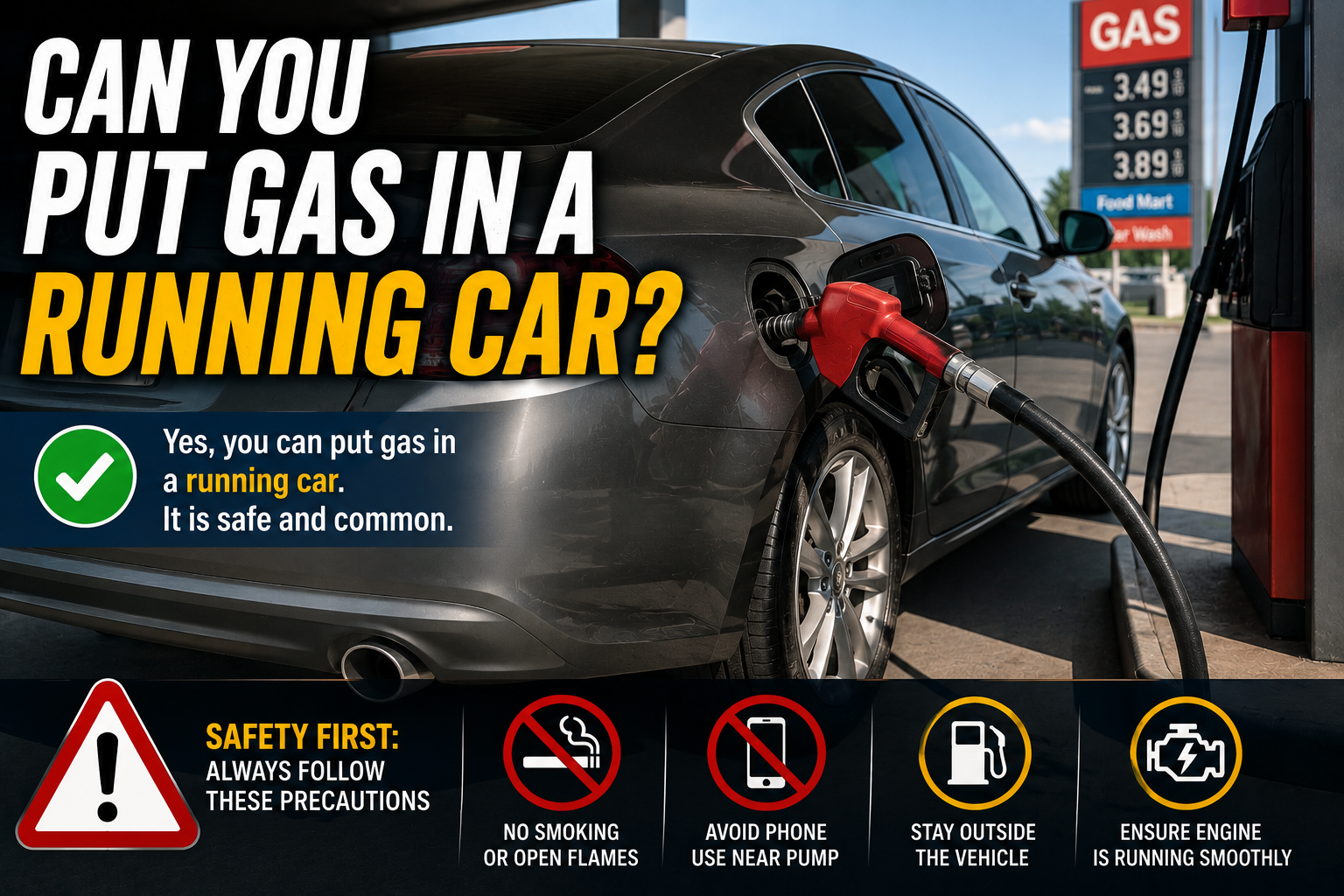
Physically, yes. The pump will dispense, the tank will fill, and nothing dramatic will happen in the overwhelming majority of cases.
- What the rule actually says
- Why a running engine is a risk
- The bigger risk: static from getting back in the car
- How to ground yourself properly
- What about cell phones?
- What actually happens if you fuel with the engine running
- The exceptions
- The reasons people leave it running, and better answers
- If something does go wrong
- A short refuelling checklist
- Conclusion
- Frequently asked questions
- Related Articles
You should still switch the engine off, and in most of the United States you are required to. Fire codes adopted by nearly every state say the engine of a vehicle being fuelled has to be shut down while fuelling. That is why every pump carries a sign about it.
The risk from a running engine is real but small. The bigger hazard at a fuel pump is something else entirely, and it is the thing almost nobody is careful about.
What the rule actually says
The wording comes from the International Fire Code, which most states enforce: the engines of vehicles being fuelled shall be shut off during fuelling. The equivalent provision sits in the fire protection standard covering motor fuel dispensing facilities.
That makes it a code requirement rather than a suggestion. Enforcement in practice is usually the station attendant rather than a police officer, and stations can refuse to authorise a pump. Insurance is the other consideration, because a claim arising from a fire during fuelling is a much harder conversation if the engine was running against posted instructions.
The rule is not new and it is not local. It applies across the US, Canada, the UK, and most of Europe in some form.
Why a running engine is a risk
Gasoline does not burn as a liquid. What burns is the vapour, and vapour is heavier than air, so it pools around the filler neck and drifts down toward the ground rather than dispersing upward.
A running engine adds several potential ignition sources to that area at once.
Hot exhaust components. A catalytic converter runs hot enough to matter, and the autoignition temperature of gasoline is around 536°F. On most cars the exhaust is not near the filler, but on some it is closer than you would like, and a spill changes the geometry.
Electrical faults. A running car has an alternator charging, fans cycling, and current moving through wiring throughout the vehicle. A chafed wire or a failing connector that would be harmless anywhere else is an arc source in a vapour-rich space.
Restarting. Cranking a starter motor draws very high current and is the single largest electrical event a car produces. If your engine stalls at the pump, do not restart it there. Replace the cap, push or roll the car well clear of the dispenser, and sort it out away from the fuel.
A healthy modern car is unlikely to ignite anything. The point of the rule is that you cannot tell from the driver’s seat whether your car is the healthy one.
The bigger risk: static from getting back in the car
This is the part worth actually changing your behaviour over.
The Petroleum Equipment Institute began investigating unexplained refuelling fires in the 1990s, and its Stop Static campaign has since collected close to 200 reported incidents that appear to have been caused by static electrical discharge. In these cases there was no cigarette, no open flame, and the nozzle was properly grounded.
The pattern is remarkably consistent. Someone starts fuelling, gets back into the car while the nozzle runs, slides across the seat and builds a charge on their clothing, then gets out and reaches for the nozzle. The discharge jumps from hand to metal, into the vapour, and there is a flash fire at the filler.
Two details make it more useful than a general warning. It concentrates in winter, with roughly half of reported static fires occurring in December, January, and February, when the air is dry and people are most tempted to sit in a warm car. And it is more likely on synthetic upholstery and synthetic clothing.
The irony is direct. The reason many people leave the engine running is to keep the heater going while they sit in the car, and sitting in the car is the behaviour that causes the fires.
How to ground yourself properly
If you have to get back into the vehicle mid-fill, discharge before you touch the nozzle.
Touch a metal part of the car with your bare hand after you get out and before you reach for the pump. A door frame or the roof edge works. Choose somewhere away from the filler, so that if a spark does occur it is not in the vapour.
Bare skin matters. Touching metal through a glove or a sleeve does not discharge you.
Better still, stay outside the car for the whole fill. Pay at the pump, keep hold of the nozzle, and the problem never arises.
What about cell phones?
Phones are not a documented ignition source at the pump.
PEI has not recorded a single refuelling fire caused by a cellular phone, and researchers who have deliberately tried to ignite fuel vapour with one have not managed it. Testing by the fire protection and telecommunications authorities reached the same conclusion.
The signs remain on the pumps anyway. They cost nothing to leave up and they reduce a station’s liability, so they persist regardless of what the evidence shows.
None of that makes a phone a good idea while fuelling, but the reason is attention rather than ignition. Watching a screen instead of the nozzle is how people overfill and spill, and spilled fuel is a genuine hazard.
What actually happens if you fuel with the engine running
In practice, almost always nothing. The tank fills, you drive away, and there is no consequence at all.
There are two mechanical side effects worth knowing about.
Modern cars capture refuelling vapour with an onboard system that routes it into a charcoal canister rather than the atmosphere. That system is designed around a stationary, switched-off vehicle. Running the engine while fuelling can occasionally upset it enough to set a fault code, which shows up later as a check engine light.
The other is the nozzle shutting off early. The auto-shutoff works on back-pressure from the filler neck, and vapour movement from a running engine can trip it prematurely, leaving you convinced the tank is full when it is not.
Neither is serious. Neither is a reason to do it either.
The exceptions
Some vehicles genuinely do get fuelled while running, and they follow different rules.
Diesel is the main one. Diesel has a much higher flash point than gasoline and does not produce ignitable vapour at ordinary temperatures the way petrol does, which is why commercial diesel fuelling practice differs. Refrigerated trailers, some heavy trucks with auxiliary units, and equipment with power take-off systems are fuelled under specific procedures at commercial facilities.
That does not transfer to a diesel pickup at a retail forecourt. The code requirement to shut the engine off applies to the vehicle being fuelled regardless of what it burns, and station rules apply to everyone on site.
Motorsport refuelling is not a comparison either. Those crews use fire suits, dedicated equipment, grounding, and standby extinguishers, none of which you have at a filling station.
The reasons people leave it running, and better answers
Most of the time this is not carelessness. There is usually a specific reason, and each one has a fix that does not involve an idling engine.
Keeping warm or cool. A cabin holds its temperature for the two or three minutes a fill takes, especially with the doors shut. If it is genuinely severe weather, fill up somewhere with a canopy or go inside and pay while the tank is untouched.
Passengers or pets in the car. They can stay in the vehicle with the engine off. What matters is that nobody climbs in and out during the fill, which is the static problem again.
Worrying the car will not restart. If you are avoiding switching off because you doubt the battery or the starter, that is a repair, not a refuelling strategy. A car that might not restart is a car you do not want stranded across a pump island.
If something does go wrong
The instinct is exactly wrong, so it is worth deciding now.
Leave the nozzle where it is. Pulling a burning nozzle out of the filler turns a contained flash fire into a spray of burning fuel across the forecourt.
Back away from the vehicle and tell the attendant immediately so they can hit the emergency stop, which cuts every pump on the site. Every station has one, usually near the kiosk door and on the pump island.
Do not try to move the car, and do not go back for anything inside it. State environmental and fire agencies publish the same sequence; Maryland’s guidance for the pump forecourt sets out both the static precautions and what to do if a fire starts.
A short refuelling checklist
| Do | Do not |
| Switch the engine off before you lift the nozzle | Leave the engine idling to keep the heater on |
| Stay outside the vehicle for the whole fill | Sit back in the car while the pump runs |
| Touch bare metal away from the filler if you do get back in | Reach straight for the nozzle after sitting down |
| Stop at the first click of the auto shutoff | Top off past the click, which forces fuel into the vapour system |
| Know where the emergency stop is | Pull a burning nozzle out of the filler |
Topping off deserves a mention of its own. Squeezing in extra fuel after the pump clicks pushes liquid into the vapour recovery system, which is designed for vapour, and it is a common cause of both spills and expensive canister repairs.
Conclusion
You can put gas in a running car, but you should not. Fire codes across the US require the engine off during fuelling, a running engine adds ignition sources next to pooling vapour, and there is nothing to gain by leaving it on. The larger risk is static from climbing back into the car mid-fill, which is the documented cause of nearly 200 reported refuelling fires and concentrates in cold weather. Switch it off, stay out of the car, and stop at the first click.
Frequently asked questions
Is it illegal to pump gas with the engine running?
In most of the US, yes. Fire codes adopted by nearly every state require the engine of a vehicle being fuelled to be shut off. Enforcement is usually by the station rather than police, but stations can refuse service.
What happens if you accidentally fuel with the car running?
Almost always nothing. The tank fills normally. On rare occasions the vapour recovery system can log a fault and trigger a check engine light, or the nozzle may shut off early.
Can a cell phone start a fire at a gas station?
There are no documented cases. Researchers have failed to ignite fuel vapour with a phone in testing. The real reason to put it down is attention, since distraction causes spills.
Why is static electricity more dangerous than a running engine?
Because it is the documented cause. Getting back into the car builds a charge on your clothing, and the discharge to the nozzle happens directly in the vapour at the filler neck, which is exactly the wrong place.
Can you fuel a diesel with the engine running?
Commercial diesel operations sometimes do, under specific procedures, because diesel produces far less ignitable vapour. At a retail station the rule is the same for everyone: engine off.
Related Articles
Can You Lease a Used Car? How CPO Leasing Works
Can You Lease a Car With Bad Credit? What It Costs
Can You Jump Start a Car in the Rain? Safety Guide