


If your car battery has died and you’re standing in the aisle of an auto store wondering, “is 1000A amp jumper good for a 2007 Ford Escape?“ — you’re definitely not alone. Jump starters come in all kinds of power ratings, and it can get confusing trying to figure out how much power your vehicle actually needs versus how much is overkill. In this guide, we’ll break everything down in simple language so you can make the right choice without any guesswork.
- Quick Answer
- What Does “1000A” Mean in a Jump Starter?
- How Jump Starter Ratings Work
- 2007 Ford Escape Battery & Engine Specs
- CCA (Cold Cranking Amps) Requirement of 2007 Escape
- Engine Options (2.3L I4 / 3.0L V6) and Their Power Needs
- Is 1000A Enough for a 2007 Ford Escape?
- Benefits of Using a 1000A Jump Starter on This Vehicle
- Things to Check Before Buying
- Battery Terminal Compatibility
- Portability & Size
- Additional Features (USB, Air Compressor, Flashlight)
- How to Safely Use a Jump Starter on a Ford Escape
- Best Practices & Maintenance Tips
- Frequently Asked Questions (FAQs)
- Conclusion
- Related Articles
Quick Answer
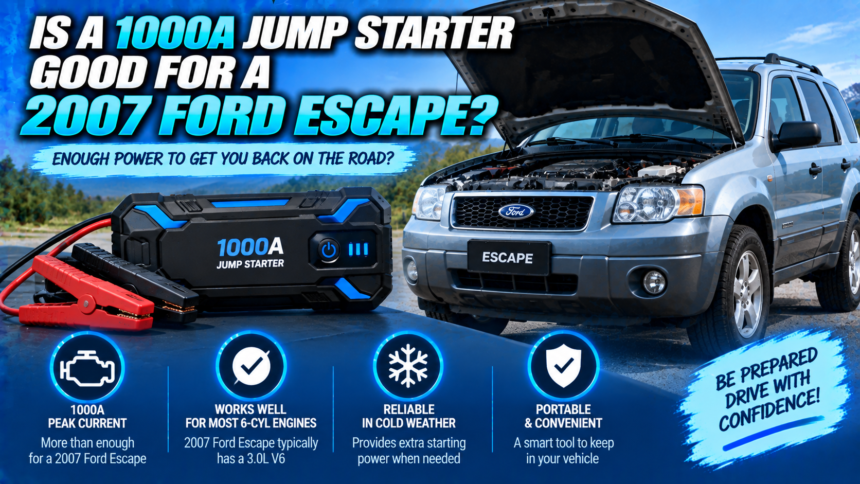
Yes, a 1000A jump starter is good for a 2007 Ford Escape. In fact, it’s more than enough power. The 2007 Ford Escape typically requires somewhere between 400 and 500 cold cranking amps (CCA) to start, depending on whether it has the 4-cylinder or V6 engine. A 1000A unit gives you a comfortable buffer above that requirement, which means faster, more reliable starts — even in cold weather or if your battery is significantly drained.
What Does “1000A” Mean in a Jump Starter?
Before you can properly judge whether a jump starter is right for your Escape, it helps to understand what that “1000A” number actually represents.
Peak Amps vs Cranking Amps Explained
Jump starters usually list two different numbers: peak amps and cranking amps. Peak amps refer to the maximum burst of power the unit can deliver for a split second, while cranking amps represent the sustained power it can provide to actually turn the engine over. Manufacturers often advertise the peak amp number because it looks more impressive, but the cranking amp rating is what really matters for starting your car. When a jump starter is labeled “1000A,” it’s usually referring to peak amps, so the real-world starting power may be somewhat lower — but still typically well above what a small SUV like the Escape needs.
How Jump Starter Ratings Work
Think of amp ratings like a fuel tank size for your car. A bigger tank doesn’t mean your car uses more fuel — it just means you have more reserve capacity. Similarly, a higher amp rating on a jump starter doesn’t mean it forces more power into your battery than needed. It simply means the unit has more capacity available, which becomes especially useful in cold temperatures, with larger engines, or when the battery is very deeply discharged.
2007 Ford Escape Battery & Engine Specs
To understand whether 1000A is the right amount of power, it helps to look at what the 2007 Ford Escape actually needs under the hood.
CCA (Cold Cranking Amps) Requirement of 2007 Escape
Most 2007 Ford Escape models come factory-equipped with a battery rated between 400 and 500 CCA. This rating tells you how much power the battery can deliver to start the engine at 0°F (-17°C). A 1000A jump starter, therefore, provides roughly double the power the vehicle’s own battery needs to do the job — giving you plenty of headroom for a smooth, dependable jump start.
Engine Options (2.3L I4 / 3.0L V6) and Their Power Needs
The 2007 Escape was available with two engine choices: a 2.3-liter 4-cylinder and a 3.0-liter V6. Here’s a simple breakdown of typical requirements for each:
| Engine Type | Approx. CCA Needed | Starting Difficulty |
|---|---|---|
| 2.3L 4-Cylinder | 400–450 CCA | Easier to start |
| 3.0L V6 | 450–500 CCA | Slightly more demanding |
Both engines fall well within the comfortable range of what a 1000A jump starter can handle, so engine choice doesn’t change the answer much — a 1000A unit works fine for either version.
Is 1000A Enough for a 2007 Ford Escape?
The short answer, as mentioned earlier, is a clear yes. But let’s look at why this is true from a slightly more technical angle.
Comparing 1000A Rating vs Actual CCA Needed
Since the Escape needs around 400–500 CCA to start, and a 1000A jump starter offers significantly more than that, you’re never at risk of being underpowered. In fact, most jump starters rated at 1000A or higher are designed with larger engines in mind — trucks, vans, and even some diesel vehicles — so a smaller SUV like the Escape is well within its comfort zone.
Why Manufacturers Add Extra “Safety Margin” in Ratings
Jump starter manufacturers intentionally build in extra capacity beyond what’s strictly necessary. This safety margin accounts for real-world factors like cold weather (which reduces battery efficiency), older or corroded battery terminals, and batteries that have been sitting dead for a while. Having that extra buffer means the jump starter can still perform reliably even when conditions aren’t ideal — which is exactly the kind of insurance you want in an emergency situation.
Benefits of Using a 1000A Jump Starter on This Vehicle
Choosing a jump starter with more power than the bare minimum comes with some real advantages for Ford Escape owners.
Faster, More Reliable Starts
Because the 1000A unit isn’t working at its limit, it can deliver a strong, consistent burst of power right away, which usually means your engine turns over faster and more smoothly compared to using a jump starter that’s rated closer to your vehicle’s minimum requirement.
Extra Power for Cold Weather Starts
Cold temperatures are one of the biggest reasons batteries struggle to start engines. Since battery performance drops in the cold, having a jump starter with extra amp capacity in reserve makes a noticeable difference during winter mornings or in colder climates.
Longevity/Less Strain on the Unit
When a jump starter isn’t constantly working near its maximum output, it tends to experience less internal strain, which can help it last longer over repeated uses. A 1000A unit jumping a vehicle that only needs 400–500 CCA is essentially working well within its comfortable capacity range.
Things to Check Before Buying
Power rating isn’t the only factor that matters when picking the right jump starter for your Escape. A few other details deserve attention too.
Battery Terminal Compatibility
Make sure the jump starter’s clamps are compatible with your Escape’s battery terminal size and placement. Some vehicles have batteries tucked into tighter spaces, so clamp size and cable length can matter more than people expect.
Portability & Size
Since you’ll likely be keeping the jump starter in your trunk or glovebox, consider its physical size and weight. Many 1000A-rated units are compact lithium-ion models, making them easy to store without taking up much space.
Additional Features (USB, Air Compressor, Flashlight)
Many modern jump starters come with bonus features that add everyday value, such as:
- USB ports for charging phones or small devices
- Built-in flashlights for nighttime emergencies
- Air compressors for topping off tire pressure
- LCD screens showing battery percentage and voltage
These extras can make the jump starter more useful beyond just emergency starts.
How to Safely Use a Jump Starter on a Ford Escape
Using a jump starter correctly is just as important as choosing the right power rating.
Step-by-Step Connection Guide
- Turn off the ignition and make sure the jump starter is also switched off before connecting.
- Connect the red (positive) clamp to the positive terminal of the Escape’s battery.
- Connect the black (negative) clamp to a solid, unpainted metal surface on the engine block — not directly to the negative battery terminal.
- Turn on the jump starter and try starting the engine.
- Once the car starts, remove the clamps in reverse order — negative first, then positive.
Common Mistakes to Avoid
Some of the most frequent errors people make include connecting the clamps in the wrong order, attaching the negative clamp directly to the battery instead of a grounded metal surface, and forgetting to fully charge the jump starter before it’s needed. Avoiding these small mistakes goes a long way toward a safe, smooth jump-starting experience.
Best Practices & Maintenance Tips
Getting the most out of your jump starter means taking care of it properly.
Charging the Jump Starter Regularly
Even if you don’t use it often, it’s good practice to recharge your jump starter every 1–3 months. Lithium-ion units especially benefit from staying topped up, since letting them sit fully drained for long periods can shorten their lifespan.
Storage Tips
Store the jump starter somewhere with moderate temperatures — extreme heat or cold can affect battery performance over time. Keeping it in the trunk is convenient, but during very hot summers or freezing winters, consider storing it inside the vehicle cabin if possible.
Frequently Asked Questions (FAQs)
Can too much amperage damage my car battery?
No. A jump starter only supplies power on demand — your car’s electrical system draws what it needs, so a higher-rated unit like 1000A won’t overload or damage your Escape’s battery.
How long does a 1000A jump starter last?
Most quality 1000A jump starters can perform anywhere from 20 to 30+ jump starts on a single full charge, depending on the brand and battery condition.
What size jump starter do I actually need?
For a 2007 Ford Escape, anything rated 400 CCA or higher technically works, but choosing a 1000A unit gives you extra reliability, especially in cold weather or emergency situations.
Conclusion
So, is 1000A amp jumper good for a 2007 Ford Escape? Absolutely. With the Escape only requiring around 400–500 CCA to start, a 1000A jump starter offers more than enough power, plus extra reserve capacity for tough conditions like cold weather or a deeply drained battery. As long as you pick a unit with compatible clamps, decent portability, and follow safe connection steps, a 1000A jump starter is a smart, reliable choice for keeping your Escape ready to go.
Related Articles
How to Set Car Headlights (25-Foot Wall Method)
Is Doing a Burnout Bad for Your Car? What It Costs